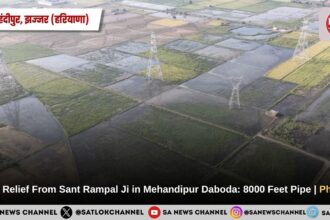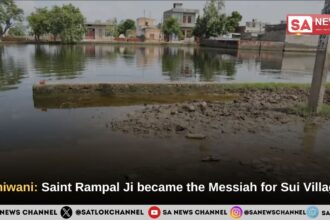


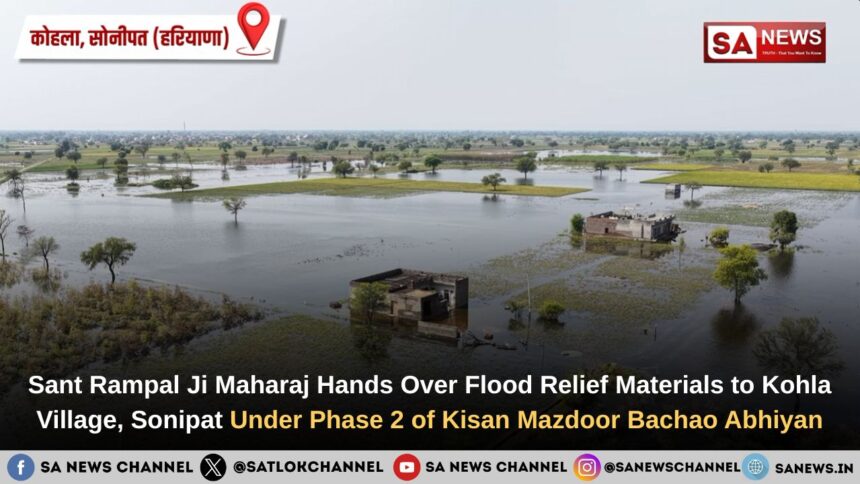
Kohla village, located in Gohana Tehsil of Sonipat district, Haryana, had been facing a severe waterlogging problem for the past 10 to 12 years. The neighbouring village of Baroda is situated at a significantly higher elevation than Kohla. Due to this geographical difference, rainwater from every monsoon season naturally flowed downhill and accumulated along the boundaries of Kohla and Banwasa villages.
The affected area in Kohla covered approximately 60 to 70 acres of agricultural land. Water became trapped in this low-lying section with no natural drainage route available for its escape. As a result, prolonged waterlogging gradually led to tensions and disputes between residents of Kohla and Banwasa villages.
Crop Damage and Administrative Neglect
Farmers in Kohla village faced repeated losses of both Kharif and Rabi crops. During years of limited rainfall, farmers attempted to cultivate their fields. However, whenever heavy rainfall occurred, entire crops were submerged and destroyed. Agricultural experts and farmers observed that if water remained standing in fields for more than ten days, plant roots began to rot, leaving little possibility of replanting.
For the previous four years, farmers had continuously submitted written and verbal complaints to government departments and administrative authorities. Although officials repeatedly assured villagers that the issue would be resolved in future sessions, no practical action was taken and not a single drainage pipeline was installed.
Panchayat Appeal at Dhanana Dham and Rapid Technical Survey
After receiving no effective response from the administration, Kohla village Panchayat unanimously decided to seek assistance elsewhere.
Under the leadership of the village Sarpanch, Sunil Kumar, a delegation of 15 to 20 villagers and Panchayat members travelled to Dhanana Dham Ashram in Haryana and submitted a formal application requesting relief.
Initially, the Panchayat requested:
- 4,200 feet (approximately 1,280 metres) of pipeline
- One water-extraction motor
Before the delegation had even returned to Kohla village from Dhanana Dham, a technical survey team had already arrived in the village that same evening.
The survey team conducted a detailed assessment of:
- Field gradients and elevation patterns
- The central points of water accumulation
- The final drainage route for water disposal
The technical inspection concluded that the distance between the waterlogged area and the nearest drain was approximately 1 kilometre. Based on this assessment, the team determined that a pipeline measuring 3,300 feet (approximately 1,006 metres) would be sufficient for the project.
Distribution of Relief Materials Within 24 Hours
Exactly 24 hours after the application was submitted at Dhanana Dham, two heavy transport trucks loaded with pipeline materials arrived at the entrance of Kohla village at around 9:00 a.m.
Under the Kisan Mazdoor Bachao Abhiyan, Sant Rampal Ji Maharaj arranged for all necessary materials to be delivered to the village gathering place.
The materials provided included:
- Total pipeline length: 3,300 feet (approximately 1,006 metres) of 8-inch diameter pipeline
- Supporting materials: Fevicol solvent and essential fittings required to connect the pipes, which were supplied proactively even though villagers had not specifically requested them
- Installation condition: Sant Rampal Ji Maharaj directed villagers to first complete the underground installation of the entire 3,300-foot pipeline. After completion, the technical survey team would revisit the site to physically verify the installation. Following successful verification, a high-capacity motor would also be provided.
Kohla Waterlogging Mitigation Project Summary
| Project Component | Facts and Figures |
| Affected Area and District | Kohla Village, Gohana Tehsil, Sonipat District, Haryana |
| Duration of Problem | Continuous for the past 10 to 12 years |
| Affected Agricultural Land | Approximately 60 to 70 acres |
| Key Representatives | Sunil Kumar (Village Sarpanch) and Surender Singh (Resident) |
| Initial Request vs Approved Material | Requested: 4,200 feet (1,280 m) pipeline | Approved: 3,300 feet (1,006 m) of 8-inch pipeline |
| Response Time | Materials delivered within 24 hours of application |
| Final Drainage Point | Drain located approximately 1 kilometre away |
Timeline for Underground Pipeline Installation and Expected Impact
Village Sarpanch Sunil Kumar and local residents Surender Singh, Joginder and Dayaram jointly received the relief materials.
The Panchayat and villagers collectively resolved to complete the underground installation of the 1-kilometre pipeline within the following week (seven days). The pipeline will connect the lowest point of the affected farmland directly to the drainage channel.
Once the installation is completed, the village will immediately inform the Ashram so that the motor approved under Phase 2 can also be installed.
According to local estimates, once the 8-inch pipeline and motor become operational, water from the entire 60 to 70-acre affected area will be drained into the nearby channel within a maximum of ten days, even during periods of excessive rainfall. This is expected to eliminate crop root rot caused by prolonged waterlogging and significantly reduce future agricultural losses.