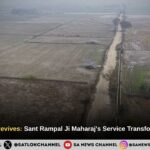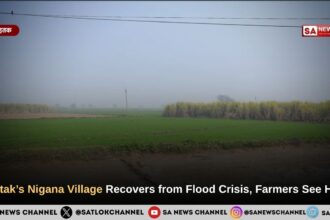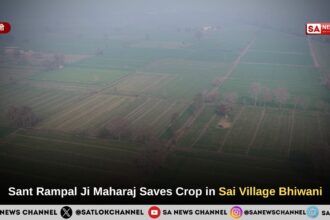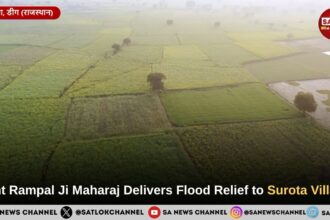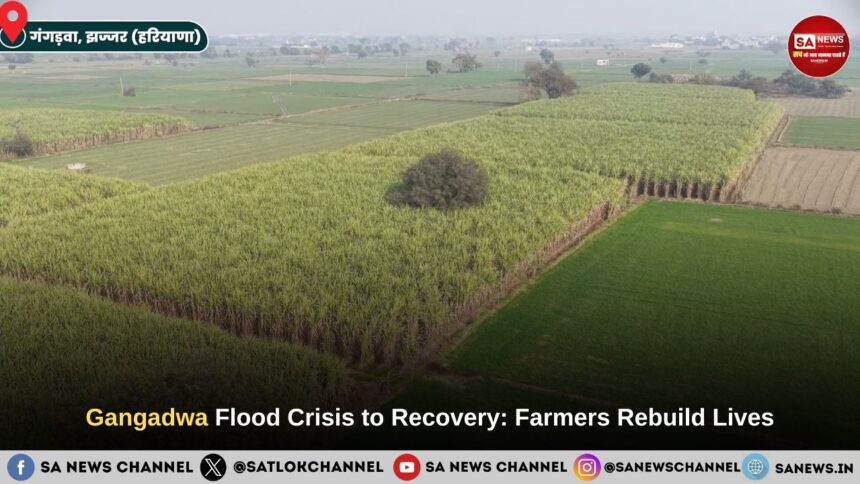
The small Gangadwa village in Jhajjar district, Haryana, had recently gone through a tragedy that brought the entire village to a standstill. It was not just a natural disaster, but a situation that drowned people’s hopes, hard work, and future altogether. The fields, once lush green with crops, were submerged under 6 to 7 feet of dark water. Schools, roads, homes—everything was underwater.
- Sinking Crops and Growing Hardships
- Farmers’ Pain: “We Were on the Verge of Starvation”
- Hope for Help: A Prayer and a Major Change
- Relief Work: Machines Changed the Scenario
- From Destruction to Recovery: Fields Smiled Again
- Voice of the Village: “We Found a Reason to Live Again”
- Social Impact: Life Regained Momentum
- An Example of Service: The Impact of Selfless Help
Around 3000 bighas of land were completely waterlogged. Life in the village had come to a halt. Standing crops in the fields were entirely destroyed, leaving farmers struggling for survival. At that time, even government assistance proved insufficient, and the villagers were sinking into despair.
Sinking Crops and Growing Hardships
For the farmers of Gangadwa village, this flood was nothing less than a catastrophe. The paddy crop, the result of a year’s hard work, was completely destroyed. The accumulated water also damaged the soil fertility.
Water surrounded the village from all sides. Roads were blocked. There was no fodder for animals, and even basic daily needs became difficult to fulfill. According to the farmers, “It felt as if the whole village had become unemployed.”
If the situation had continued longer, people would have been forced to buy food and fodder from outside, increasing their debt burden.
Also Read: Floods Crippled a Village for Months—Then Sant Rampal Ji Maharaj Changed Gangadwa’s Fate
Farmers’ Pain: “We Were on the Verge of Starvation”
A farmer named Neeraj said that the water level was so high that only 20–25 acres of land remained, while the rest was submerged. Another farmer, Surendra, said they were “deeply distressed” and the future looked completely dark.
A farmer named Devaraj expressed that if help had not arrived in time, “not even a single grain would have been produced, and the village would have faced starvation.” Village elders said that this was not just a crop loss, but a crisis threatening the very existence of the village.
Hope for Help: A Prayer and a Major Change
When all hope seemed lost, the farmers decided to seek help from Saint Rampal Ji Maharaj. They went to Barwala and submitted a request asking for motors and pipes to drain the water.
No one expected help to arrive so quickly and on such a large scale. But within a few days, the situation changed.
Relief Work: Machines Changed the Scenario
Soon, a large convoy of assistance reached the village. This included:
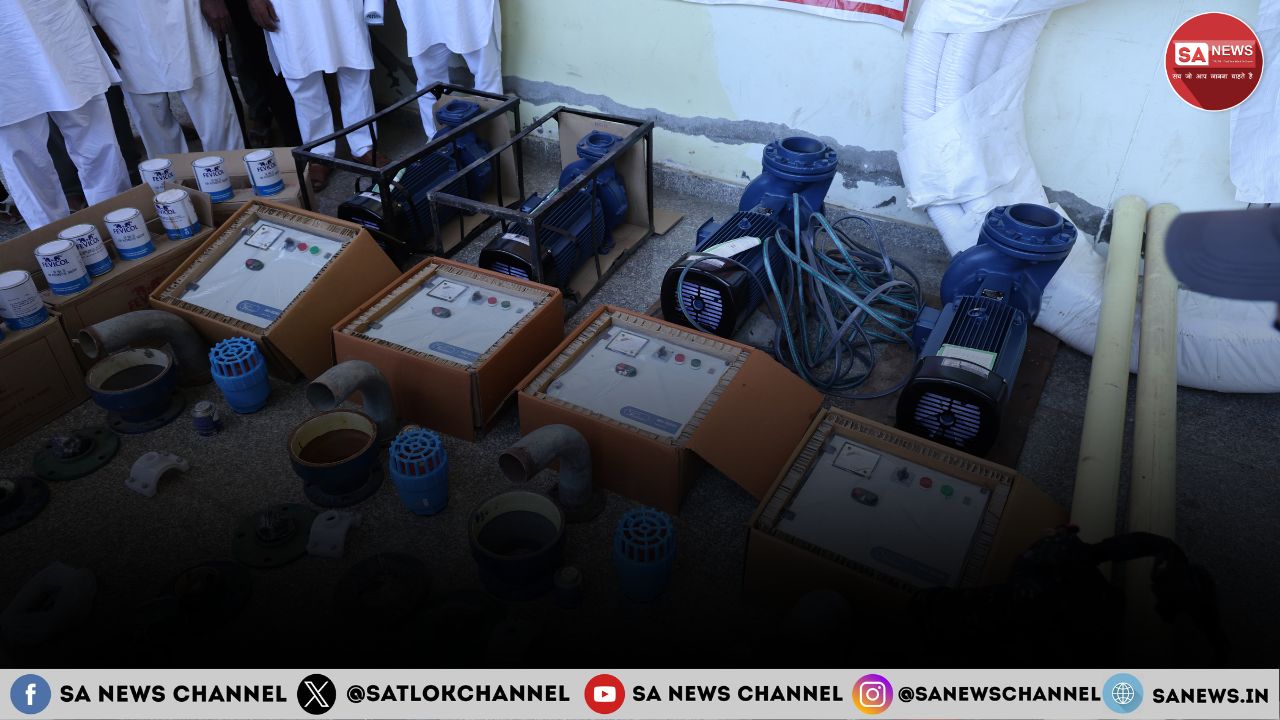
- 8 powerful motors
- 5 15 horsepower submersible motor
- 3 15 horsepower monoblock motor
- 8000 feet of high-quality pipes
- Starters, cables, and other necessary equipment
These machines worked day and night to drain the water out of the village. It was not an easy task, but through continuous efforts, the stubborn water was finally pushed out beyond the village boundaries.
From Destruction to Recovery: Fields Smiled Again
Where there was once silence, the sound of tractors began to echo again. Fields that were once flooded are now flourishing with wheat crops. Except for around 100 acres, almost all land has been resown. Smiles have returned to the faces of farmers.
Villagers say this was not just about draining water—it was about bringing their lives back on track.
Voice of the Village: “We Found a Reason to Live Again”
The reactions of villagers reflect this transformation:
- “Now the village is completely fine.”
- “There is happiness in every home.”
- “We can eat again.”
Sarpanch representative Anita also said that sowing has resumed and prosperity has returned.
Elders stated that without this help, the village would have been completely destroyed.
Social Impact: Life Regained Momentum
This disaster did not just affect agriculture; it shook the entire social fabric of the village. When the fields drowned, livelihoods, routines, and hopes were also submerged. But as the water receded, the village began rebuilding itself.
The first impact was on the economy. Farmers who had lost everything now found a way to earn again through resowing. Those burdened with debt felt relief knowing they could recover through their hard work.
Gradually, social life also returned to normal. Where there was once silence and water, now movement, farming activity, and daily life resumed. People returned to work, and a sense of cooperation revived.
Livestock, an essential part of the village economy, had also suffered due to lack of fodder. But as conditions improved, fodder availability increased, and animals were saved.
The most significant change was in people’s morale. Those who were once broken and hopeless now regained confidence and hope. Smiles returned, along with the belief that no matter how big the crisis is, it can be overcome with support.
An Example of Service: The Impact of Selfless Help
According to the villagers, when the system had abandoned them, the help from Saint Rampal Ji Maharaj proved to be life-saving. They said it was not just technical assistance, but a service that saved the entire village from drowning. His spirit of service and timely help proved that true assistance is that which is given selflessly in times of need.
Villagers repeatedly mentioned that He stood with every needy person without any discrimination of caste or background, setting an example of humanity. They said that while many so-called saints take money in the name of help, He provides assistance with both hands in times of need.
Whether it is medical treatment for the poor, building homes, arranging education for children, or feeding the hungry—His service is visible in every field. His support for farmers has left a deep impression on the hearts of villagers. Now, villagers believe that such selfless service seems beyond the capability of an ordinary person, saint Rampal Ji Mharaj ji is God.