

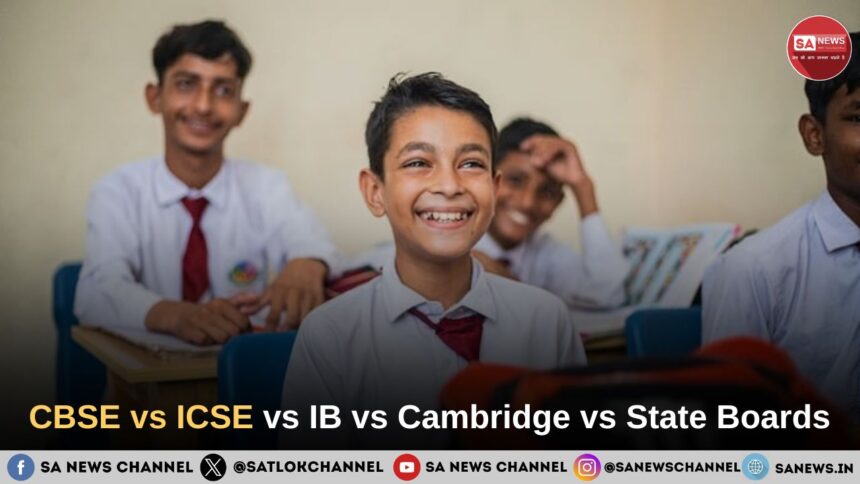
Recent controversies surrounding the Central Board of Secondary Education (CBSE) have reignited a nationwide debate among parents, educators and students about whether India’s most popular school board remains the best option. As discussions spread across social media platforms, parent groups and education forums, many families are exploring alternatives such as ICSE, IB, Cambridge and state boards.
- Key Takeaways: CBSE vs ICSE vs IB vs Cambridge vs State Boards
- Why School Boards Are Back in Focus
- The Exam Connection Many Families Overlook
- Why CBSE Remains the Preferred Choice for Competitive Exams
- ICSE’s Strength in Language and Analytical Skills
- IB and Cambridge: Designed for Global Pathways
- The Continuing Importance of State Boards
- Accessibility and Affordability Remain Major Barriers
- What Education Experts Say Parents Should Ask
- Choosing a Board Based on Future Goals
- Education, Purpose and Inner Balance
- FAQs on CBSE vs ICSE vs IB vs Cambridge vs State Boards
Education experts suggest that the answer is not about finding a universally superior board. Instead, the focus is increasingly shifting toward understanding how different curricula align with competitive examinations, higher education pathways and long-term career goals. From JEE and NEET to foreign university admissions, each board offers distinct strengths and challenges.
Key Takeaways: CBSE vs ICSE vs IB vs Cambridge vs State Boards
- CBSE remains closely aligned with JEE Main, JEE Advanced, NEET, CUET and several government examinations.
- ICSE is recognised for strong English proficiency, writing skills and broad academic exposure.
- IB focuses on research, critical thinking, independent learning and international university admissions.
- Cambridge emphasises subject specialisation and analytical learning, particularly for global higher education pathways.
- State boards continue to support thousands of successful students through regional accessibility and state-level exam alignment.
- Experts say the best board depends on a student’s academic goals rather than the board’s popularity.
- Accessibility and affordability remain major barriers for families considering a shift away from CBSE.
Why School Boards Are Back in Focus
Recent discussions surrounding CBSE have prompted many parents to reconsider educational choices. Concerns relating to inconsistent evaluation, delays in grievance resolution and a perceived lack of transparency in post-result procedures have contributed to growing dissatisfaction.
The issue has been particularly significant for Class 12 students, where examination outcomes can directly influence college admissions and future opportunities. Following the CBSE Class 12 Result 2026, some students reportedly scored higher marks in JEE Main than in their board examinations, further intensifying discussions about assessment systems.
Also Read: CBSE New Rule 2026: अब 3 भाषाएं होंगी अनिवार्य | R1 R2 R3 Explained
As a result, parents have increasingly begun evaluating other boards, including ICSE, IB and Cambridge.
The Exam Connection Many Families Overlook
Experts argue that one of the most important considerations when choosing a board is curriculum alignment with future entrance examinations.
Different boards emphasise different academic strengths:
- Conceptual science and mathematics
- Analytical thinking
- Research projects
- Communication skills
- Interdisciplinary learning
When an entrance examination rewards those same strengths, students may find themselves at an advantage.
Why CBSE Remains the Preferred Choice for Competitive Exams
There is a reason coaching institutes across India have traditionally catered to CBSE students.
The syllabi for JEE Main, JEE Advanced and NEET have historically drawn heavily from the NCERT framework, which forms the backbone of CBSE education. As a result, students often encounter familiar concepts, terminology and question patterns during preparation.
Best aligned with:
- JEE Main
- JEE Advanced
- NEET
- CUET
- SSC and several government examinations
Skills commonly developed:
- Exam-oriented preparation
- Conceptual science and mathematics
- Objective test-taking
For students targeting IITs, NITs, AIIMS and central universities, CBSE remains the most naturally aligned board.
ICSE’s Strength in Language and Analytical Skills
ICSE students have long been associated with strong English proficiency, detailed subject knowledge and broad academic exposure.
Although no major entrance examination is built directly around the ICSE curriculum, the board’s emphasis on writing, reading comprehension and communication can be useful in examinations that assess reasoning, language skills and general awareness.
Best aligned with:
- NDA (partial advantage)
- CLAT foundation
- Humanities and commerce pathways
- Liberal arts programmes
Skills commonly developed:
- Essay writing
- Reading comprehension
- Communication skills
Former students often report smoother transitions into humanities and social science programmes due to extensive writing requirements.
Also Read: CBSE का ऐतिहासिक कदम: कक्षा 3 से शुरू हुआ नया AI और कम्प्यूटेशनल थिंकिंग पाठ्यक्रम
IB and Cambridge: Designed for Global Pathways
Unlike CBSE and ICSE, the International Baccalaureate (IB) was designed primarily for international higher education.
Students spend significant time on:
- Research projects
- Presentations
- Essays
- Independent inquiry
- Critical thinking exercises
IB is best aligned with:
- SAT
- UCAT
- International university admissions
- Liberal arts pathways
Cambridge, particularly through IGCSE and A Levels, offers a more specialised approach.
Students can focus earlier on subjects most relevant to future plans, including engineering, medicine and economics. The curriculum is widely recognised by universities worldwide, especially in the United Kingdom.
Cambridge is best aligned with:
- UK university admissions
- Engineering, medicine and science degrees abroad
- Subject-specific university pathways
Skills commonly developed:
- Subject mastery
- Analytical thinking
- Exam-writing skills
Both IB and Cambridge students preparing for JEE or NEET often require additional coaching because these systems were not designed around India’s NCERT-based entrance examination ecosystem.
The Continuing Importance of State Boards
Despite receiving less attention in national discussions, state boards continue to produce thousands of successful engineers, doctors and civil servants every year.
Students often benefit from:
- Lower fees
- Regional language options
- Alignment with state-level entrance examinations
- State university admission processes
Many state governments also reserve a significant share of higher education seats for students from their own boards.
However, students preparing for national examinations such as JEE and NEET may need additional preparation because these examinations are largely based on NCERT concepts.
Accessibility and Affordability Remain Major Barriers
While interest in alternative boards is growing, practical challenges remain significant.
The scale difference is substantial:
| Board | Approximate Number of Schools in India |
| CBSE | More than 30,000 |
| ICSE | Around 1,500 |
| IB | Around 270 |
CBSE schools remain far more accessible, particularly across Tier 2 and Tier 3 cities.
Affordability is another major factor. According to users participating in the online debate, IB and Cambridge schools may charge between ₹3 lakh and ₹4 lakh annually even at the primary level, compared with approximately ₹50,000 to ₹70,000 in many CBSE schools.
Concerns regarding teaching quality have also emerged, with some users claiming that certain schools offering IB or ICSE curricula may not always have teachers fully familiar with the syllabus requirements.
What Education Experts Say Parents Should Ask
The debate gained further visibility after comments posted on X by TheLiverDoc, who encouraged parents to explore IB and Cambridge curricula and referred to opportunities through examinations such as UCAT and BMAT for students considering medical education abroad.
Another user, Deepak, criticised policy decisions such as making three languages mandatory in Class 9 with limited notice while noting that many entrance examinations continue to rely heavily on the CBSE curriculum.
Rather than asking which board is the best overall, education experts increasingly recommend asking a different question: best for what?
Choosing a Board Based on Future Goals
The discussion ultimately points toward alignment rather than superiority.
A student targeting IIT admissions may benefit from CBSE’s connection with NCERT-based examinations. A learner aspiring to study abroad may find IB or Cambridge more suitable. Students interested in language, communication and humanities-focused pathways may find ICSE better aligned with their strengths.
The board itself is not the destination. It remains one of several educational tools that help shape a student’s academic journey. For families weighing different options, experts suggest that the most effective choice is the one that aligns most closely with a student’s ambitions, strengths and future plans.
Education, Purpose and Inner Balance
As discussions continue around choosing the right educational board and career pathway, the broader question of life’s purpose also remains relevant for many families. Academic success, professional achievement and higher education are important aspirations, but they exist within a larger human journey shaped by values, responsibility and personal growth.
According to the spiritual teachings shared by Tatvdarshi Sant Rampal Ji Maharaj, education helps individuals develop knowledge and skills, while spiritual understanding helps them recognise the deeper purpose of human life. He explains that learning and devotion can progress together, helping individuals face uncertainty with greater clarity, balance and confidence. His Teachings emphasise that while careers and achievements hold value, understanding the purpose of human existence remains equally important.
For more information visit our
Website: www.jagatgururampalji.org
YouTube: Sant Rampal Ji Maharaj
Facebook: Spiritual Leader Saint Rampal Ji
X (Twitter): @SaintRampalJiM
FAQs on CBSE vs ICSE vs IB vs Cambridge vs State Boards
1. Which board is most aligned with JEE and NEET?
CBSE is considered the most naturally aligned because these examinations have historically drawn heavily from NCERT-based content.
2. Is ICSE better for language and communication skills?
ICSE is widely recognised for strong English proficiency, writing practice and broad academic exposure.
3. Why do students choose IB?
IB emphasises research, critical thinking, independent learning and international university admissions.
4. What is Cambridge best suited for?
Cambridge is best aligned with UK university admissions and specialised academic pathways abroad.
5. Can state board students succeed in national entrance exams?
Yes. However, additional preparation may be required because JEE and NEET are largely based on NCERT concepts.