

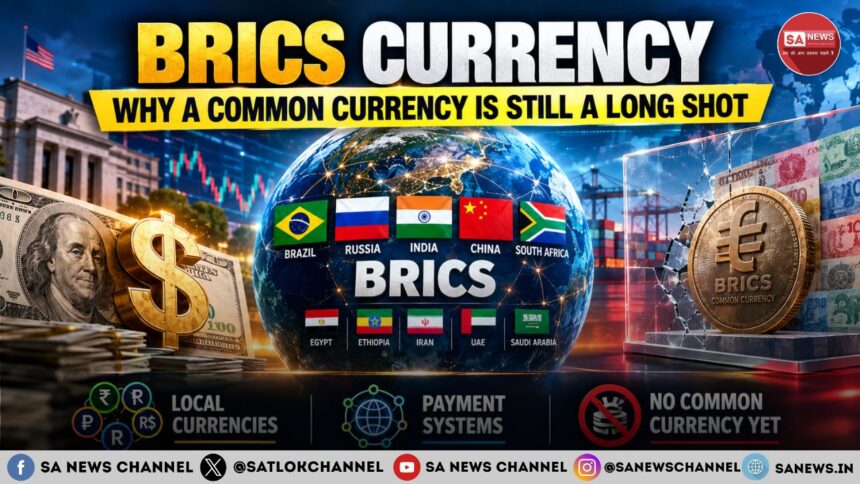
The concept of a BRICS currency has resurfaced in conversations as the group has sought to reduce its dependence on the U.S. dollar. This idea suggests that the BRICS nations would develop a shared currency for trade and international transactions.
- What is the BRICS currency?
- Why is the idea so attractive?
- Would a common BRICS currency really displace the dollar?
- What would BRICS gain from using local currencies?
- The Role of BRICS Payment Systems
- Why would a common currency challenge India?
- Could a common currency hurt the U.S. dollar?
- What should India be focusing on?
- What are the alternative strategies that BRICS can use?
- What does this mean for the future?
- FAQs
However, that is not what BRICS is pursuing at the moment
In reality, there is no BRICS currency, and the group has not taken any steps to create one. Instead, the conversation has revolved around utilizing national currencies in trade and promoting interoperability among payment systems.
These are two very different concepts.
What is the BRICS currency?
The term BRICS currency is used to refer to either a common currency that could be used by the BRICS nations or a common instrument of settlement, which would serve to reduce the dominance of the U.S. dollar in international transactions.
While this concept has been discussed in both political and economic circles, it has not yet materialized. Instead of introducing a common currency, BRICS has been focusing on local-currency settlements and interoperability of payment systems. The BRICS Cross-Border Payments Initiative and BRICS Payment Task Force are the relevant projects in this regard.
Therefore, the more realistic question to ask yourself is not “When will the BRICS currency launch?”, but rather “How can BRICS members advance their trade while being less dependent on the dollar?”.
Why is the idea so attractive?
There are several reasons why this topic has been garnering so much attention.
The first is de-dollarization. In other words, diversifying away from the U.S. dollar as the dominant currency in international transactions. This is a popular concept among the BRICS nations, who wish to have more flexibility in their foreign trade.
Another reason is related to the financial and economic security of the BRICS nations. Political and economic isolation can be very costly, especially when the relevant country is unable to access certain financial markets or payment systems. For this reason, reducing the importance of the U.S. dollar is seen by many as a way to limit exposure to such risks.
A more mundane explanation of why using a BRICS currency would be beneficial is that it would allow for a reduction in costs. In other words, if the BRICS nations traded with each other using their local currency, they would not have to spend as much on conversions as they do currently.
The relevant documents produced by the BRICS nations mention the importance of promoting the use of local currencies and improving interoperability.
Would a common BRICS currency really displace the dollar?
Perhaps not in the foreseeable future.
Creating a common currency requires much more than political will. A comprehensive set of rules and regulations would have to be established, as well as a currency-clearing system. Moreover, countries would have to standardize their monetary policy, banking regulations, foreign exchange rules, and reserves.
One example of a common currency, of course, is the euro. The establishment of the euro required significant political and economic integration among the participating nations.
BRICS, however, is much more heterogeneous than the European Union, meaning the introduction of a common currency would be much more challenging.
What would BRICS gain from using local currencies?
The adoption of a policy designed to promote the use of national currencies by BRICS members would be much easier than the creation of a common currency.
It would also provide some benefits, as the transaction costs of trade between BRICS nations would be reduced. To explain this, let us take the example of two companies, one based in India and the other one in Russia, that wish to engage in trade.
Under the current circumstances, they will most likely convert their currencies into U.S. dollars in order to facilitate the transaction. This will inevitably involve some costs and risks. It would be much more efficient if the Russian company paid in rubles and the Indian company paid in rupees, as this would eliminate the need for currency conversion.
This example demonstrates that there are tangible benefits to be had from adopting such policies. Moreover, this approach would not require the elimination of the U.S. dollar as the currency of international transactions.
India has long been a proponent of this approach, with Prime Minister Narendra Modi specifically mentioning the potential benefits of local-currency trade and interoperability of BRICS payment systems when addressing the 2024 BRICS Summit. In his speech, he also mentioned India’s UPI as a potential model for facilitating such transactions.
This is the most probable scenario in the short to medium term.
The Role of BRICS Payment Systems
This approach may actually be a lot more important than this idea of a BRICS currency.
BRICS has been focusing on the establishment of a payment system, which is being handled by the BRICS Payment Task Force (BPTF). Documents produced by the BPTF mention that they are working towards “enhancing interoperability of payment systems among BRICS countries that enable faster, cheaper, more transparent, and secure cross border payments and trade”. Note that this approach does not involve the replacement of national currencies.
Rather, each BRICS nation will be able to retain its currency while eliminating some of the transaction costs associated with international trade.
Why would a common currency challenge India?
The main problem with a common currency from India’s perspective would be the loss of monetary autonomy.
The Reserve Bank of India maintains monetary policy, which involves implementing actions designed to promote price stability, economic growth, and financial stability in the economy. These actions primarily include interest-rate adjustments, as well as other measures.
A common currency would effectively limit India’s ability to implement independent monetary policy and decisions regarding capital controls.
There is another concern, which involves China’s influence. China is by far the biggest economy among the BRICS nations, which means that should a common currency be established, it is likely that it would be governed by Beijing. This would be a matter of great concern to New Delhi, as it would essentially have to accept Chinese oversight of its monetary policy.
Could a common currency hurt the U.S. dollar?
In theory, yes. In practice – likely not for a very long time.
The U.S. dollar is the dominant currency in the world by a significant margin. It is estimated that it comprises more than 50% of all currency in circulation, not to mention its importance in foreign exchange reserves, international transactions, and the global financial system.
The creation of a BRICS currency would be needed in order to challenge the dollar’s dominance in this sphere.
What should India be focusing on?
A balanced assessment of the situation leads to the conclusion that India should focus on a multi-pronged approach.
First and foremost, it should seek to internationalize the rupee as much as possible. This would provide significant benefits to the Indian economy and companies, and it would most likely become a priority for policymakers once they understand its potential benefits. The second prong of this approach would involve developing local-currency arrangements with other nations, which India has actually been doing for quite some time. The BRICS nations have long promoted such policies; however, it is not a BRICS-specific phenomenon by any means.
Finally, the third prong would involve digital payment methods. India has an example of one such system in its UPI, which has been very successful thus far. Moreover, it could potentially be used to develop a BRICS-specific application, which would replace some of the current methods of international payments.
What are the alternative strategies that BRICS can use?
There are several things that BRICS can do without introducing a common currency.
First, the nations can adopt local-currency settlements. In other words, they can trade using their local currency rather than converting it into another currency. This is a much simpler and less disruptive alternative that still provides most of the benefits of a common currency. Another option is the establishment of interoperability of payment systems. This would allow for the reduction in transaction costs associated with international transfers.
The use of digital currencies and digital payment methods is another way to reduce transaction costs and promote the use of local currencies. Third, the BPTF, which focuses on working with national payment systems, will be able to promote greater interoperability as well as the necessary standards and regulations. Note that this task force was mentioned in the official BRICS documents. While it may not be as attractive as the idea of a BRICS currency, it is certainly much more realistic.
What does this mean for the future?
Essentially, this has to be seen in the context of the larger debate between the BRICS nations and the West regarding the extent to which the former should rely on the latter.
A common currency would be beneficial to an extent for the BRICS nations, but it would be extremely disruptive to the current system. This system has been in place for a long time and has produced fairly consistent results, although it comes with its own set of challenges.
For this reason, it is very unlikely that the BRICS nations will move towards the creation of a common currency anytime soon.
India, in particular, would benefit from this approach as it would allow it to strengthen its relationship with other BRICS nations while also avoiding the negative consequences of a common currency.
The BRICS currency, however, is still an interesting concept, but it is unlikely to actually see implementation anytime soon. On the contrary, the changes that have been implemented so far and will continue to be implemented are likely to have a much more meaningful impact in the long term.
From BRICS Currency to the Currency of Spiritual Knowledge
The blog explains that a common BRICS currency is not currently a reality; instead, BRICS is focusing on local currencies and payment-system interoperability to make transactions easier and reduce dependence on the U.S. dollar. In a similar way, spirituality also requires the right means to progress beyond the temporary material world.
Just as a currency enables a transaction, spiritual knowledge and the correct Naam are described as essential for the soul’s spiritual journey. According to the spiritual knowledge of Sant Rampal Ji Maharaj, scripturally supported devotion and Naam from a Complete Satguru are important for attaining spiritual benefits beyond this life. To learn more, explore his spiritual teachings and philanthropic work on the Sant Rampal Ji Maharaj Youtube channel.
FAQs
Is there a BRICS currency right now?
No, there is no common BRICS currency.
Will BRICS launch a common currency?
No, BRICS is currently discussing other options besides a common currency.
Why does BRICS want to use local currencies?
They can give more flexibility to the nations in terms of trade, as well as reduce some costs associated with transactions in other currencies.
Does India support a common BRICS currency?
India is actually promoting the use of local currencies and smoother transactions between the BRICS nations.
Could the BRICS currency replace the U.S. dollar?
In theory, yes, but in practice, it would take a very long time.
What is the BRICS Payment Task Force?
It focuses on payment issues in BRICS, including the development of a common currency.
What is India’s preferred approach?
It is to promote the use of local currencies and build stronger relationships with other BRICS members.