

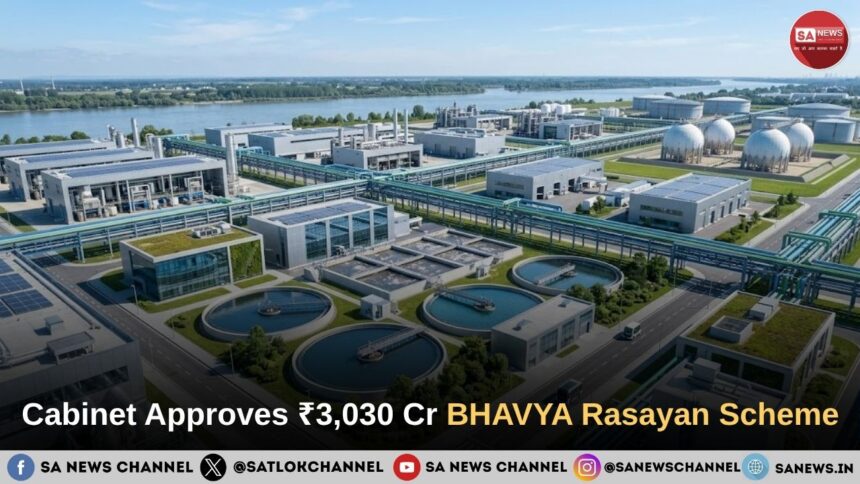
The Union Cabinet, chaired by Prime Minister Narendra Modi, has approved the Bharat Audyogik Vikas Yojana Rasayan (BHAVYA – Rasayan) scheme on July 24, 2026. Announced as a key initiative in the Union Budget 2026–27, the central sector industrial park development scheme aims to strengthen India’s chemical and petrochemical manufacturing ecosystem through world-class, integrated infrastructure.
- Key Highlights of the BHAVYA Rasayan Scheme
- Financial Framework and Land Norms for State Government Participation
- Plug-and-Play Infrastructure & Eco-Friendly Facilities
- Economic Importance of the Chemical Sector in India
- Transcending Material Formulations in Pursuit of Supreme Purity
- FAQs on BHAVYA Rasayan
Key Highlights of the BHAVYA Rasayan Scheme
- Total Financial Allocation: ₹3,030 crore (₹3,000 crore for common infrastructure facilities and basic utilities; ₹30 crore for administrative expenditure).
- Implementation Period: 5 Financial Years, spanning from FY 2026–27 to FY 2030–31.
- Nodal Ministry: Department of Chemicals and Petrochemicals under the Ministry of Chemicals and Fertilizers.
- Target Infrastructure: Establishment of 3 specialized, world-class Chemical Parks across India.
- Selection Process: Participating states will be evaluated and chosen competitively using a transparent Challenge Route.
Financial Framework and Land Norms for State Government Participation
The Central Government will extend financial assistance of up to ₹1,000 crore per park. However, this central assistance is contingent upon a minimum matching grant contribution of ₹500 crore by the respective state government.
Also Read: India’s International Trade System Explained: What Nobody Tells You
To ensure large-scale, unhindered industrial operations, participating states must fulfill specific land criteria:
| Scheme Component | Specifications & Requirements |
| Total Central Outlay | ₹3,030 Crore |
| Central Assistance per Park | Up to ₹1,000 Crore |
| Minimum State Contribution | ₹500 Crore per Park |
| Land Area Requirement | Minimum 2,000 acres (8 sq. km.) of contiguous, encumbrance-free land |
| Expected Private Investment | ₹20,000 Crore to ₹50,000 Crore per park |
| Park Category | Greenfield or Brownfield industrial developments |
Plug-and-Play Infrastructure & Eco-Friendly Facilities
The BHAVYA Rasayan scheme addresses long-standing infrastructure bottlenecks in the chemical sector by deploying a plug-and-play model. By centralizing essential industrial and environmental management utilities, the parks lower setup costs and accelerate operational readiness for manufacturing units.
Core Common Utilities Provided:
- Common Effluent Treatment Plants (CETPs): Shared advanced treatment facilities for handling industrial wastewater and effluents safely.
- Treatment, Storage, and Disposal Facilities (TSDFs): Centralized facilities for processing, storing, and disposing of hazardous chemical waste.
- Solvent Recovery & Distillation Units: Shared facilities designed to recycle industrial solvents and reduce operational wastage.
- Logistics & Warehousing Infrastructure: Interconnected pipeline networks, bulk storage tanks, and steam generation networks.
- Utility Distribution: High-capacity power transmission, water supply networks, and dedicated industrial access roads.
Also Read: Revolutionizing the World: The Origins, Innovations, and Legacy of the Industrial Revolution
Economic Importance of the Chemical Sector in India
India is currently the 6th largest chemical producer globally and the 3rd largest in Asia, producing more than 80,000 commercial chemical products. The sector contributes approximately 7% to India’s GDP and accounted for 8.1% of manufacturing Gross Value Added (GVA) according to the Economic Survey 2025–26.
Transcending Material Formulations in Pursuit of Supreme Purity
While state initiatives like BHAVYA Rasayan focus on treating chemical effluents, managing material elements, and fostering economic sustainability, they underscore a broader truth: the material realm is constantly plagued by toxicity, pollution, and decay. Human civilization continuously seeks external solutions to manage hazardous waste and physical instability, yet the material body and planet remain prone to impermanence and suffering.
In the spiritual discourses of Sant Rampal Ji Maharaj, it is taught that physical elements and material formulations can never grant everlasting peace or ultimate purity. Real purification occurs internally when a soul breaks free from physical bondage through true, scripture-based devotion (Sat-Bhakti).
The journey begins by seeking an Enlightened Saint (Tatvadarshi Sant) and taking spiritual initiation (Naam Diksha). The saint provides the authentic, scripture-based path of worship. Chanting True Names: The seeker must practice Sat-Bhakti by reciting the authentic three-stage mantras (Om – Tat – Sat) provided by the true Guru.
By taking refuge in the True Guru and practicing true worship, a soul achieves permanent liberation and reaches Satlok-the eternal abode where decay, toxicity, suffering, and mortality do not exist.
FAQs on BHAVYA Rasayan
1. What does BHAVYA Rasayan stand for?
BHAVYA Rasayan stands for Bharat Audyogik Vikas Yojana Rasayan, a central government scheme dedicated to industrial park development in the chemical and petrochemical sector.
2. What is the total financial outlay approved for the BHAVYA Rasayan scheme?
The Cabinet approved a total financial outlay of ₹3,030 crore, with ₹3,000 crore dedicated to common infrastructure facilities and ₹30 crore for administrative expenses.
3. How many chemical parks will be established under the BHAVYA Rasayan scheme?
The scheme provides financial support to establish 3 dedicated chemical parks across participating states in India.
4. What is the maximum central financial assistance provided per chemical park?
The Central Government will provide a grant of up to ₹1,000 crore per park, subject to a minimum contribution of ₹500 crore by the respective state government.
5. What are the land requirements for state participation in the scheme?
Participating state governments must provide a minimum contiguous and encumbrance-free land area of 2,000 acres (8 sq. km.) per park.