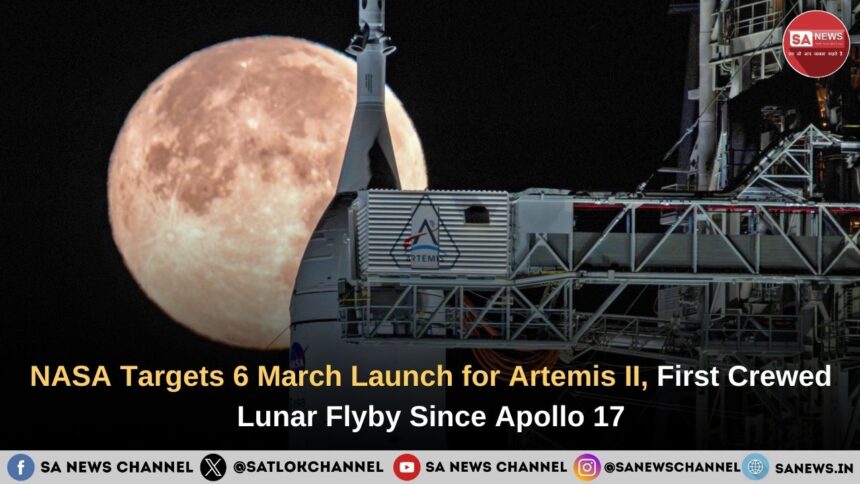
NASA is targeting early March to send humans around the Moon for the first time in more than five decades, marking a major milestone in deep space exploration. The Artemis II mission will carry four astronauts on a 10-day journey around the far side of the Moon and back to Earth, paving the way for a future lunar landing. Following a successful pre-launch “wet dress rehearsal” at Kennedy Space Center, the agency has set the earliest launch date as March 6. If successful, the mission will represent humankind’s furthest trip into space since the Apollo era.
- Key Takeaways: NASA Artemis II Moon Mission
- NASA Prepares for Historic Return to Crewed Lunar Missions
- Crew and Spacecraft Details
- Mission Timeline and Flight Path
- Role in NASA’s Artemis Programme
- Global Competition for the Moon’s South Pole
- A New Era of Deep Space Exploration Approaches
- Human Curiosity and Higher Truth
- FAQs on NASA Artemis II Moon Mission
Key Takeaways: NASA Artemis II Moon Mission
- Earliest launch date set for March 6 (March 7 in the UK)
- First crewed lunar flyby in over 50 years since Apollo 17 (1972)
- Four astronauts from the US and Canada on a 10-day mission
- Space Launch System (SLS) rocket to carry Orion spacecraft
- Mission will orbit the Moon’s far side before returning to Earth
- Designed to pave the way for a future lunar landing under Artemis III
- Landing targeted by 2028, though considered ambitious
NASA Prepares for Historic Return to Crewed Lunar Missions
NASA is preparing to launch the Artemis II mission, which will send humans around the Moon for the first time since 1972. The agency has identified March 6 as the earliest possible launch date after successfully completing a critical “wet dress rehearsal,” a full countdown simulation during which the rocket is fuelled and tested.
The rehearsal took place at Kennedy Space Center in Florida and marked the Artemis team’s second attempt. An earlier test in early February had ended prematurely due to a hydrogen fuel leak at the launch pad. According to NASA, issues involving seals and filters were subsequently resolved.
Also Read: The Black Death in 14th Century Europe: How History’s Deadliest Plague Killed 50 Million People
Lori Glaze of NASA said during a news conference that the successful test has intensified anticipation for the mission. “Every night I look up at the Moon and I see it and I get really excited because I can feel she’s calling us and we’re ready,” she said. She added that excitement for Artemis II is “really, really starting to build.”
Crew and Spacecraft Details
The Artemis II crew consists of four astronauts:
- Reid Wiseman (United States)
- Victor Glover (United States)
- Christina Koch (United States)
- Jeremy Hansen (Canada)
Following the successful rehearsal, the crew entered quarantine ahead of launch preparations.
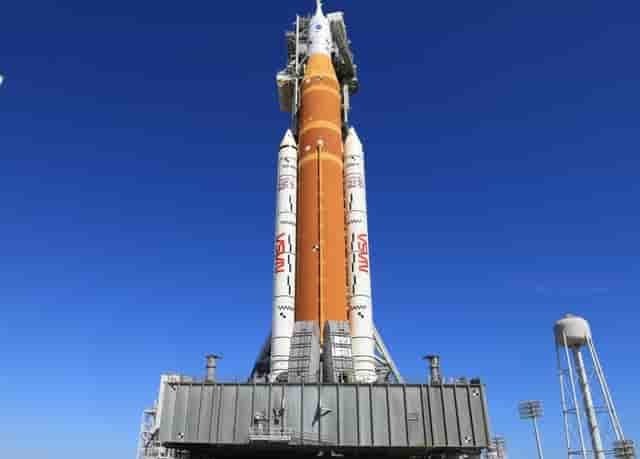
The astronauts will travel aboard the Orion capsule, positioned atop NASA’s Space Launch System (SLS) rocket. Standing 98 metres (322 feet) tall, the SLS is NASA’s most powerful rocket and has flown only once before — during the uncrewed Artemis I mission in November 2022.
Inside Orion, the living space is roughly the size of a minibus. During the 10-day mission, it will serve as the astronauts’ habitat for eating, working, sleeping, and daily operations.
Mission Timeline and Flight Path
The Artemis II mission profile involves multiple stages:
Day 1:
The spacecraft will remain in orbit around Earth while system checks are completed.
Days 2–5:
If all systems perform as expected, the spacecraft will head toward the Moon. The journey to lunar orbit is expected to take about four days.
Lunar Flyby:
The crew will travel around the Moon’s far side, the hemisphere not visible from Earth. They will fly at an altitude of approximately 6,500 to 9,500 kilometres (4,000 to 6,000 miles) above the lunar surface.
During this phase, astronauts will conduct observations and capture images of the Moon.
Return Journey:
After completing the flyby, the spacecraft will begin a four-day trip back to Earth.
Mission End:
The mission will conclude with a splashdown landing in the Pacific Ocean.
Role in NASA’s Artemis Programme
Artemis II is designed as a critical step toward returning humans to the lunar surface. If successful, it will pave the way for Artemis III, which aims to land astronauts on the Moon.
NASA has indicated that a lunar landing could occur by 2028, although the timeline is widely regarded as ambitious.
The Artemis III mission will rely on a lunar lander being developed by SpaceX, the company founded by Elon Musk. The lander is expected to be delivered to the Moon using SpaceX’s Starship rocket. However, delays in Starship development have prompted NASA to request a streamlined plan from SpaceX to accelerate progress.
NASA has also asked Blue Origin, owned by Jeff Bezos, to propose an accelerated lunar strategy as a competing option for Artemis III.
Global Competition for the Moon’s South Pole
The United States faces growing pressure to return to the Moon as other nations advance their lunar ambitions. China is aiming for a crewed lunar landing by 2030 and has been making steady progress toward that goal.
Both the United States and China plan to target the Moon’s south pole, a region believed to hold valuable resources and suitable locations for long-term bases. The competition includes securing the most advantageous sites for future exploration and infrastructure.
A New Era of Deep Space Exploration Approaches
Artemis II represents more than a single mission; it marks the beginning of a renewed human presence in deep space. By sending astronauts farther than any humans have travelled since the Apollo era, NASA aims to demonstrate the technologies, procedures, and international cooperation needed for sustained lunar exploration.
With launch preparations underway and excitement building within the space community, the mission stands as a pivotal step toward establishing a long-term human foothold beyond Earth orbit. Its success will directly shape the timeline for future lunar landings and broader ambitions in space exploration.
Human Curiosity and Higher Truth
As humanity prepares for missions to the Moon, there is a constant desire to explore what lies beyond, whether other beings such as aliens exist, whether life may be present on other planets, or whether new atmospheres and resources beneficial for humans can be discovered. This spirit of exploration reflects mankind’s quest for survival and knowledge.
Yet, in this pursuit, it is often forgotten that science itself is not the creator of the universe. According to the teachings of Tatvadarshi Sant Rampal Ji Maharaj, scientific progress is limited when compared to the Supreme Power. In front of God, science is like a small lamp before the Sun, its existence is overshadowed by divine wisdom. He explains that the Creator Who formed the universe knows every realm within it, because all creation ultimately remains under His control.
For more information visit our
Website:www.jagatgururampalji.org
YouTube: Sant Rampal Ji Maharaj
Facebook: Spiritual Leader Saint Rampal Ji
X (Twitter): @SaintRampalJiM
FAQs on NASA Artemis II Moon Mission
1. When is the Artemis II launch planned?
NASA has set March 6 as the earliest possible launch date.
2. How long will the mission last?
The Artemis II mission is planned as a 10-day journey.
3. How many astronauts are on Artemis II?
Four astronauts — three Americans and one Canadian — will fly on the mission.
4. Will Artemis II land on the Moon?
No. It will perform a lunar flyby without landing.
5. Why is Artemis II important?
It is a key step toward Artemis III, which aims to land humans on the Moon.