


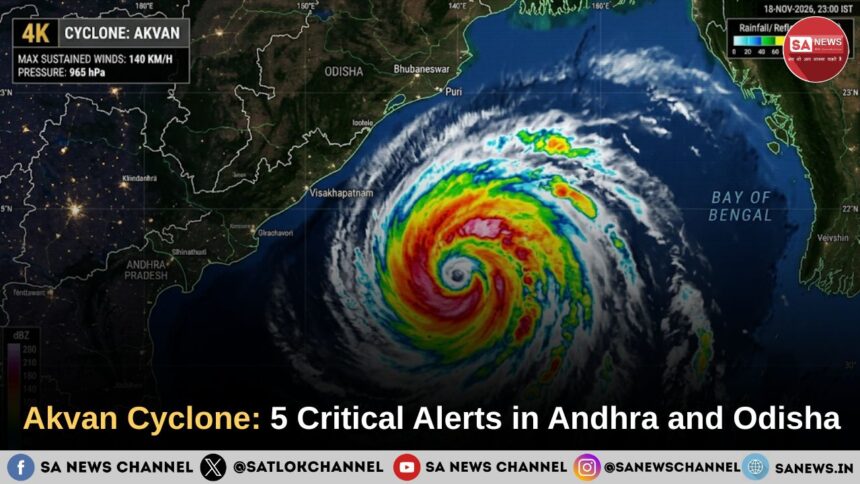
The Akvan cyclone has intensified into a severe cyclonic storm over the Bay of Bengal, prompting the India Meteorological Department (IMD) to issue urgent weather warnings across coastal Andhra Pradesh and Odisha. As the weather system tracks north-northwestward toward India’s eastern coastline, state administrations have activated large-scale evacuation plans and deployed disaster response teams.
- Latest Path and Landfall Forecast for the Akvan Cyclone
- Red and Orange Alerts Across Andhra Pradesh and Telangana
- Odisha Prepares Mass Evacuations Ahead of the Akvan Cyclone
- Regional Impact on Tamil Nadu, West Bengal, and Telangana
- Finding True Shelter and Lasting Protection Amid Nature’s Unpredictable Fury
- FAQs on Akvan Cyclone
This weather event marks the third cyclonic system to threaten the Andhra coast within a single month, following Cyclones Arnab and Murasu. Millions of coastal residents, farmers, and fishing communities are bracing for heavy downpours, squally winds, and potential infrastructure disruptions ahead of the projected November 20 landfall.
Alt Text: Akvan cyclone satellite radar view approaching Andhra Pradesh and Odisha coast
Latest Path and Landfall Forecast for the Akvan Cyclone
Meteorologists monitoring the Akvan cyclone revised its projected trajectory slightly northward on Wednesday, November 18, 2026. According to the official bulletins released by the India Meteorological Department (IMD), the severe cyclonic storm was centered over the west-central and adjoining central parts of the south Bay of Bengal.
The storm moved north-northwestward at a steady pace of roughly 8 kmph. At its current position, the system lies approximately 520 km southeast of Narsapur in Andhra Pradesh, 570 km south-southeast of Kalingapatnam, and 720 km south of Puri in Odisha.
Revised Landfall Corridor and Wind Speeds
Weather models now indicate that the Akvan cyclone will cross the coast between Narsapur in north Andhra Pradesh and Puri in south Odisha around noon on November 20. At the time of landfall, the system is expected to pack maximum sustained wind speeds of 90 to 100 kmph, with gusts reaching up to 110 kmph.
| Meteorological Parameter | Latest Official Forecast (November 18, 2026) |
| System Intensity | Severe Cyclonic Storm |
| Current Location | West-central & adjoining south Bay of Bengal |
| Expected Landfall Date | Friday, November 20, 2026 (Around Noon) |
| Projected Landfall Corridor | Between Narsapur (Andhra Pradesh) and Puri (Odisha) |
| Sustained Wind Speed | 90–100 kmph, gusting up to 110 kmph |
| Primary Rainfall Window | November 19 to November 21, 2026 |
Also Read: 10 of the Deadliest Cyclones in World History: When Nature Claimed Hundreds of Thousands of Lives
Red and Orange Alerts Across Andhra Pradesh and Telangana
Coastal districts in Andhra Pradesh face the most immediate threat from the Akvan cyclone. Because the state is still recovering from agricultural and structural damage caused by Cyclones Arnab in late October and Murasu earlier in November, authorities are taking zero chances.
The weather department has placed seven coastal districts—Kakinada, Konaseema, East Godavari, West Godavari, Eluru, Krishna, and Bapatla—along with Yanam under a strict red alert for extremely heavy rainfall. Neighboring districts from Srikakulam down to Nellore remain on high alert for squally winds and localized flooding.
Agricultural and Maritime Warnings
Local farmers have rushed to harvest standing paddy crops before torrential rains submerge low-lying fields. Coconut and banana plantations along the Godavari delta also face high risks of wind damage.
Meanwhile, the IMD has enforced a complete suspension of fishing operations across the west-central and southwest Bay of Bengal. Coast Guard vessels and marine police units have directed all deep-sea fishing boats to return to harbors immediately, as sea conditions are expected to turn very rough to high.
Odisha Prepares Mass Evacuations Ahead of the Akvan Cyclone
As the projected track of the Akvan cyclone shifted closer to southern Odisha, the state government placed 14 coastal and adjoining districts on high alert. Districts under watch include Ganjam, Gajapati, Puri, Khurda, Jagatsinghpur, Kendrapara, Bhadrak, Balasore, Nayagarh, Cuttack, Jajpur, Dhenkanal, Keonjhar, and Mayurbhanj.
According to the Office of the Special Relief Commissioner in Bhubaneswar, authorities have identified 87 vulnerable blocks and over 1,900 sensitive locations for immediate action. State officials have mapped out plans to evacuate more than 204,000 residents from low-lying areas and mud houses into multi-purpose cyclone shelters.
| Odisha District | Targeted Population for Potential Evacuation | Key Administrative Measures |
| Ganjam | 121,597 residents | Schools closed Nov 19–20; coastal tourism restricted |
| Gajapati | 25,000 residents | Landslide monitoring in hilly blocks; shelters stocked |
| Puri | 24,076 residents | Beach access banned; Gundicha Temple closed for 3 days |
| Kandhamal | 10,240 residents | Anganwadi centers shut; tree-clearing teams stationed |
| Malkangiri | 10,000 residents | Emergency communication lines and power backups active |
Landslide Precautions and Reservoir Management
In addition to coastal storm surges, hilly districts such as Rayagada face acute landslide hazards. The Rayagada district administration has identified 55 landslide-prone villages for pre-emptive evacuation.
Water resources engineers have also begun controlled water releases from the Harabhangi and Badanalla dam projects. Lowering current reservoir levels ensures adequate buffer capacity to absorb the heavy runoff expected between November 19 and 21.

Regional Impact on Tamil Nadu, West Bengal, and Telangana
Although the Akvan cyclone is bypassing a direct landfall in Tamil Nadu, its outer rainbands have already triggered widespread showers across Chennai and northern coastal districts. Weather officials noted that Tamil Nadu may experience a temporary lull before another spell of heavy rain arrives around November 23.
Further north, West Bengal is bracing for heavy rainfall along its coastal belt, including East Medinipur and South 24 Parganas, as moisture feeds into the eastern periphery of the storm. Simultaneously, eastern Telangana has been placed under an orange alert for November 20 and 21, with warnings of gusty winds and heavy downpours.
Deployment of Rescue Forces and Public Advisories
To minimize casualties and restore essential services quickly, 74 specialized rescue teams from the National Disaster Response Force (NDRF) and the Odisha Disaster Rapid Action Force (ODRAF) have been stationed across high-risk zones. State governments have canceled all leaves for emergency and revenue staff until the storm passes.
Authorities have issued clear safety guidelines for residents living in the projected path of the Akvan cyclone:
- Stay Indoors: Avoid stepping outside during peak wind hours on November 19 night and November 20.
- Secure Loose Objects: Fasten tin roofs, signboards, and outdoor equipment that could become airborne projectiles.
- Prepare Emergency Kits: Keep flashlights, charged power banks, dry rations, drinking water, and essential medicines accessible.
- Follow Official Bulletins: Rely exclusively on verified updates from state disaster management authorities and the IMD rather than unverified rumors.
Also Read: Climatology Explained: From Weather Patterns to Indian Monsoon and Cyclones
Finding True Shelter and Lasting Protection Amid Nature’s Unpredictable Fury
Every time a powerful storm like the Akvan cyclone approaches our coastlines, humanity is reminded of how fragile material security truly is. Despite advanced satellites, early warning radars, and massive relief operations, sudden shifts in nature’s course can uproot homes, destroy months of hard agricultural labor, and fill millions of hearts with fear and uncertainty. In moments when winds roar and floodwaters rise, people naturally realize that worldly wealth and physical structures cannot guarantee complete protection.
True peace and unshakable security come when human beings understand the deeper purpose of life and seek the shelter of the Supreme Creator. According to the authentic spiritual wisdom revealed by Sant Rampal Ji Maharaj, all souls are children of Supreme God Kabir Sahib, and human life is a rare opportunity to attain permanent liberation from the cycle of birth, death, and natural calamities. When society turns away from true scriptures and engages in unscripted rituals, moral decline follows, disturbing the harmony of nature itself.
By adopting true worship (Sat-Bhakti) strictly in accordance with our sacred scriptures under the guidance of Sant Rampal Ji Maharaj, devotees receive the divine grace and protection of Almighty God Kabir even during the gravest worldly crises. Moreover, inspired by His teachings of universal brotherhood and selfless service, followers actively step forward during floods and disasters to distribute food, shelter, and essential aid to affected families without discrimination. To understand how true spiritual knowledge brings fearlessness and permanent peace in every circumstance, watch the enlightening spiritual discourses of Sant Rampal Ji Maharaj on the Official YouTube Channel of Sant Rampal Ji Maharaj.
FAQs on Akvan Cyclone
1. When and where will the Akvan cyclone make landfall?
Ans. The Akvan cyclone is expected to make landfall around noon on Friday, November 20, 2026, between Narsapur in north Andhra Pradesh and Puri in south Odisha.
2. What wind speeds are forecast during the Akvan cyclone?
Ans. The storm will cross the coast with sustained winds of 90 to 100 kmph, with gusts reaching up to 110 kmph.
3. Which districts are under red and orange alerts?
Ans. Seven coastal districts in Andhra Pradesh plus Yanam are under a red alert, while 14 districts in Odisha and parts of eastern Telangana face high rainfall warnings.
4. How did Cyclone Akvan get its name?
Ans. Iran contributed the name “Akvan” as part of the official tropical cyclone naming list maintained by the World Meteorological Organization (WMO).
5. What safety measures have state governments taken?
Ans. Authorities have deployed 74 NDRF and ODRAF rescue teams, closed schools in six Odisha districts, suspended Bay of Bengal fishing, and prepared to evacuate over 204,000 residents.