



The Bay of Bengal unleashed its fury on the Indian coastline twice in the last few days with two consecutive cyclones. Can scientists always anticipate how powerful a cyclone will become before it reaches land? With the forces of nature unleashing their fury more and more frequently this year, this article brings you the ten deadliest cyclones that the world has experienced, how they overwhelmed settlements and the irretrievable loss they bring with them, with a focus on how cyclones form.
- Highlights on 10 Deadliest Cyclones in World History
- What Makes a Cyclone Deadly?
- India’s Back-to-Back Cyclones in 2026: Could Their Strength Have Been Predicted?
- Ten of the Deadliest Cyclones in World History
- Bhola Cyclone (1970), Bangladesh
- Coringa Cyclone (1839), India
- Backerganj Cyclone (1876), Bangladesh
- Bangladesh Cyclone (1991), Bangladesh
- Cyclone Nargis (2008), Myanmar
- Typhoon Nina (1975), China
- Shantou Typhoon (1922), China
- Great Hurricane of 1780, Caribbean
- Andhra Pradesh Cyclone (1977), India
- Bangladesh Cyclone (1985), Bangladesh
- Why Has the Bay of Bengal Witnessed So Many Deadly Cyclones?
- Why Do Some Cyclones Become Dangerous So Suddenly?
- Can Modern Technology Prevent Another Cyclone Catastrophe?
- Can We Escape the Endless Cyclone of Birth and Death?
- Frequently Asked Questions
Highlights on 10 Deadliest Cyclones in World History
- In 1970 Bangladesh experienced Bhola Cyclone which is considered as the deadliest cyclone ever known to humanity so far. It claimed an estimated 3,00,000-5,00,000 lives and was also recognised by the World Meteorological Organization as the deadliest tropical cyclone.
- India’s recent cyclones Arnab and Murasu struck Andhra Pradesh within days in October-November 2026, making us realise how important cyclone intensity forecasting and coastal preparedness are.
- Historical disasters such as the Coringa Cyclone of 1839, Backerganj Cyclone of 1876 and Cyclone Nargis of 2008 also caused enormous human losses.
- Bay of Bengal’s cyclone vulnerability cannot be ignored.
- The region’s funnel-shaped coastline, shallow coastal waters, low-lying river deltas and large coastal populations increase the risk of catastrophic cyclone disasters.
What Makes a Cyclone Deadly?
‘Deadly’ might mean something different for different people. For some it might mean material loss, for some it may mean the trauma it brings and for some loss of life. In this article, we will primarily focus on the loss of lives brought on by a cyclone, so deadly in that sense, because that is an irreversible loss.
The strength of a cyclone is usually communicated through wind speeds, but its most dangerous feature is often something less visible in satellite photographs – the seawater it pushes onto land (storm surge). Fierce cyclonic winds and low atmospheric pressure also contribute to the rise, among these factors.
When a storm surge collaborates with high tide, it is nothing but a formula for dangerous coastal conditions. Water will surge inside the land as far as the winds can support it.
Several conditions to its overall threat to all life in its path:
- The low-lying areas are the biggest natural victims of cyclones.
- More the people in coastal settlements, more the possibility.
- Rainfall and flooding during the landfall.
- Reliable forecasts are definitely valuable, but only when people receive them on time.
- Cyclone shelters, evacuation routes and rescue services can also help reduce fatalities, but finally, it would depend on the cyclone’s intensity too.
India’s Back-to-Back Cyclones in 2026: Could Their Strength Have Been Predicted?
India’s eastern coastline experienced two significant cyclonic events within days at the end of October and beginning of November 2026. They were more significant because they came right after each other.
28th October 2026 Cyclone Arnab
Cyclone Arnab struck the Andhra Pradesh coast as a ‘Very Severe Cyclonic Storm’. We have seen the live visuals of extremely powerful winds, intense rainfall and widespread disruption, on social media.
- The Andhra Pradesh State Disaster Management Authority (APSDMA) recorded Arnab’s peak intensity at approximately 86 knots, while its intensity near the coastline was lower, at around 70 knots.
- The storm caused damage to houses, agricultural land and infrastructure, particularly across coastal districts.
- The reported loss of lives has been 6, but one news channel also reported 7 as the correct figure.
According to Andhra Pradesh CM N. Chandrababu Naidu, an approximate total loss of INR 4,600 crores is what Andhra Pradesh faced.
2-3 November 2026 Cyclone Murasu
The second cyclone ‘Murasu’ followed suit just days after Cyclone Arnab, battering the coastal areas of Andhra Pradesh yet again.
The storm developed over the Bay of Bengal, strengthened into a Severe Cyclonic Storm and crossed the Andhra Pradesh coast near Ongole around the night of 2nd and 3rd November 2026.
It is said that the winds were of approximately 100-110 km/h (gusts reaching 120 km/h). The government of Andhra Pradesh had also been active in providing updates about evacuation,and the extent of damage faced.
Did Weather Forecasting Fail?
It would be premature to conclude that either cyclone became dangerous without warning. However, the intensity in which they suddenly converted into the severe and very severe category is what shook the weather forecast predictors.
- On 31st October 2026, the IMD described it as ‘a well-marked low pressure area’. Overnight it turned into a severe category.
- The India Meteorological Department’s 1st November 2026 bulletin for the developing system that became Murasu already projected the possibility of a Severe Cyclonic Storm.
- Subsequent bulletins refined the expected landfall location and timing.
- Thereafter, the department was forecasting a coastal crossing near Ongole during the night of November 2-3.
This proves that meteorologists had identified the threat before landfall. However, cyclone forecasting involves two distinct challenges – estimating where a storm will travel and predicting how much its intensity will change.
A cyclone may be accurately tracked while its exact strengthening rate remains uncertain. This could be a reason why the two swift cyclones.
Ten of the Deadliest Cyclones in World History
The following selection brings together ten exceptionally deadly or historically consequential tropical cyclones.
They are not presented as an undisputed numerical ranking. Historical death tolls can vary in reliability, particularly for events that occurred before modern meteorological records. We will state such cases so there is no confusion. In some cases, estimates include people who died after the storm because of flooding, disease or food shortages.
Before discussing each of these cyclones, a quick look at their known statistics:
The Deadliest Cyclones at a Glance
| CYCLONE | YEAR & LOCATION | ESTIMATED FATALITIES |
| Bhola | 1970, Bangladesh | 3,00,000-5,00,000 |
| Coringa | 1839, India | Approximately 3,00,000, but disputed |
| Backerganj | 1876, Bangladesh | Approximately 200,000 |
| Bangladesh Cyclone | 1991, Bangladesh | 138,866 |
| Nargis | 2008, Myanmar | Approximately 1,38,000 dead/missing too |
| Nina | 1975, China | Approximately 26,000 flood deaths, statistics are believed to be higher including indirect deaths |
| Shantou | 1922, China | Approximately 60,000, uncertain |
| Great Hurricane | 1780, Caribbean | 22,000-27,500 |
| Andhra Pradesh | 1977, India | 14,204 |
| Bangladesh Cyclone | 1985, Bangladesh | Approximately 15,000 |
Note: This is a selected historical comparison, not a definitive global ranking.
Bhola Cyclone (1970), Bangladesh
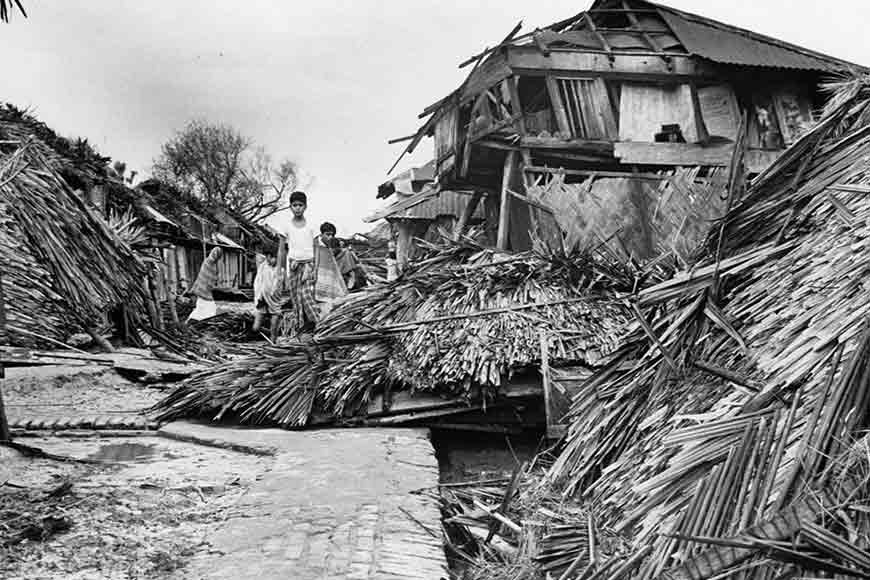
One of the most tragic cyclones that ate up more than 3,00,000 human lives, Bhola Cyclone is the deadliest tropical cyclone in the World Meteorological Organization’s records.
- Death toll: 3,00,000-5,00,000
- Category: Extremely Severe Cyclonic Storm and ‘Category 4-equivalent’ tropical cyclone
- That time Bangladesh was East Pakistan. On 12-13th November 1970, the cyclone entered with a gigantic storm surge at coastal settlements of the Ganges delta.
- Tazumuddin faced the maximum destruction. Out of the total of 1,67,000 residents, about 45% people lost their lives.
- Entire villages were overwhelmed, leaving countless families with little chance of escaping the rising water.
- Although warnings had been issued before landfall, they did not always communicate the danger effectively.
- On Manpura Island, for example, residents received coded storm alerts without adequate explanations of their severity or the protective action required.
- The suffering still continued after the cyclone had passed, as the crops were destroyed, water was contaminated and relief operations were not upto the mark.
- Hunger and illness haunted the affected areas.
- Due to this, there was widespread discontent about the government’s response to the disaster.
Coringa Cyclone (1839), India
Though Andhra Pradesh came into spotlight recently for the two cyclones that hit its coast, it is not new to cyclones. In 1839, Cyclone Coringa scurried through the port of Coringa. Today, we can gauge the area as that close to Kakinada in Andhra Pradesh.
- Death toll: approximately 3,00,000 deaths, but some historians dispute this figure.
- Category: Category 4-equivalent
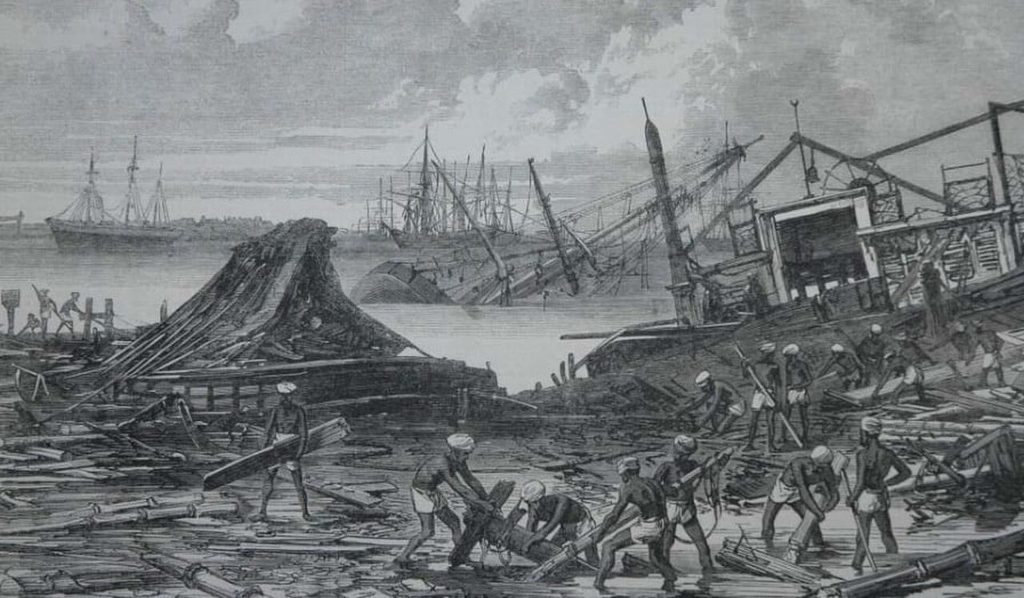
The scale of the port’s destruction is an important part of India’s cyclone history.
Backerganj Cyclone (1876), Bangladesh
Bangladesh has a long-standing relation with cyclones. In 1876, during the night of 31st October and 1st November, the Backerganj Cyclone now tore through the Bengal delta of Bangladesh.
- Death toll: approximately 2,00,000
- Category: Super Cyclonic Storm and Category 4-equivalent
- As this horror of a storm moved towards the coast, seawater swept across low-lying settlements as though there were no settlements earlier. Barely any trace left.
- There was an immediate health crisis because flooding contaminated the fresh water available.
- Cholera and other illnesses also contributed to suffering among survivors, doubling the grief of losing loved ones and struggling with the loss of basic necessities like shelter, food and drinking water.
- Most estimates reveal the overall death toll as about 2,00,000, but this would include both during and aftermath death count too.
The disaster showed the world how a cyclone’s consequences can continue even long after its winds have subsided.
Bangladesh Cyclone (1991), Bangladesh
More than two decades after Bhola, another exceptionally powerful cyclone devastated the southeastern coast of Bangladesh on 29-30th April 1991.
- Death toll: 1,38,866
- Category: Super Cyclonic Storm and ‘Category 5-equivalent’ too
- The cyclone, also known as Gorky Cyclone, gave rise to destructive winds. The surge it generated reached approximately six metres in some locations, which proved fatal.
- Though meteorological warnings were given, many residents could not even reach safety.
- Limited transport, inadequate shelter capacity and the difficulty of evacuating vulnerable populations, altogether contributed to the enormous death toll.
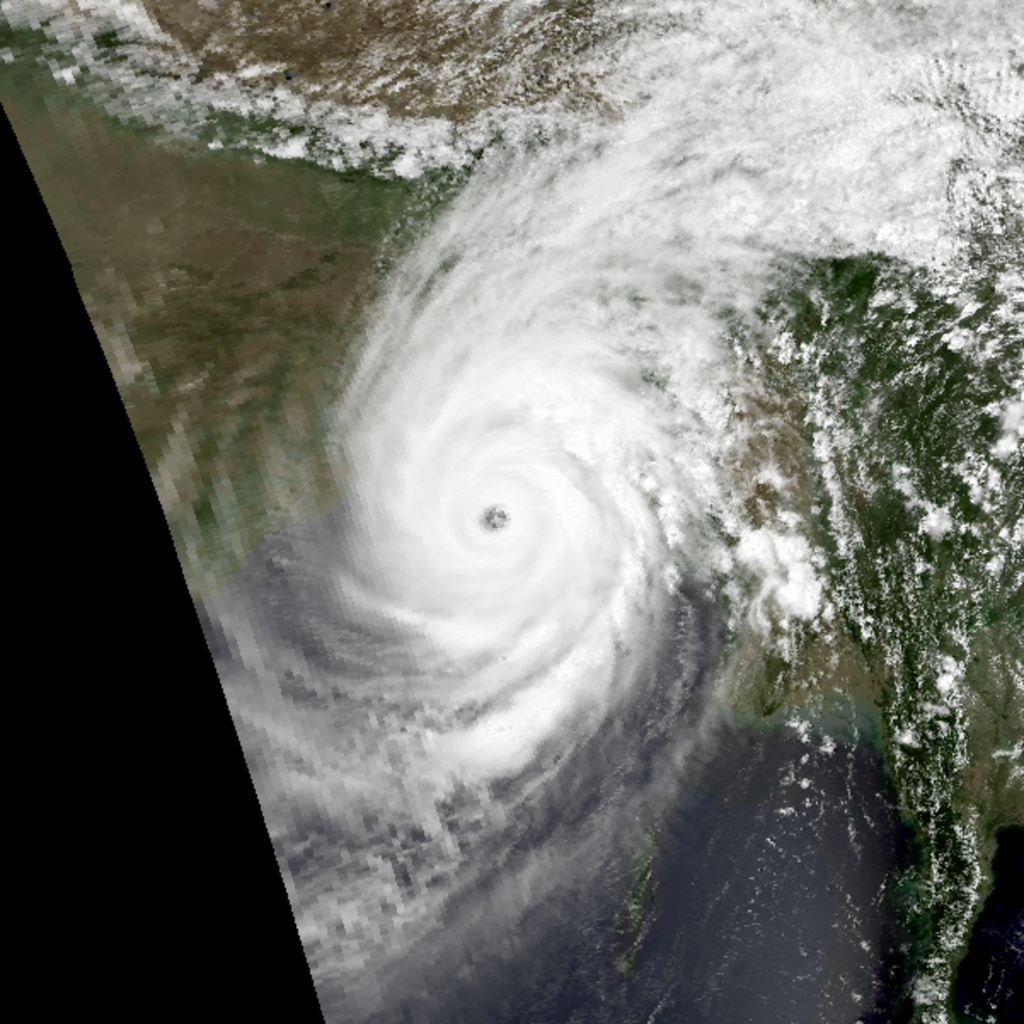
The World Meteorological Organization’s Atlas of Mortality records 1,38,866 deaths from this 1991 cyclone.
Cyclone Nargis (2008), Myanmar
In May 2008, Cyclone Nargis swept across Myanmar’s Irrawaddy Delta. This cyclone destroyed agricultural settlements heavily.
- Death toll: approximately 1,38,000
- Category: Extremely severe cyclonic storm
- The cyclone brought with it all its tools of destruction such as powerful winds and severe coastal flooding. The result was destroyed homes, livelihoods and everything that stood in its way.
- There was an immediate shortage of drinking water, food and medical assistance in most places due to the sheer scale of this disaster.
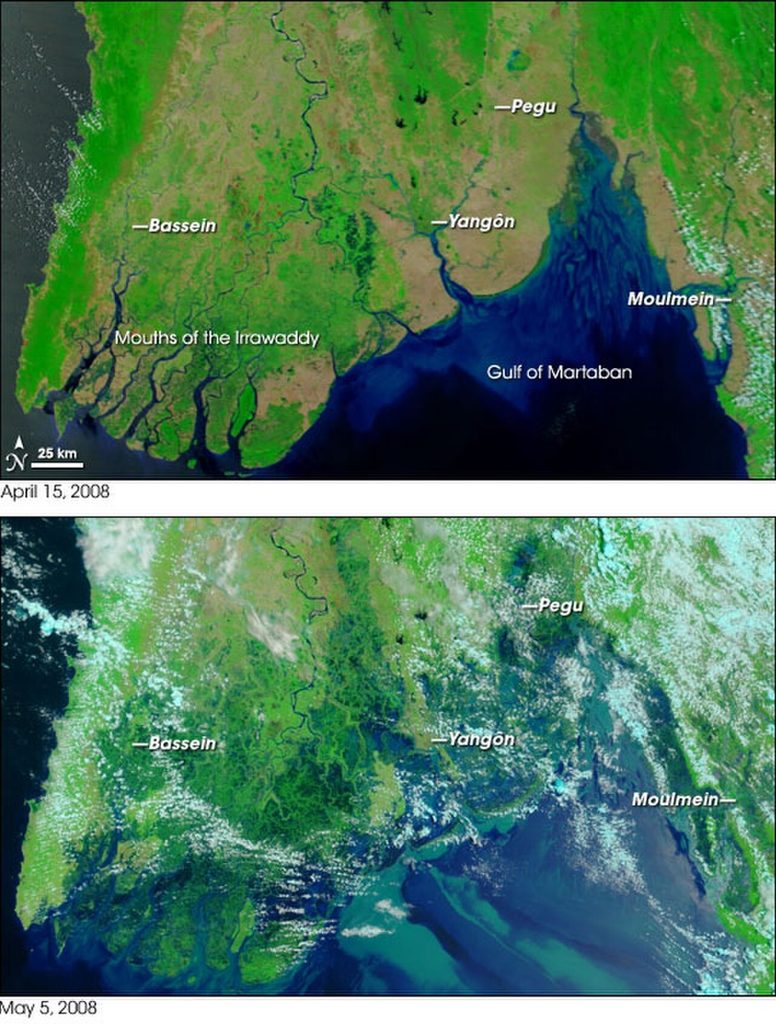
Before and After Cyclone Nargis
The WMO’s Atlas records 138,366 deaths, while other widely cited assessments report approximately 138,373 people dead or missing. These figures use somewhat different reporting conventions where measures are not identical. Nevertheless, it does not take away from the disaster.
Typhoon Nina (1975), China
August 1975 paved the way for Typhoon Nina to strike China, producing exceptionally heavy rainfall across several parts of its Henan province.
- Death toll: approximately 26,000 from flooding. But the final tally was much much higher, taking into account the aftermath death toll too.
- Category: ‘Category 4-equivalent’ super typhoon
- Its most devastating consequences were linked to the failure of dams, including the Banqiao Dam. The dam released unprecedented volumes of water downstream, straight into communities living close by.
- The resulting flooding destroyed settlements and infrastructure, leaving many people without food, shelter or medical care.
The WMO’s mortality-extreme assessment discusses estimates of approximately 26,000 flood deaths, with a further 1,00,000 attributed in some research to subsequent disease and famine. Other historical compilations cite still higher totals.
Are Typhoons, Cyclones and Hurricanes Different?
Although they have different names, typhoons, cyclones and hurricanes belong to the same family of tropical weather systems. The terminology changes depending on the part of the world where the storm develops.
| STORM NAME | PART OF THE WORLD |
| Typhoon | The Western-North-Pacific region (Japan, China and the Philippines) |
| Cyclone | Indian Ocean and South Pacific (particularly India, Bangladesh and Australia) |
| Hurricane | The North Atlantic and eastern-North Pacific areas ( also includes the areas close to the Caribbean, Mexico and the United States) |
Shantou Typhoon (1922), China
As a country, China has also seen many typhoons. The Shantou Typhoon remains one of the deadliest. It struck the southern China coast in August 1922, particularly the Shantou region, therefore, the name Shantou Typhoon.
- Estimated deaths: commonly around 60,000; historical estimates vary
- Category: Very strong typhoon
- The cyclone had violent winds and coastal flooding for company, just like wind fans fire.
- The disaster affected several coastal communities. Their livelihoods specifically depended on activities around the coast.
The cumulative death toll is generally stated as approximately 60,000 people dead.
Great Hurricane of 1780, Caribbean
The Great Hurricane of 1780 is widely recognised as the deadliest hurricane in recorded Atlantic history.
- Death toll: 22,000-27,500 approximately
- Category: Category 5 hurricane as estimated by most experts, but still no concrete historical data
- It literally swallowed several Caribbean islands, including Barbados, Martinique and Saint Lucia.
- It was also the time when these very islands were affected by naval activity associated with the American Revolutionary War.
- Needless to say, this category 5 storm destroyed all sorts of settlements, damaged vessels and caused enormous loss of life not just on land, but also at sea.
- Although its estimated death toll was lower than that of several major Asian cyclones, the disaster remains a landmark in Atlantic hurricane history.
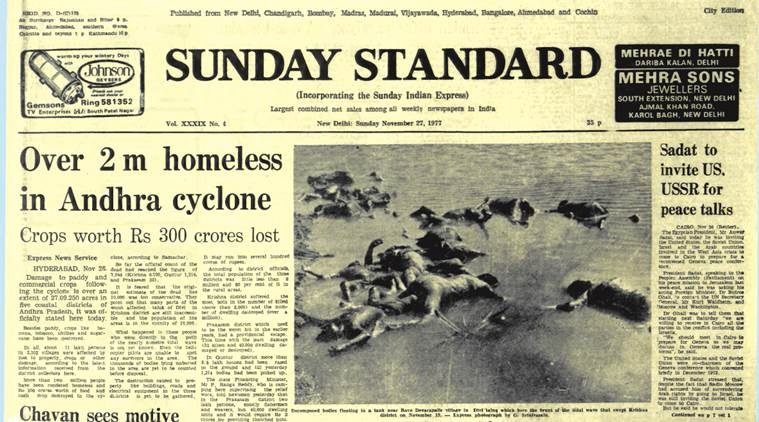
Andhra Pradesh Cyclone (1977), India
Another cyclone Andhra Pradesh can never forget is the 1977 cyclone. In November, this destructive cyclone brought along with it a severe storm surge and thereby unleashed fury on all coastal communities in its line of target.
- Death toll: 14,204 approximately
- Category: Super cyclonic storm, also Category 3 equivalent tropical cyclone
- The Diviseema region, situated within the Krishna River delta, suffered particularly devastating losses.
- Homes and agricultural land were submerged after this cyclone hit Andhra Pradesh.
- The low-lying settlements were especially the biggest victims.
Bangladesh Cyclone (1985), Bangladesh
We will end this list with a Bangladeshi cyclone that hit its coastal region in May 1985.
- Death toll: approximately 15,000
- Category: Super Very severe cyclonic storm
- Just like most cyclones, this one too tore apart through the coastal communities. Most were fishing and coastal agri communities.
- The WMO’s Atlas recorded approximately 15,000 deaths for the 1985 cyclone.
Why Has the Bay of Bengal Witnessed So Many Deadly Cyclones?
By now we have seen how many deadly cyclones actually arose from the Bay of Bengal. There are multiple reasons for this tragedy.
The Shape of the Coastline
The peculiar structure of the coastal region along the Bay of Bengal actually proves favourable for big surges and dangerous storms. The coastal waters are also shallow there, particularly as it narrows towards Bangladesh and eastern India.
Vast Low-Lying Deltas
The Ganges, Brahmaputra and Meghna river systems have created extensive delta regions. These are occupied by large populations, plus the elevations are also low.
Warm Ocean Waters
Heat and moisture are the fodder for tropical cyclones. The Bay of Bengal frequently provides favourable conditions for cyclone development and this is the reason for so many devastating cyclones documented so far.
Why Do Some Cyclones Become Dangerous So Suddenly?
A cyclone does not always strengthen gradually, as we have already seen in the case of Murasu that took a formidable form just within a few hours.
Several environmental conditions could be supporting this process, though sometimes it can be beyond comprehension too.
- Warm ocean water supplies energy to a cyclonic storm, as a general thumb rule.
- Moist air further helps sustain intense thunderstorms, whereas, relatively weak vertical wind shear allows the cyclone’s circulation to remain more controlled.
- The depth of warm water can matter too. If cooler water is brought to the surface as the cyclone moves, it may stop or slow down the further strengthening of the cyclone. Vice versa for warm water.
These processes and their interactions are definitely more complicated and thus, more difficult to ascertain at times. Scientists sometimes forecast rapid strengthening successfully. At other times, its timing or magnitude remains difficult to estimate.
Can Modern Technology Prevent Another Cyclone Catastrophe?
Satellite observations, numerical weather models, ocean measurements and improved communication systems have definitely improved cyclone forecasting. But, can they help prevent a catastrophe? Not really, at least none till now. We are already living through real-life examples at this point to validate this argument.
Can We Escape the Endless Cyclone of Birth and Death?
The disasters examined in this article have occurred across different time periods, countries and stages of scientific development. But still, several lessons appear repeatedly, despite the scientific progress.
The destruction caused by a cyclone is most often measured solely through financial estimates. This includes just material loss. However, there is one consequence that cannot be measured in monetary terms. The life of someone lost to a disaster can never be restored.
Natural disasters remind us about the whimsical nature of life and how it can change suddenly. In a matter of hours, possessions accumulated over decades may disappear and countless families may lose their dearest ones too. Is our existence limited to this temporary world alone?
Jagatguru Tatvdarshi Sant Rampal Ji Maharaj explains through the teachings of the holy scriptures that human life offers us the biggest precious opportunity to understand our true spiritual identity and thereby, to attain complete salvation.
He further reveals that the soul’s ultimate destination is Satlok – the only eternal, immortal abode free from suffering, ageing and death. Sant Rampal Ji teaches that by understanding the scriptures and following true devotion under the guidance of a Complete Saint (Tatvdarshi Sant) alone, human beings can pursue their goal of complete salvation from the unending cycle of birth and death.
Understand how to earn the ultimate protection of Supreme God Kabir by listening to the precious spiritual discourses of Jagatguru Tatvdarshi Sant Rampal Ji Maharaj Ji on:
Website: www.jagatgururampalji.org
YouTube: Sant Rampal Ji Maharaj
Facebook: Spiritual Leader Saint Rampal Ji
‘X’ handle: @SaintRampalJiM
Frequently Asked Questions
Q1) Which is the deadliest cyclone ever recorded?
Answer: The 1970 Bhola Cyclone.
Q2) Why do some cyclones become powerful suddenly?
Answer: It depends on many factors like wind, warm water, etc.