


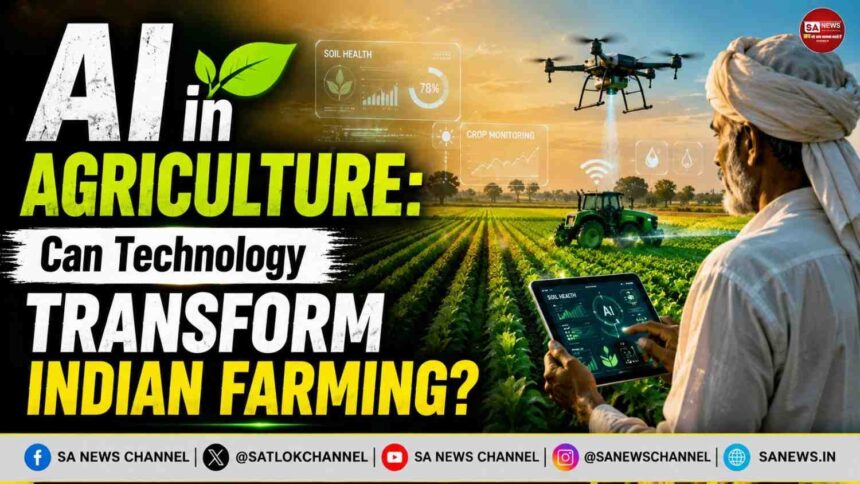
Indian agriculture is standing at an interesting crossroads. For generations, farmers have depended on experience, seasonal patterns and traditional knowledge to grow crops. Today, AI in agriculture is adding a new layer of decision-making. Artificial intelligence can analyse weather information, identify crop diseases, monitor soil conditions and support precision farming. For Indian farmers, particularly those facing unpredictable weather, water shortages and changing market conditions, these technologies could offer valuable assistance.
- What Is AI in Agriculture?
- Why Is AI Becoming Important for Indian Farming?
- How AI Can Transform Indian Agriculture
- 1. AI-Powered Crop Monitoring
- 2. Early Detection of Crop Diseases
- 3. Smart Irrigation and Water Management
- AI and Weather Forecasting for Farmers
- AI, Soil Health and Precision Farming
- The Role of IoT in Smart Agriculture
- Drones and AI: A New View of the Farm
- AI and Better Market Decisions for Farmers
- AI for Reducing Post-Harvest Losses
- Making AI More Farmer-Friendly
- The Future of AI in Indian Farming
- Can AI Help Small and Marginal Farmers?
- Major Challenges of AI in Indian Agriculture
- The Future of AI in Agriculture
- Integrating Technology with Spiritual Values and Human Welfare
- FAQs on AI in agriculture
However, technology alone cannot solve every agricultural problem. Cost, digital literacy, internet access and local-language support matter too. The real question is not whether AI can help farming, but whether its benefits can reach farmers at scale.
What Is AI in Agriculture?
Artificial intelligence in agriculture refers to using computer systems, machine learning and data analysis to help farmers make informed decisions.
Instead of depending only on manual observation, farmers can use technology to process large amounts of information. For example, an AI-based system can analyse images of crops and potentially identify signs of disease or nutrient deficiencies.
This does not mean that machines will replace farmers. Rather, AI technology for farmers can work as a decision-support tool.
A farmer still understands the land, crop and local conditions in a way that a computer cannot. AI can complement that experience by providing additional information at the right time.
Why Is AI Becoming Important for Indian Farming?
Indian farmers face several challenges. Weather patterns can be difficult to predict, water availability varies across regions, and pests and diseases can damage crops quickly.
At the same time, India’s agricultural sector includes a very large number of small and marginal farmers. This makes affordability and accessibility especially important.
If AI solutions are designed according to local needs, they could help farmers answer practical questions such as:
- When should a crop be irrigated?
- Is a plant showing signs of disease?
- Is rainfall expected soon?
- How much fertiliser may be required?
- Which part of a field needs attention?
- When could harvesting be appropriate?
These are areas where smart farming technology could potentially make everyday agricultural decisions more efficient.
Also Read :World Press Freedom Day: The Interaction Of AI, Media & Press Freedom
How AI Can Transform Indian Agriculture
1. AI-Powered Crop Monitoring
Farmers cannot physically inspect every plant in a large field every day. Cameras, drones and satellite imagery can help monitor crops across larger areas.
AI can analyse these images to identify unusual patterns. For instance, if one section of a field appears different from surrounding areas, it may indicate water stress, pest activity or disease.
This type of crop monitoring technology could allow farmers to focus attention where it is needed instead of treating the entire field in exactly the same way.
2. Early Detection of Crop Diseases
Crop diseases can spread rapidly. Early identification can therefore be valuable.
AI-based image recognition systems can examine photographs of leaves, fruits or stems and compare visible characteristics with known disease patterns.
A farmer could potentially use a smartphone-based system to receive an initial indication of what might be affecting a crop.
However, such systems should be treated as assistance rather than an unquestionable diagnosis. Local agricultural experts and reliable agricultural services remain important, particularly when crop health is seriously affected.
3. Smart Irrigation and Water Management
Water is one of the most important resources in agriculture.
Traditional irrigation can sometimes result in water being applied without considering the precise needs of the crop or current soil conditions.
AI-based irrigation systems can combine information such as soil moisture, crop requirements and weather forecasts to help determine when irrigation may be needed.
For farmers in water-stressed regions, better irrigation management could potentially reduce unnecessary water use while maintaining crop health.
The larger goal is precision agriculture, where resources are used according to actual field requirements rather than applying the same amount everywhere.
AI and Weather Forecasting for Farmers
Weather has always played a major role in farming. Rainfall, temperature, heat waves, storms and changing seasonal conditions can directly affect agricultural decisions.
AI can process large datasets and help improve weather-related predictions and agricultural advisories.
For example, a farmer may benefit from information about expected rainfall before deciding whether irrigation is necessary. Similarly, weather alerts could help farmers prepare for extreme conditions.
Better Decisions, Not Perfect Predictions
It is important to remember that no technology can guarantee perfectly accurate weather predictions.
Agriculture involves uncertainty. AI can help farmers manage that uncertainty, but it cannot eliminate it.
This distinction is important because farmers should not be encouraged to depend entirely on automated predictions without considering local conditions and expert advice.
AI, Soil Health and Precision Farming
Healthy soil is the foundation of productive agriculture.
AI in precision farming can help analyse information about soil characteristics, moisture levels and crop requirements. When combined with sensors and field data, these systems can potentially help farmers apply fertilisers, water and other inputs more efficiently.
Instead of treating an entire field identically, farmers can potentially identify areas requiring different levels of attention.
This approach can have two major benefits: improving resource efficiency and reducing unnecessary input use.
The Role of IoT in Smart Agriculture
AI often works alongside the Internet of Things (IoT).
Sensors placed in agricultural fields can collect information about soil moisture, temperature and other conditions. That information can then be analysed by software to provide useful recommendations.
In simple terms:
Sensors collect data → AI analyses data → Farmers make decisions.
This combination is one of the foundations of modern smart agriculture.
Drones and AI: A New View of the Farm
Agricultural drones can capture aerial images of fields. When AI analyses those images, farmers can obtain a broader picture of crop conditions.
Drones may help identify variations in crop growth, water stress or areas requiring closer inspection.
For large agricultural operations, this can save considerable time. But for small farmers, the cost of equipment and services remains an important consideration.
A practical approach could therefore involve shared services, cooperatives or affordable agricultural technology platforms rather than expecting every farmer to purchase expensive equipment individually.
AI and Better Market Decisions for Farmers
AI can help farmers understand market trends, crop demand and price patterns. This information can support better decisions about where and when to sell their produce.
Understanding Crop Prices
AI-powered platforms can analyse market data and provide farmers with useful information about changing crop prices. This can help farmers compare different selling opportunities.
Predicting Market Demand
AI can analyse past trends and demand patterns. Farmers may use these insights while planning which crops to grow in the upcoming season.
AI for Reducing Post-Harvest Losses
Growing a crop is only half the journey. Proper storage and transportation are also important because poor handling can reduce the value of agricultural produce.
Smart Storage Systems
AI and sensors can monitor factors such as temperature and humidity in storage facilities. Farmers and businesses can receive alerts when conditions become unsuitable.
Improving Transportation
AI can help coordinate transportation by analysing factors such as routes, timing and storage requirements. Better planning can help agricultural produce reach markets efficiently.
Making AI More Farmer-Friendly
For AI in agriculture to succeed, technology needs to be simple and accessible. Farmers should not need advanced technical knowledge to use basic AI services.
AI in Local Languages
AI tools that support Indian languages can make agricultural information easier to understand. Voice-based services could also help farmers interact with technology more naturally.
Connecting Farmers With Experts
AI can provide initial information, but agricultural experts can offer additional guidance. Combining AI technology and expert advice can make farming decisions more reliable.
Training Farmers to Use AI
Training is essential for successful technology adoption. Demonstrations and simple learning programmes can help farmers understand both the benefits and limitations of AI tools.
The Future of AI in Indian Farming
The future of Indian agriculture could combine farmer experience with modern technology.
AI, sensors, drones and digital platforms can support farmers, while human knowledge remains at the centre of decision-making.
Can AI Help Small and Marginal Farmers?
This may be the most important question.
India’s agricultural technology revolution will have limited impact if advanced tools are accessible only to large farms.
For AI for small farmers to become meaningful, solutions need to be:
- Affordable
- Easy to operate
- Available in Indian languages
- Usable through smartphones where possible
- Supported by reliable agricultural information
- Designed for local crops and climatic conditions
Voice-based agricultural assistants could be particularly useful because farmers should not need advanced technical knowledge to benefit from AI.
A farmer should be able to ask a question in a familiar language and receive a simple, understandable response.
Major Challenges of AI in Indian Agriculture
Despite its potential, AI in agriculture in India faces several challenges.
High Cost
Advanced sensors, drones and specialised software can be expensive. Unless costs fall or shared-service models become available, many small farmers may struggle to adopt them.
Digital Literacy
Not every farmer is comfortable using complicated digital platforms. Technology needs to be designed around the user, not the other way around.
Internet and Infrastructure
AI-powered agricultural services often depend on smartphones, connectivity, electricity and digital infrastructure. Rural connectivity has improved, but access is not identical everywhere.
Data Privacy
Agricultural technology can collect valuable information about farms, crops and farming practices. Farmers should understand how their data is collected, stored and used.
Accuracy and Trust
An AI recommendation that works well in one region may not always work equally well in another. Local soil, climate, crop varieties and farming practices matter.
Therefore, AI agricultural solutions should be tested locally and supported by agricultural professionals.
The Future of AI in Agriculture
The future may not be about choosing between traditional farming and technology. Instead, the strongest model could combine both.
A farmer’s practical experience can be paired with:
- AI crop monitoring
- Digital weather advisories
- Smart irrigation
- Soil sensors
- Agricultural drones
- Pest detection
- Data-driven crop planning
- Digital marketplaces
This combination could create a more responsive agricultural system.
The goal should not simply be to make farming more technological. It should be to make farming more productive, sustainable, affordable and resilient.
Integrating Technology with Spiritual Values and Human Welfare
While discussing the future of modern agriculture, it is essential to look beyond raw mechanical efficiency and evaluate the underlying human values guiding technological development. The core tenets of Satgyaan (true spiritual knowledge) as taught by Sant Rampal Ji Maharaj place strong emphasis on ethical living, compassionate conduct, and universal brotherhood (Jeev humari jaati hai, Maanav dharam humara). From this perspective, technological advancements are meant to serve as instruments for broad human welfare rather than becoming isolated ends in themselves.
FAQs on AI in agriculture
1. What is AI in agriculture?
AI in agriculture means using artificial intelligence, machine learning, sensors and data analysis to help farmers make better decisions about crops, irrigation, soil, pests and weather.
2. How can AI help Indian farmers?
AI can help Indian farmers through crop monitoring, disease detection, weather forecasting, smart irrigation, soil analysis and precision farming.
3. Can AI reduce farming costs?
AI may help reduce unnecessary use of water, fertilisers and other inputs by providing more targeted recommendations. However, the actual savings depend on the technology, crop and farming conditions.
4. Is AI useful for small and marginal farmers?
Yes, but affordability and accessibility are essential. Smartphone-based tools, local-language services and shared technology models could make AI more useful for small farmers.
5. What is the future of AI in Indian agriculture?
The future could involve AI working alongside farmers through smart irrigation, drones, sensors, crop monitoring, weather advisories and data-driven farming. Human experience will remain an important part of agricultural decision-making.