

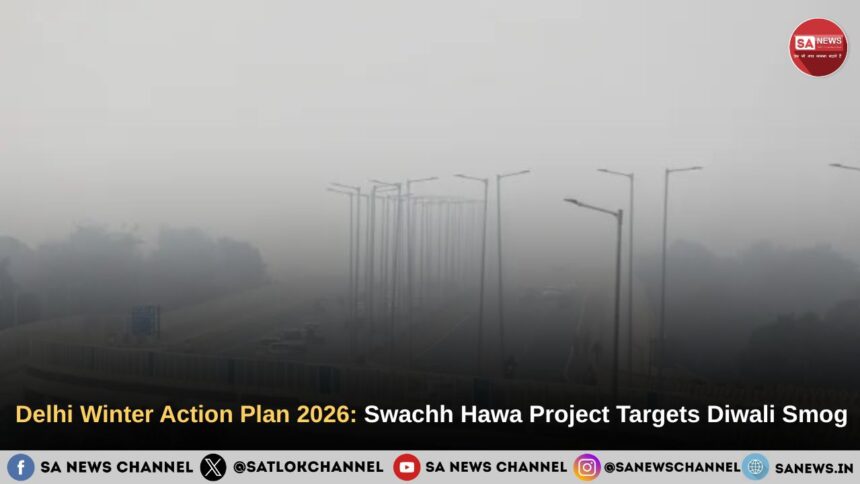
As October unfolds and the festive spirit of Diwali approaches, a familiar and hazardous gray haze is already settling over the national capital. Lower temperatures, stagnant winds, and regional crop residue burning are combining to create a severe environmental crisis. With the Air Quality Index (AQI) rapidly crossing the 300 mark, placing it firmly in the “very poor” category; the concentration of fine PM2.5 particles is regularly exceeding the World Health Organization’s recommended daily limits by more than 25 times.
- The ‘Swachh Hawa, Swasth Delhi’ Megaproject
- The Winter Action Plan: Emergency Measures for Diwali and Beyond
- The Graded Response Action Plan (GRAP) Explained
- Public Impact: How Residents Must Adapt
- Beyond the Festival of Lights, Embrace the Light of True Spiritual Knowledge
- FAQs Related to‘Swachh Hawa’ Project and Winter Action Plan
However, 2026 marks a major shift in how the government is tackling this annual emergency. This year, the Delhi government is armed with an unprecedented ₹8,300 crore financial initiative backed by the World Bank, alongside a highly aggressive Winter Action Plan. Here is an in-depth look at the “Swachh Hawa, Swasth Delhi” megaproject, the incoming vehicle restrictions, and how these sweeping measures will impact residents through the Diwali weekend and beyond.
Key Points at Glance
- Massive Financial Backing: A seven-year, ₹8,300 crore project titled ‘Swachh Hawa, Swasth Delhi’ has been launched with World Bank assistance to restructure urban pollution management.
- The 10-Point Winter Action Plan: A strict strategy targeting vehicles, road dust, and construction is being enforced across the capital.
- Drone Surveillance: Drones and artificial intelligence are being deployed to monitor 13 identified pollution hotspots in real time.
- Strict Vehicle Rules: The “No PUC, No Fuel” mandate is actively preventing polluting vehicles from purchasing petrol at the pumps.
- Work From Home: The government is pushing for a 50% work-from-home arrangement and staggered office timings to cut peak-hour traffic congestion.
The ‘Swachh Hawa, Swasth Delhi’ Megaproject
This year, the fight against pollution is receiving its most significant financial injection to date. The Delhi government has officially commenced the ‘Swachh Hawa, Swasth Delhi’ (Clean Air, Healthy Delhi) initiative. Backed heavily by the World Bank, this ambitious seven-year program commands a budget of ₹8,300 crore.
The primary objective of this project is to implement structural, long-term solutions rather than just seasonal fixes. It focuses on significantly reducing emissions from the city’s three largest polluters: vehicles, road dust, and construction waste. One of the standout initiatives under this plan is the implementation of Recycled Aggregate Manufacturing Systems (RAMS), which process construction demolition waste into usable materials, thereby reducing landfill accumulation and airborne dust across urban zones.
The Winter Action Plan: Emergency Measures for Diwali and Beyond
While the Swachh Hawa project focuses on the long game, immediate emergency measures are required to survive the impending Diwali smog. The government has activated a strict Winter Action Plan, coordinating efforts between the Commission for Air Quality Management (CAQM), the Central Pollution Control Board (CPCB), and the Delhi Police.
- No PUC, No Fuel: Enforcement is stricter than ever. Vehicles without a valid Pollution Under Control Certificate (PUCC) are being turned away at petrol pumps. During recent compliance checks, thousands of vehicles were inspected, and over 1,500 were turned back for violating restrictions, resulting in heavy financial penalties.
- Drone Hotspot Monitoring: The government has identified 13 critical pollution hotspots across the city, including Anand Vihar, Mundka, and Wazirpur. For the first time, drones are being actively deployed over these areas for real-time surveillance, allowing authorities to immediately identify and shut down illegal waste burning or unregulated construction.
- Construction and Demolition Bans: As AQI levels worsen, strict bans on dust-generating outdoor civil construction are being enforced. Sites that are permitted to operate must use mechanised sweepers, anti-smog guns, and water sprinklers constantly.
The Graded Response Action Plan (GRAP) Explained
To combat the post-Diwali pollution spike, authorities rely on the Graded Response Action Plan (GRAP), an emergency framework that triggers progressively stricter rules based on the AQI. Early stages of GRAP are already in motion, and experts anticipate subsequent stages will be activated as the festive weekend approaches.
| GRAP Stage | Air Quality Index (AQI) Trigger | Key Emergency Interventions |
| Stage I (Poor) | AQI 201 – 300 | Strict enforcement of PUC norms, heavy fines for open waste burning, and deployment of anti-smog guns. |
| Stage II (Very Poor) | AQI 301 – 400 | Bans on diesel generators, increased parking fees to discourage private vehicles, and enhanced public transport frequency. |
| Stage III (Severe) | AQI 401 – 450 | Complete halt on construction activities, ban on BS-III petrol and BS-IV diesel vehicles, and potential primary school closures. |
| Stage IV (Severe Plus) | AQI > 450 | Ban on entry of commercial trucks (except essentials), odd-even vehicle rationing, and mandatory work-from-home directives. |
Public Impact: How Residents Must Adapt
As the city braces for the Diwali weekend, residents must prepare for significant lifestyle adjustments. The government is actively promoting flexible working models, specifically encouraging a 50% work-from-home arrangement for both public and private sectors to reduce vehicular emissions. Additionally, parking charges at authorized facilities (excluding Metro stations) are being doubled to heavily discourage the use of private cars.
For the average commuter, the message is clear: utilize the city’s expanding fleet of over 5,000 electric buses and the extensive Metro network. The combination of the immediate Winter Action Plan and the long-term Swachh Hawa megaproject proves that Delhi is no longer treating air pollution as a temporary inconvenience, but as a critical public health crisis demanding absolute compliance.
Beyond the Festival of Lights, Embrace the Light of True Spiritual Knowledge
Delhi’s recurring air pollution crisis reminds us that celebrations should not come at the cost of public health and environmental well-being. Firecrackers release harmful pollutants into the atmosphere, worsening air quality and creating serious health concerns, particularly for children, elderly people and those with respiratory problems. Therefore, festivals should encourage happiness, compassion and responsible behaviour rather than practices that harm society and nature.
However, the deeper meaning of light extends beyond lamps, decorations and celebrations. According to the spiritual teachings presented by Tatvdarshi Rampal Ji Maharaj, true illumination comes from acquiring spiritual knowledge and understanding the correct method of worship through sacred scriptures. His teachings draw attention to the distinction between traditional practices based on popular beliefs and the method of devotion prescribed in holy scriptures.
Also Read: Diwali 2026 (दीवाली): दीपावली पर जानिए कैसे होगा हमारे जीवन में मोक्ष रूपी उजाला?
The references from the Bhagavad Gita, particularly Chapter 16, Verses 23–24, to explain the importance of following scripture-based worship. It further highlights the spiritual significance of attaining true knowledge, rather than limiting the festival to external rituals and temporary celebrations.
Sant Rampal Ji MMaharaj explains that the ultimate purpose of human life is to attain salvation through the correct spiritual path. His teachings identify Supreme God Kabir as the source of complete spiritual knowledge and encourage seekers to understand the evidence presented in different religious scriptures. This message makes the idea of inner illumination especially significant: just as pollution-free air is essential for a healthy life, true spiritual knowledge is essential for a meaningful life.
In this direction, ‘Shastrarth Ka Shankhnaad’, an initiative associated with Sant Rampal Ji Maharaj, invites spiritual leaders to participate in scripture-based discussions and examine spiritual claims through evidence from holy texts. Readers can explore these teachings, understand the spiritual significance of Diwali and learn more about the initiative through the Sant Rampal Ji Maharaj App and Channel.
Because the real light is not merely the one that illuminates our homes, but the knowledge that enlightens our lives.
FAQs Related to‘Swachh Hawa’ Project and Winter Action Plan
1. What is the ‘Swachh Hawa, Swasth Delhi’ project?
It is a massive ₹8,300 crore, seven-year environmental megaproject backed by the World Bank. The initiative aims to implement long-term structural changes to reduce emissions from major sources like vehicles, road dust, and construction waste.
2. How is the government monitoring pollution hotspots this year?
For the 2026 Winter Action Plan, the government is deploying drones and AI-enabled cameras over 13 consistently highly polluted areas (hotspots) like Anand Vihar and Mundka to provide real-time identification of illegal waste burning and dust generation.
3. What does the “No PUC, No Fuel” rule mean?
As part of the strict vehicle emission guidelines, any motorist whose vehicle does not possess a valid Pollution Under Control Certificate (PUCC) will be denied fuel at designated petrol pumps across the capital.
4. How will the winter pollution plan affect private office workers?
To reduce peak-hour traffic congestion and vehicle idling, the government is strongly encouraging private and public sectors to adopt staggered office timings and implement a 50% work-from-home arrangement for their employees.
5. What is GRAP and how does it relate to Diwali?
The Graded Response Action Plan (GRAP) is an emergency protocol that enforces stricter restrictions as the Air Quality Index worsens. Because Diwali fireworks and seasonal crop burning severely spike the AQI, higher stages of GRAP (like banning diesel generators and halting construction) are typically triggered during this festive period.