



For decades, society sold us a comforting yet terrifying myth: your brain is like wet cement. According to this old narrative, during your childhood and teenage years, that cement is soft, impressionable, and eager to take on any shape.
- What is Neuroplasticity (and Why Does It Change After 25)?
- The Science of Adult Learning (Why Adults Actually Have an Advantage)
- Breaking Old Patterns (The Neuroscience of Unlearning)
- A Step-by-Step Blueprint for Accelerated Learning After 25
- Step 1: Design for Micro-Bouts of Hyper-Focus
- Step 2: Embrace “Error-Driven” Learning
- Step 3: Leverage Consolidated Rest
- Step 4: Use Spaced Repetition and Interleaving
- Contemplating on Life
- Frequently Asked Questions (FAQ)
You can pour languages into it, press musical instruments into it, and mold complex skills with ease. But somewhere around your mid-twenties, often pinned right around age 25, the cement hardens.
Modern neuroscience has thoroughly shattered this myth; it is more like a living, breathing jungle. Trails that are walked on every day become paved superhighways, while paths left alone are slowly reclaimed by vines and underbrush. We’ll unpack the same in this article so keep on reading!
What is Neuroplasticity (and Why Does It Change After 25)?
To understand adult neuroplasticity, we first need to look at what happens inside the skull. Your brain consists of roughly 86 billion neurons, communicating through trillions of synapses. Every time you think, feel, or do something, electrical and chemical signals fire across these networks.
Neuroplasticity falls into two primary categories:
- Functional Plasticity: The brain’s ability to move functions from a damaged area of the brain to an undamaged area (often seen in stroke recovery).
- Structural Plasticity: The brain’s ability to physically change its structure growing new synaptic connections, pruning unused ones, and strengthening the myelin sheaths around neural pathways in response to learning and environmental demands.
So, what does change after 25?
In children, neuroplasticity is passive and ubiquitous. A child’s brain is designed to absorb the environment indiscriminately, a process known as critical periods of development. They learn languages or accents effortlessly because their brains are wired to soak up ambient data like a sponge.
After 25, the brain shifts gears. It achieves a level of structural maturity, particularly in the prefrontal cortex, the seat of executive function, impulse control, and long-term planning. To conserve energy and maximize efficiency, the adult brain closes down those wide-open critical periods. It decides: “We know how the world works now; let’s stop rewriting the rulebook for everything.”
This doesn’t mean plasticity stops. Instead, the adult brain implements a paywall. It requires three specific biological keys to unlock neuroplasticity:
- Intense, undivided focus
- A sense of urgency or consequence (state of alert)
- Deep rest and sleep for consolidation
When these conditions are met, an adult can rewire their brain just as effectively as a child—and often with much greater strategic intent.
The Science of Adult Learning (Why Adults Actually Have an Advantage)
If children learn faster through passive immersion, how do adults compensate? We use cognitive frameworks.
Research in cognitive psychology and neuroscience highlights that adult learning is mediated by specific neuromodulators released in the brain. When you try to learn something new as an adult, two key chemicals must be present:
- Acetylcholine: Released from the basal forebrain, acetylcholine marks specific synapses for modification. It essentially puts a neon sticky note on a cluster of neurons saying: “Pay attention to this specific pattern; we need to change this later.”
- Dopamine: Often misunderstood as just the “pleasure chemical,” dopamine is actually the molecule of anticipation and motivation. When released in the striatum, it signals salience and reward, lowering the threshold for neurons to fire together in the future.
Children get bursts of these chemicals automatically through play and novelty. Adults, however, can consciously trigger them. By cultivating genuine curiosity, eliminating distractions to force deep focus, and attaching meaningful stakes to what we are learning, we flood our neural pathways with the exact chemical cocktail required to build new connections.
Michael Merzenich: Growing evidence of brain plasticity
Furthermore, neuroscientist Dr. Michael Merzenich, a pioneer in the field of brain plasticity, notes that adult brains excel at top-down learning. Because our prefrontal cortex is fully developed, we can analyze our own mistakes, conceptualize abstract rules, and apply mental models that accelerate skill acquisition.
Breaking Old Patterns (The Neuroscience of Unlearning)
Learning something new is only half the battle. Often, our biggest obstacle isn’t acquiring a new skill—it’s breaking an old, destructive habit or pattern of thinking.
Why is it so easy to fall back into procrastination, negative self-talk, or unhealthy routines, even when we consciously want to change? Blame your basal ganglia.
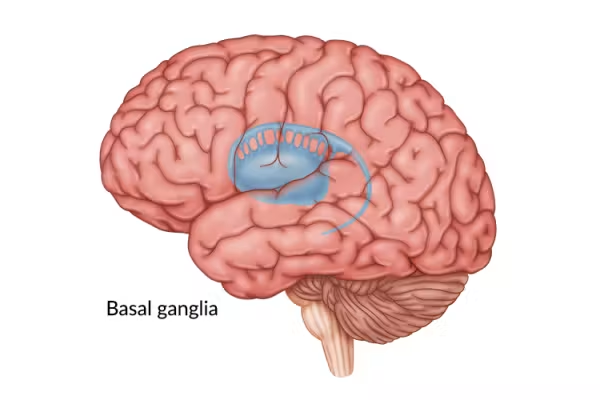
(Source: FlintRehab)
The basal ganglia is an evolutionarily ancient structure deep in the brain responsible for procedural memory and automatized behaviors (habits).
When you repeat an action or a thought pattern enough times, the neural sequence is handed off from the energy-hungry prefrontal cortex to the basal ganglia. It becomes a macro script. Driving a car, typing on a keyboard, or reacting defensively to criticism all live here.
Once a pathway is deeply myelinated, wrapped in a fatty sheath that speeds up electrical impulses like insulation around a copper wire, it becomes the path of least resistance.
How to Dismantle an Old Neural Loop
You cannot simply “erase” an old neural circuit. Neurons that fire together wire together, and once wired, those structural connections remain dormant even if unused.
Instead, neuroscience gives us three powerful strategies for unlearning:
- Active Interference (Hebbian Learning): To weaken an old pathway, you must actively interrupt it. When the trigger occurs and the old habit loop begins to fire, you insert a new behavioral response. Over time, the new loop competes with the old one, and through synaptic pruning, the unused old pathway weakens due to lack of activation.
- The Power of Awareness (Mindful Interruption): Because adults possess metacognition, you can observe your own mind mid-loop. Simply bringing conscious awareness to an automatic reaction floods the prefrontal cortex with blood flow, temporarily overriding the basal ganglia’s automated script.
- Extinction Training: In behavioral neuroscience, extinction doesn’t mean forgetting; it means building a new inhibitor circuit that overrides the old response. You teach your amygdala and basal ganglia that the old reward is no longer guaranteed or satisfying.
A Step-by-Step Blueprint for Accelerated Learning After 25
Knowing that neuroplasticity is possible is empowering; having a tactical framework to harness it is transformative. Here is how to structure your learning and habit changes based on contemporary neuroscience:
Step 1: Design for Micro-Bouts of Hyper-Focus
Adults often try to sit down for a 4-hour study marathon, only to get distracted by notifications, fatigue, and cognitive overload. The brain cannot maintain the high levels of acetylcholine required for structural plasticity for hours on end.
- The Protocol: Aim for 20 to 90 minutes of absolute, zero-distraction focus. Put your phone in another room. Close all browser tabs except the one you need. Treat this window as sacred biological time.
Step 2: Embrace “Error-Driven” Learning
If learning feels smooth and easy, your brain is likely running on existing automated pathways. True neuroplasticity is triggered by friction and error.
- The Protocol: Frustration is not a sign that you should quit; it is the biological cue that your brain is releasing acetylcholine and recognizing that its current model is broken. Lean into difficult problems, test yourself before you feel ready, and welcome mistakes.
Step 3: Leverage Consolidated Rest
Here is the most counterintuitive rule of neuroscience: You do not grow brain connections while you are studying; you grow them when you sleep and rest. During focused learning, you mark the pages. During deep sleep (specifically slow-wave sleep) and non-sleep deep rest (NSDR), the brain replays neural firing patterns at up to 20 times normal speed, physically building the protein structures required for long-term potentiation (LTP).
- The Protocol: Ensure 7–9 hours of quality sleep. If you have an intense learning session during the day, take a 15-to-20-minute quiet walk without audio or a non-sleep deep rest protocol to let your nervous system consolidate the data.
Step 4: Use Spaced Repetition and Interleaving
Cramming creates temporary accessibility, not structural wiring.
- The Protocol: Revisit material at expanding intervals (1 day, 3 days, 1 week, 1 month). Additionally, practice interleaving, mixing up different types of problems or skills within a single session rather than blocking identical tasks. This forces your brain to constantly reconstruct pathways rather than relying on short-term muscle memory.
Contemplating on Life
Similar to how metacognition helps in rewiring and neuroplasticity in adults, one must contemplate about the scale of this universe and the purpose of our human life.
The entropy of this universe is very high and it’s no coincidence for life to be blooming on a small little planet like ours. We’ve been narrated many stories by past philosophers, some of which were convincing but didn’t complete the full picture.
This is where Sant Rampal Ji Maharaj steps in, he unravels the truth behind the creation of this universe through evidence from our very own scriptures!
Frequently Asked Questions (FAQ)
1. Can you still rewire your brain after age 25?
Yes. While passive learning slows down as the prefrontal cortex matures around age 25, adult neuroplasticity remains active throughout your life. Adults can physically alter brain pathways through focused attention, repeated effort, and adequate sleep.
2. How long does neuroplasticity take to form a new habit?
Structural neural changes begin immediately, but establishing automatic habit pathways typically takes anywhere from 18 to 254 days (with an average of 66 days), depending on task complexity and consistency.
3. What triggers neuroplasticity in adults?
Adult neuroplasticity requires specific chemical signals: acetylcholine (released during high focus and friction/error) and dopamine (triggered by motivation and novelty). Sleep and rest then consolidate these physical connection changes.
4. How do you erase an old neural pathway?
You cannot physically erase an existing neural circuit. Instead, you weaken it through synaptic pruning by repeatedly interrupting the old behavior and replacing it with a new pathway until the new path becomes the default route.
5. Why is sleep necessary for brain plasticity?
Focusing marks neural circuits during the day, but actual physical connection growth occurs during sleep. Deep sleep and non-sleep deep rest (NSDR) replay daily learning patterns at high speeds to solidify long-term memory and skill retention.