


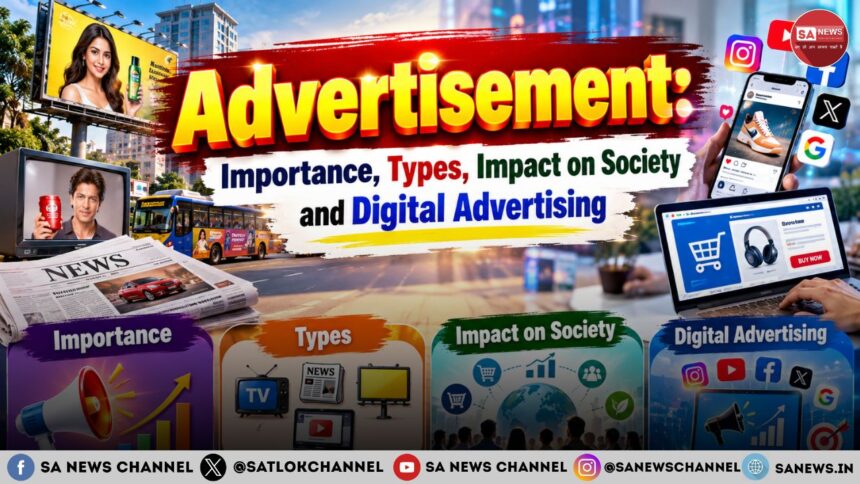
In today’s fast-changing world, advertisements have become an essential part of everyday life. From television commercials and newspaper advertisements to social media promotions and online shopping platforms, people encounter advertisements almost everywhere. Whether someone watches a television programme, reads a newspaper, travels on a road, uses a smartphone or browses the internet, advertising has become an unavoidable part of the modern information and communication system.
- What Is Advertisement? Understanding Its Meaning and Purpose
- Types of Advertisements in the Modern World
- The Role of Advertising in Economic Growth
- Advertising and Consumer Behaviour
- The Impact of Advertising on Children and Young People
- Misleading Advertisements: A Growing Consumer Concern
- Advertising in the Agricultural Sector
- Advertising as a Tool for Social Awareness
- The Role of Artificial Intelligence in Advertising
- Advertising and Privacy in the Digital Age
- Government Regulations and Consumer Protection in India
- Challenges Faced by the Advertising Industry
- The Future of Advertising
- Role of Sant Rampal Ji Maharaj in Using Advertising for Social Awareness and Humanitarian Service
- Don’t Forget to Watch Sant Rampal Ji Maharaj’s Spiritual Programmes
- Final Thoughts: Responsible Advertising Is Essential for Society
- FAQs
Advertisement is one of the most powerful tools used by businesses, organisations and institutions to communicate information about their products, services, ideas and activities. It helps companies introduce new products, inform customers about available services and encourage people to make purchasing decisions. At the same time, advertisements also play an important role in public awareness campaigns related to health, education, road safety, environmental protection and social welfare.
With the rapid development of technology, the advertising industry has undergone a significant transformation. Traditional methods of advertising, such as newspapers, magazines, radio and television, continue to remain relevant. However, digital platforms have created new opportunities for advertisers to reach large audiences within a short period.
Today, businesses can promote their products through websites, search engines, mobile applications, social media platforms and online videos. Even small businesses can reach potential customers without investing the enormous amounts of money that large-scale advertising campaigns may require.
However, the growing influence of advertising has also raised important questions about consumer protection, misleading claims, privacy, excessive commercialisation and the impact of advertisements on children and young people.
Therefore, understanding the importance, benefits, challenges and responsibilities associated with advertising has become increasingly necessary in modern society.
What Is Advertisement? Understanding Its Meaning and Purpose
Advertisement refers to a form of communication used to inform, persuade or remind people about a product, service, brand, organisation, event or idea. It is generally created by businesses, government departments, non-governmental organisations and other institutions to reach a specific audience.
The primary purpose of commercial advertising is to attract potential customers and encourage them to purchase a product or service. For example, a company manufacturing agricultural equipment may advertise its machinery to farmers, while an educational institution may promote its courses to students seeking higher education.
Similarly, government departments may use advertisements to communicate information about public welfare schemes, vaccination programmes, sanitation, road safety and environmental conservation.
Advertising is different from ordinary communication because it is usually designed with a specific objective and target audience in mind. Advertisers carefully select the message, language, images, colours and communication platforms they believe will attract the attention of their intended audience.
An effective advertisement generally communicates three important things: what is being offered, why it may be useful to the audience and how interested people can obtain further information.
However, advertisements should not merely attract attention. They should also provide accurate information and avoid making claims that could mislead consumers.
Types of Advertisements in the Modern World
Advertising has developed into a diverse industry with several different forms. Each type has its own characteristics, advantages and limitations.
1. Print Advertising
Print advertising is one of the oldest forms of commercial promotion. It includes advertisements published in newspapers, magazines, brochures, pamphlets, leaflets and other printed materials.
Newspapers remain an important advertising medium because they can reach readers across different age groups, professions and geographical regions.
Businesses often publish advertisements in newspapers to announce new products, promote sales, advertise employment opportunities or inform people about upcoming events.
For example, an agricultural equipment company may publish an advertisement explaining the features of a new tractor. Similarly, a college may advertise its admission process, available courses and scholarship opportunities.
Print advertising can be particularly useful when businesses want to reach readers who prefer printed information.
However, its effectiveness depends on factors such as circulation, publication frequency, advertisement placement and the interests of the intended audience.
2. Television Advertising
Television advertising combines visuals, sound, dialogue, music and storytelling to communicate messages to viewers.
It has traditionally been one of the most influential forms of advertising because it can present products and services in an engaging and memorable manner.
Companies selling food products, household appliances, automobiles, personal care products and consumer electronics frequently use television commercials to introduce their brands and highlight product features.
Television advertisements can also support public awareness campaigns. Messages about disease prevention, cleanliness, women’s education and road safety can reach a large audience through televised campaigns.
However, producing and broadcasting television advertisements can be expensive. Consequently, smaller businesses may find it difficult to compete with companies that have larger advertising budgets.
3. Radio Advertising
Radio advertising uses spoken messages, music, sound effects and short promotional announcements to communicate with listeners.
Despite the growth of digital media, radio remains useful for reaching audiences during travel, work and daily activities.
Local businesses can use radio advertisements to promote restaurants, retail stores, educational institutions, agricultural products and community events.
Radio advertising is particularly valuable for communicating messages in regional languages. This allows businesses and public institutions to reach people who may not regularly use digital platforms.
For instance, an agricultural department may use local radio programmes to inform farmers about crop protection practices, weather-related precautions and agricultural training opportunities.
4. Outdoor Advertising
Outdoor advertising includes billboards, banners, posters, wall advertisements, digital display boards and promotional materials displayed in public places.
These advertisements are commonly found near markets, highways, railway stations, bus stands, shopping centres and commercial areas.
Outdoor advertisements can create repeated exposure because people may encounter the same message during their daily journeys.
A large billboard promoting a newly launched vehicle, for example, can attract the attention of commuters and pedestrians.
However, outdoor advertisements must be placed responsibly. Excessive advertising can create visual clutter, while improperly installed structures may create safety risks.
Local regulations and permissions are important considerations when installing outdoor advertising materials.
5. Digital Advertising
Digital advertising has become one of the fastest-evolving segments of the advertising industry.
It involves promoting products, services and ideas through internet-based platforms, including websites, search engines, mobile applications, social media networks and online video services.
Businesses can use digital advertising to reach audiences based on factors such as location, interests, search activity and general demographic characteristics, subject to applicable privacy rules and platform policies.
For example, an online clothing store may display advertisements to people interested in fashion, while an educational institution may promote admission information to students searching for particular courses.
Digital advertising also enables businesses to measure certain aspects of campaign performance, including clicks, impressions, enquiries and purchases.
Nevertheless, advertisers must respect users’ privacy and avoid deceptive practices, intrusive targeting and unauthorised use of personal information.
6. Social Media Advertising
Social media advertising is a major component of digital marketing.
Platforms such as Instagram, Facebook, YouTube and other social networks allow businesses to promote products through photographs, short videos, stories, sponsored posts and longer promotional content.
Social media has also created opportunities for small businesses, local entrepreneurs and independent creators to reach audiences beyond their immediate geographical areas.
For example, a local farmer selling organic produce may use social media to inform customers about available products, while a small clothing business may showcase its latest collection through short videos.
Influencers and content creators also participate in advertising by promoting products to their followers. However, paid partnerships and sponsored content should be clearly disclosed so that audiences can distinguish advertisements from independent opinions.
The Role of Advertising in Economic Growth
Advertising contributes to economic activity by connecting businesses with potential customers.
When a company launches a new product, it must communicate information about that product to people who may benefit from it. Advertising helps create this awareness and can encourage customers to explore the available options.
As demand increases, businesses may expand production, improve distribution and invest in additional resources.
Advertising can also help new businesses compete in the marketplace. Entrepreneurs who offer useful products or services need ways to introduce their offerings to consumers. Affordable digital advertising can help them reach potential customers without depending entirely on traditional promotional methods.
Another important contribution is the support advertising provides to media organisations.
Newspapers, magazines, television channels, radio stations and digital publishers may generate revenue through advertising. This revenue can help fund journalism, entertainment, educational content and other services.
However, dependence on advertising revenue can also create challenges for media independence. Media organisations must maintain editorial integrity and ensure that commercial interests do not improperly influence news reporting.
Advertising can contribute positively to economic growth, but its benefits depend on fair competition, truthful communication and responsible business practices.
Advertising and Consumer Behaviour
Advertising can significantly influence how consumers discover, compare and evaluate products.
An advertisement may introduce a product that a consumer did not previously know existed. It may also explain its features, price, intended use or availability.
For example, a farmer searching for improved irrigation equipment may discover a new water-saving technology through an advertisement. The information could encourage the farmer to investigate whether the product is suitable for local conditions.
Similarly, a student may learn about an educational course, scholarship programme or training opportunity through an advertisement.
However, advertisements can also influence consumers emotionally. Images of attractive lifestyles, celebrity endorsements, music and persuasive slogans may create positive associations with particular brands.
Sometimes, consumers may purchase products because of social pressure or emotional attraction rather than actual need.
This is particularly concerning when advertisements encourage unnecessary spending, promote unrealistic beauty standards or exaggerate the benefits of a product.
Consumers should therefore compare prices, examine product specifications, read independent reviews where available and verify important claims before making purchasing decisions.
Responsible advertising should help consumers make informed choices rather than pressure them into unnecessary purchases.
The Impact of Advertising on Children and Young People
Children and young people are an important audience for many advertising campaigns. They encounter advertisements while watching videos, playing online games, browsing websites and using social media.
Advertising can have educational benefits when it communicates age-appropriate information about healthy habits, personal safety, environmental protection and educational opportunities.
However, young audiences may not always recognise the persuasive purpose of advertisements, particularly when promotional messages are presented as entertainment.
Advertisements for sugary foods, expensive toys, gaming products and other consumer goods can influence children’s preferences and purchasing requests.
Young people may also experience pressure to purchase fashionable products, expensive gadgets or branded clothing to fit in with their peers.
Influencer marketing presents an additional challenge because children may interpret promotional content as a personal recommendation rather than paid advertising.
Parents, educators, advertisers and digital platforms all have a role in improving advertising literacy.
Children should be encouraged to ask questions about advertisements, understand the difference between needs and wants, and recognise that attractive promotional messages do not necessarily guarantee product quality.
Advertisers should also follow applicable laws and platform rules designed to protect children from inappropriate or misleading commercial content.
Misleading Advertisements: A Growing Consumer Concern
Although advertising provides many benefits, misleading advertisements remain an important concern.
A misleading advertisement may contain false information, exaggerated claims, incomplete disclosures or presentations that create an incorrect impression about a product or service.
For example, an advertisement may promise unusually rapid weight loss without reliable scientific evidence. Another may claim that a particular product guarantees success in examinations, employment or financial investments.
Consumers may suffer financial losses when they rely on such claims.
Misleading advertisements involving healthcare products, educational services, financial schemes and investment opportunities can be particularly harmful because consumers may make important decisions based on the information presented.
Some advertisements also use fabricated testimonials, manipulated images or undisclosed paid endorsements to create an appearance of credibility.
In online environments, fraudulent advertisers may imitate the branding of established companies or use fake websites to deceive consumers.
Consumers should be cautious when an advertisement promises guaranteed results, demands immediate payment, offers unusually high financial returns or discourages independent verification.
Businesses must ensure that their advertising claims are accurate, adequately supported and presented in a manner that does not mislead the public.
Consumer awareness, effective regulation and accessible complaint mechanisms are essential for addressing these problems.
Advertising in the Agricultural Sector
Advertising is not limited to urban businesses and consumer goods. It also has an important role in agriculture.
Farmers need reliable information about seeds, fertilisers, irrigation systems, agricultural machinery, crop protection products and modern farming technologies.
Agricultural companies may use advertisements to introduce new products and explain their intended uses.
Government departments and agricultural institutions can also use promotional campaigns to inform farmers about training programmes, soil testing facilities, crop insurance, agricultural schemes and improved farming practices.
For example, an advertisement about a soil testing service may encourage farmers to assess the nutrient status of their fields before applying fertilisers.
Similarly, information about water-efficient irrigation methods may help farmers explore ways to use available water resources more effectively.
However, agricultural advertising requires particular care because misleading claims can directly affect farmers’ incomes and crop production.
Advertisements should not promise guaranteed yields without considering factors such as soil conditions, climate, crop variety, water availability and farming practices.
Farmers should verify product quality, recommended dosage, official approvals and suitability for their crops before purchasing agricultural inputs.
Agricultural universities, Krishi Vigyan Kendras and authorised agricultural experts can help farmers assess product claims and obtain reliable technical information.
Responsible agricultural advertising can support awareness and innovation, provided that farmers receive accurate and practical information.
Advertising as a Tool for Social Awareness
Advertising can serve purposes beyond commercial profit.
Government agencies, educational institutions, charitable organisations and public service bodies frequently use advertisements to communicate messages related to social development.
Public awareness campaigns may address road safety, sanitation, vaccination, women’s education, environmental conservation, water protection and the prevention of harmful practices.
For example, an advertisement encouraging people to wear helmets can communicate the importance of road safety.
Similarly, campaigns promoting handwashing, safe drinking water and cleanliness can help people understand practical ways to protect public health.
Advertisements encouraging girls’ education can challenge harmful stereotypes and highlight the importance of equal educational opportunities.
Environmental campaigns may encourage people to reduce plastic waste, conserve electricity, plant trees and use water responsibly.
The effectiveness of such advertisements depends on the accuracy of the information, the suitability of the message for the target audience and the availability of practical ways to act on the message.
Public awareness advertising can contribute to positive social change when it is supported by reliable information and meaningful action.
The Influence of Advertising on News and Media
Advertising and journalism have a close relationship in the modern media industry.
Many newspapers, television channels, magazines and digital news websites depend partly on advertising revenue to support their operations.
Advertising can help media organisations cover reporting costs, maintain distribution networks, employ journalists and provide information to the public.
However, this relationship also creates the possibility of conflicts of interest.
For example, a business that spends substantial amounts on advertising may expect favourable treatment from a media organisation. If editorial decisions are influenced by such expectations, the independence of journalism may be weakened.
Another concern is the growing popularity of sponsored articles that resemble ordinary news reports.
When paid promotional content is presented without clear identification, readers may mistakenly believe that the article represents independent journalism.
This practice can undermine public trust in news organisations.
Media outlets should clearly distinguish advertisements, sponsored content, opinion pieces and independent news reporting.
Journalists should make editorial decisions based on evidence, public interest and professional standards rather than commercial pressure.
Transparent disclosure of paid content is essential to protecting the credibility of journalism.
The public has a right to know whether a piece of content is independent reporting or paid promotion.
The Role of Artificial Intelligence in Advertising
Artificial intelligence is changing how advertising campaigns are developed, delivered and evaluated.
AI-powered tools can help advertisers analyse broad patterns in consumer behaviour, generate promotional drafts, create visual material and identify audiences likely to be interested in particular products.
Businesses can use these tools to experiment with different advertising messages and produce content more efficiently.
For example, a small business may use AI-assisted tools to develop promotional text in several languages or create draft designs for a new product.
AI can also help advertisers organise campaign data and evaluate performance.
However, the use of artificial intelligence introduces new risks.
AI-generated images may misrepresent products, while synthetic voices and fabricated videos may create false impressions of endorsements or events.
Automated systems can also reproduce biases present in their training data or use personal information in ways that raise privacy concerns.
Consumers may find it difficult to distinguish genuine product demonstrations from artificially generated promotional content.
Businesses should therefore verify AI-generated advertising material before publication, disclose relevant synthetic or sponsored content where required, and ensure that advertising claims remain truthful.
Technology can make advertising more efficient, but it does not remove the responsibility to communicate honestly.
Advertising and Privacy in the Digital Age
Online advertising often relies on information about users’ interests, browsing activity and interactions with digital services.
This information can help advertisers show more relevant advertisements. However, the collection and use of personal data can raise serious privacy concerns.
Consumers may not always understand what information is being collected, how it is used or which organisations receive access to it.
Some forms of advertising may also rely on intrusive tracking or poorly explained consent mechanisms.
Businesses and advertising platforms should follow applicable privacy laws, provide clear information about data practices and respect users’ choices.
They should avoid collecting unnecessary personal information and implement appropriate security measures to protect the data they process.
Consumers can also take steps to protect their privacy by reviewing application permissions, checking advertising preferences and being cautious about sharing personal information with unfamiliar websites.
A trustworthy digital advertising system requires transparency, appropriate safeguards and respect for individual rights.
Government Regulations and Consumer Protection in India
In India, advertising operates within a legal and regulatory framework intended to protect consumers and promote responsible commercial communication.
The Consumer Protection Act, 2019, provides an important foundation for addressing misleading advertisements and unfair trade practices.
The Central Consumer Protection Authority, established under this framework, has powers relating to consumer rights and misleading advertisements, subject to the provisions of the law.
The government has also issued the Guidelines for Prevention of Misleading Advertisements and Endorsements for Misleading Advertisements, 2022, which address various aspects of truthful advertising and endorsements.
These guidelines are intended to discourage deceptive promotional practices and improve accountability.
The Advertising Standards Council of India (ASCI), a self-regulatory industry body, also publishes advertising standards and considers complaints about advertisements within its self-regulatory framework.
These mechanisms are particularly relevant when advertisements contain unsupported claims, conceal important conditions or create misleading impressions.
For example, an advertisement promoting a financial opportunity should not create unrealistic expectations about guaranteed profits. Similarly, advertisements for health-related products should not make unsupported claims about treatment or guaranteed medical outcomes.
Consumers who encounter potentially misleading advertisements can preserve screenshots, invoices, links and other relevant evidence.
Depending on the circumstances, they may seek assistance through the appropriate consumer grievance mechanism or regulatory authority.
Effective consumer protection requires not only regulations but also public awareness, responsible business conduct and timely enforcement.
Challenges Faced by the Advertising Industry
Despite its growth, the advertising industry faces several challenges.
One major challenge is intense competition. Businesses operating in crowded markets must find ways to communicate their products’ distinctive features without making exaggerated claims.
Another challenge is consumer scepticism. People who repeatedly encounter misleading promotions may become less willing to trust advertising, including advertisements from legitimate businesses.
Digital advertising also faces difficulties related to fake engagement, automated traffic, fraudulent clicks and misleading performance metrics.
In addition, advertising costs can change considerably depending on competition, audience demand and the platform used.
Privacy expectations and changing regulations require businesses to review their advertising practices regularly.
The industry must also address concerns about environmental impact, unrealistic social representations and excessive consumption.
To overcome these challenges, advertisers should prioritise accuracy, transparency, creative communication and long-term consumer trust.
Companies that build their reputation through honest communication are more likely to establish sustainable relationships with their customers than businesses that depend on misleading promises.
The Future of Advertising
The future of advertising is likely to be shaped by technological innovation, changing consumer expectations and stronger demands for transparency.
Artificial intelligence may make it easier to develop personalised advertisements and analyse campaign performance.
Interactive advertisements may allow consumers to explore product features, compare specifications and obtain additional information directly from promotional content.
Short-form videos and creator partnerships are also likely to remain important parts of digital marketing.
At the same time, consumers may increasingly expect brands to demonstrate authenticity, social responsibility and environmental awareness.
Businesses will need to balance personalisation with privacy protection and technological efficiency with human judgement.
Advertising in regional languages may also create opportunities to reach audiences who prefer information in their own languages.
For India, where consumers have diverse linguistic, cultural and economic backgrounds, accessible and culturally appropriate advertising can be particularly valuable.
However, technological advancement alone will not guarantee a trustworthy advertising environment.
The future success of advertising will depend on whether businesses can combine innovation with honesty, accountability and respect for consumers.
Role of Sant Rampal Ji Maharaj in Using Advertising for Social Awareness and Humanitarian Service
In the modern era, advertising and digital media have become powerful tools for spreading information and raising public awareness. Beyond promoting commercial products and services, these platforms can also be used to communicate messages of humanity, compassion, and social welfare. In this context, the social welfare initiatives associated with Sant Rampal Ji Maharaj provide an example of how media and communication can help bring attention to humanitarian activities. Through initiatives such as the Annapurna Muhim, Shuddh Peyjal Seva Abhiyan, and assistance to farmers, information about social service activities can be shared with the public through newspapers, websites, and social media platforms.
The Shuddh Peyjal Seva Abhiyan focuses on addressing drinking water-related challenges, while farmer assistance initiatives aim to support farmers facing agricultural difficulties. By presenting verified information, authentic accounts, and factual details about such activities, digital advertising and media coverage can help increase public awareness and encourage people to learn about social welfare initiatives.
This demonstrates that advertising is not limited to commercial promotion; when used ethically and responsibly, it can also serve as a medium for social awareness, humanitarian communication, and the dissemination of information about community welfare. Thus, the connection between advertising and the social welfare initiatives associated with Sant Rampal Ji Maharaj highlights the broader potential of communication in promoting awareness and drawing public attention to issues affecting society.
Don’t Forget to Watch Sant Rampal Ji Maharaj’s Spiritual Programmes
To learn more about spiritual knowledge, scriptural discussions, and the teachings of Sant Rampal Ji Maharaj, viewers can watch his spiritual programmes on Sadhna TV. Sant Rampal Ji Maharaj’s Mangal Pravachan is broadcast daily from 7:30 PM to 8:30 PM. Additionally, since 3 October, the programme “Shastrarth Ka Shankhnaad”, a spiritual knowledge discussion and debate programme, has been scheduled every Saturday and Sunday from 7:30 PM to 9:30 PM on Sadhna TV. Sant Rampal Ji Maharaj has also announced a reward of ₹50 lakh for anyone who can demonstrate, with evidence from the scriptures, that His spiritual knowledge is incorrect. These programmes provide viewers with an opportunity to listen to spiritual discussions, explore scriptural interpretations, and learn more about the ideas presented by Sant Rampal Ji Maharaj. So, don’t forget to watch Sant Rampal Ji Maharaj’s Mangal Pravachan and “Shastrarth Ka Shankhnaad” on Sadhna TV and explore the world of spiritual knowledge.
Also, don’t forget to read the spiritual books Gyan Ganga and Way of Living by Sant Rampal Ji Maharaj to explore spiritual knowledge and understand the purpose of human life.
Final Thoughts: Responsible Advertising Is Essential for Society
Advertising has become an influential part of modern economic, social and digital life. It helps businesses introduce products, enables consumers to discover services, supports media organisations and contributes to public awareness campaigns.
From traditional newspaper advertisements to AI-assisted digital promotions, the industry continues to evolve as technology and consumer behaviour change.
When used responsibly, advertising can provide useful information, support entrepreneurship, encourage innovation and help communicate important social messages.
However, misleading claims, undisclosed sponsorships, privacy violations and manipulative marketing can damage consumers and weaken public trust.
The responsibility for addressing these concerns is shared by advertisers, businesses, media organisations, regulators, digital platforms and consumers.
Businesses must ensure that their advertisements are truthful and transparent. Media organisations should protect editorial independence and clearly identify paid content. Regulators should enforce applicable consumer protection rules, while consumers should evaluate promotional claims carefully.
Ultimately, advertising should do more than attract attention or increase sales. It should help people make informed decisions by presenting information honestly and responsibly.
A healthy advertising industry is one that balances commercial success with consumer rights, ethical communication and social responsibility.
As advertising continues to influence how people shop, learn and interact with the world, truthfulness and transparency must remain at the heart of every successful advertising campaign.
FAQs
Q1. What is an advertisement?
An advertisement is a form of communication used to inform, persuade or remind people about a product, service, organisation, event or idea.
Q2. What are the main types of advertising?
The main types include print advertising, television advertising, radio advertising, outdoor advertising, digital advertising and social media advertising.
Q3. Why is advertising important for businesses?
Advertising helps businesses reach potential customers, introduce products, communicate useful information, build brand awareness and compete in the marketplace.
Q4. What is misleading advertising?
Misleading advertising involves false, deceptive or inadequately substantiated claims that may create an incorrect impression about a product, service or offer.
Q5. How does digital advertising benefit small businesses?
Digital advertising allows small businesses to promote their products online, reach potential customers and evaluate campaign performance, often with flexible budgets.
Q6. How does advertising influence consumers?
Advertising can influence consumer awareness, preferences and purchasing decisions by presenting information, highlighting product features and creating associations with brands.
Q7. Which Indian law addresses misleading advertisements?
The Consumer Protection Act, 2019, provides a legal framework for addressing misleading advertisements and unfair trade practices in India.
Q8. What is the future of advertising?
The future of advertising is expected to involve greater use of artificial intelligence, interactive content, digital platforms, personalisation and more emphasis on privacy and transparency.