

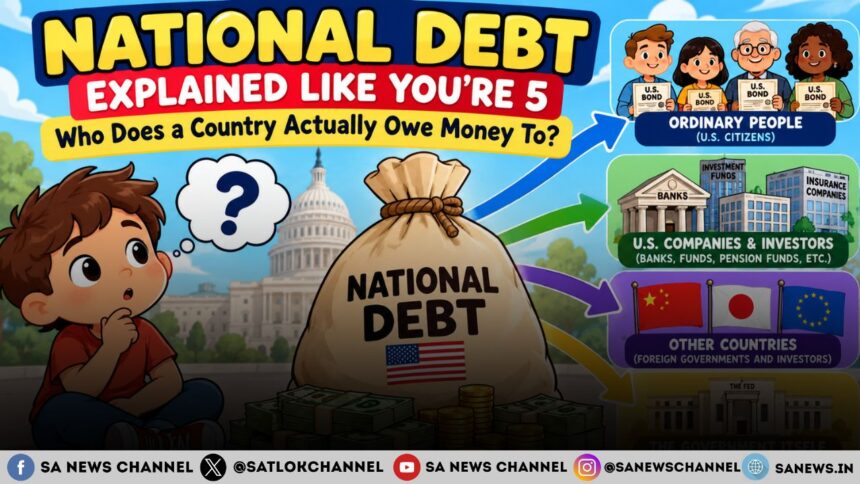
If governments can print the money we use, why do governments borrow at all? And if almost every country is in debt then who owns the actual money? Is it not possible to just print more money and clear off the debt? Let’s uncover this strange mystery of national debt in the simplest language possible.
- What Is National Debt? Explained Like You’re 5
- Why Does National Debt Matter?
- Why Do Governments Borrow Money?
- Who Actually Lends Money to a Country?
- How Does a Government Actually Borrow Money?
- If Governments Can Print Money, Why Do They Borrow?
- Who Pays Back National Debt?
- Can a Country Ever Go Bankrupt?
- Is National Debt Always a Bad Thing?
- National Debt in the Real World: India, Japan and the United States
- If Everyone Is in Debt, Where Does All the Money Really Go?
- Does a Country Ever Have to Become Completely Debt-Free?
- The Greatest Debt of All: Can We Ever Be Truly Debt-Free?
- FAQs: National Debt
What Is National Debt? Explained Like You’re 5
In this series of ELI5 (Explained Like You’re 5), we will explore national debt. It is often seen in news that countries borrow huge sums of money to finance a certain project or because they are so deep in debt that they need a helping hand.
Despite having the resources to print money, why would a government need an external financing agency such as an international bank? We will attempt to break this concept with the help of an imaginary country called Littleland.
Littleland is a small country with a few thousand people, a school, a hospital, some roads and a government.
Every year, the government collects INR 100 in taxes. It uses this money to pay teachers, maintain roads, run hospitals and provide other public services. But this year, the government budget says INR 120 is needed, whereas the government has only INR 100.
What can the government do? It borrows the remaining INR 20. That extra INR 20 becomes part of Littleland’s national debt.
Now if next year, the government needs to borrow another INR 10. If it has not repaid any of its earlier extra money borrowed, its total debt will now become INR 30.
What can we infer from this example?
- A budget deficit is the amount of money that a government does not possess for its spending when you deduct its revenue from the budget it made. This difference is its shortfall. That is why the Littleland government had to borrow INR 20 in the first place.
- National debt is the total amount the government still owes from its outstanding borrowing. This is the total outstanding it owes from all its borrowings.
On a personal level, it is also the same like every household. With each new loan, our total outstanding money we owe to the bank increases. If we repay the money, the outstanding debt will decrease.
Please bear in mind that governments and households work very differently. But the basic idea of borrowing and repayment is similar.
Why Does National Debt Matter?
The national debt of any country indirectly affects its citizens too. Lets see how:
- Suppose Littleland wants to build a new hospital.
- The hospital will cost INR 50, but the government does not have enough money available this year.
- If the government wants it can abandon this project. But, hospitals are important and if a government deems it an important project, it can borrow the money it is falling short of.
- Therefore, the government of Littleland decides to borrow the extra money it needs to build a hospital. This will add on to its national debt, however, they also plan to repay the loan over time.
- The hospital could serve thousands of people for decades. In this case, borrowing allows the country to make something useful today instead of waiting for years to save the entire amount.
Debt can become a serious burden when a government continues borrowing without planning how to meet its future financial commitments.
Just like our own families, if we keep borrowing from banks, eventually it will be difficult to pay all the loans.
How does a lot of national debt affect countries?
- The interest may increase their existing debt.
- A country pays off this interest and debt likewise from its revenue.
- This will leave less room in its budget for other priorities.
Thus, national debt matters a lot for the finance management of a country too. Borrowing can help a country grow, but poorly managed borrowing can limit its future choices.
Why Do Governments Borrow Money?
There are several reasons a government may want to borrow for. For example it could be to fund an important infrastructure project, a hospital, railways etc.
However, if there is an economic slowdown, the tax revenue will also go down. The government still needs to function, provide salaries and also provide public services.
And sometimes, unexpected events such as wars, pandemics or natural disasters require immediate spending. Just like it happened recently in Nepal.
Let us go back to Littleland. A devastating flood damages its roads and destroys several homes. The government cannot simply tell its citizens to wait until next year’s taxes arrive. It needs to act immediately. Borrowing money will allow it to respond immediately in such a challenging situation.
This is one reason national debt is not automatically a sign of economic failure.
Who Actually Lends Money to a Country?
A country’s lenders may include:
- Banks
- Pension funds
- Insurance companies
- Individual investors
- Investment funds
- Foreign investors and governments
- International financial institutions
We go back to Littleland and consider this example:
Suppose the government wants to borrow INR 1,000.
A local bank lends INR 400. A pension fund lends INR 300. An insurance company lends INR 200. An individual investor lends the remaining INR 100. This totals INR 1000. But Littleland owes INR 1,000 to several different creditors, not a single entity.
A country can, therefore, owe a substantial amount of its national debt to investors and institutions within its own borders. For example, government securities in India are held by institutions such as banks, insurance companies, pension funds and other investors.
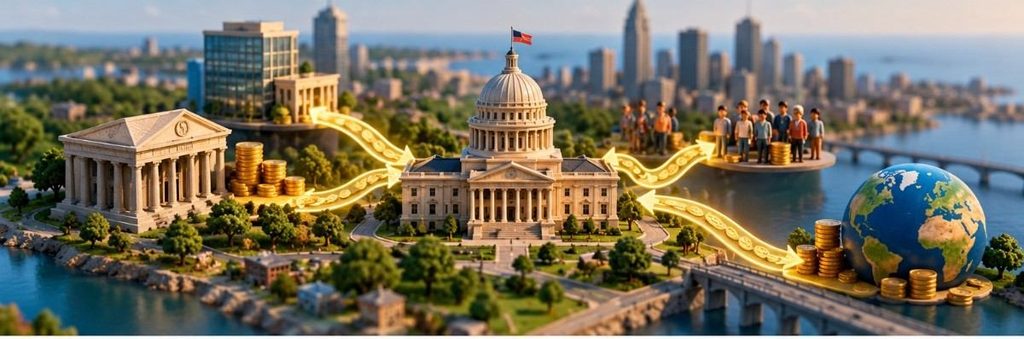
So the answer to the question ‘Who does a country owe money to?’ is often partly its own financial system.
How Does a Government Actually Borrow Money?
Let us run to Littleland now. Littleland needs INR 1,000 to build a new school.But the government does not have enough money. So it makes a public announcement:
- ‘We need INR 1,000 today. If you lend us your money, we’ll give it back after five years. And as a thank-you for lending it to us, we’ll pay you a little extra every year’.
- A bank agrees to lend INR 500. A pension fund offers INR 300 and a few ordinary citizens contribute the remaining INR 200.
- Together, they have lent the government INR 1,000.
- But how does the government keep track of who lent how much?
- It gives each lender an official promise letter stating how much money they lent, how much extra they will receive, and when they will get their original money back.
- That official promise is called a government bond.
- The extra money the government agrees to pay is called interest.
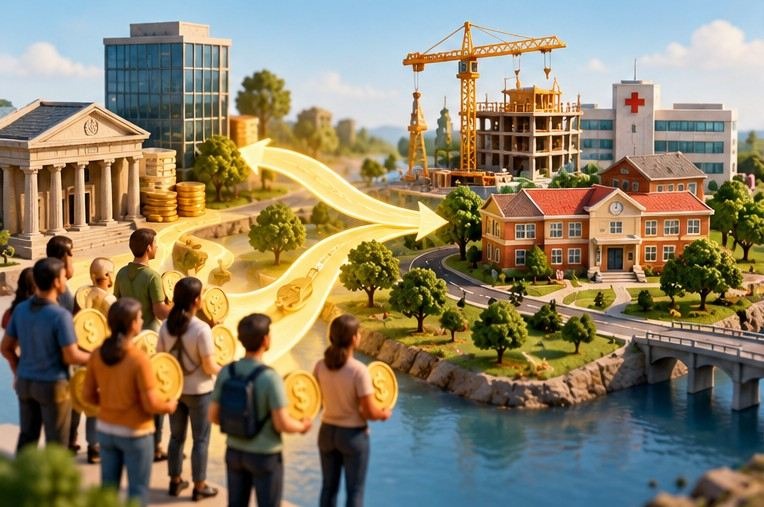
This is how government borrowing works.
In real life, governments sell these bonds through organised financial markets, where investors can also buy and sell them.
If Governments Can Print Money, Why Do They Borrow?
If a government could print all the money it owes, that would solve all the problems. But in reality the national economic dynamics is far more complicated. Let us simply understand the part we need to understand here.
If a small village in Littleland has just 10 chocolates for sale. There are 10 children in this village, and each child has INR 10. Each chocolate costs INR 10, hence everyone can buy one. But if every child has another INR 100 and the shopkeeper still has only 10 chocolates.
There are no extra chocolates, even though everyone suddenly has much more money to spend. The children are also willing to pay more to get their favourite chocolates. Therefore, the shopkeeper raises the price.
Soon, a chocolate that once cost INR 10 might cost INR 50. The children have more money, but the village does not have more chocolates. This is the problem that happens in an economy.
Printing more money does not automatically produce more food, houses, clothes or anything else people need.
When too much extra money is spent on the same limited supply of goods, prices can rise. This is called inflation.
Thus printing money is not a magical solution to a country’s financial problems. Another catch is that in many countries, governments cannot simply print unlimited money whenever they want. Central banks, such as the Reserve Bank of India, manage the supply of money under established rules.
Also, if a country owes money in another country’s currency, printing its own currency will not directly produce the foreign money it needs.
This is the reason why governments usually borrow money instead of simply printing more whenever they need it.
Who Pays Back National Debt?
We will understand this through an example again: if Littleland borrowed INR 1,000 to build a school. Five years have passed, and it is time to return the money. But where will the government get INR 1,000 from?
Remember, the government collects taxes from people and businesses. It can use some of this money to repay what it borrowed. But if the government does not have enough money available to repay the entire amount, it can borrow money again to pay back an earlier loan.
Inside Littleland now: If the country borrowed INR 1,000 from Ravi five years ago and today, Ravi wants his money back. The government can borrow INR 1,000 from Priya and use it to repay Ravi. Ravi gets his money back. He is happy now, but now the government owes Priya INR 1,000 instead.
The country is still in debt but the older debt has been paid off by its new borrowing. Governments often take new loans to repay older ones. This is called refinancing.
Can a Country Ever Go Bankrupt?
Suppose Littleland owes INR 1,000, but investors refuse to lend it more money and its available resources are insufficient to meet the payment. Littleland could face a sovereign default.
- A sovereign default occurs when a government fails to meet its debt obligations according to their agreed terms.
- Unlike an ordinary company, a sovereign country does not generally enter a standard corporate bankruptcy process.
- Instead, it may negotiate with creditors to change the repayment schedule, reduce interest obligations or restructure some of the debt.
- Such situations can seriously damage investor confidence and make future borrowing more difficult.
- They may also contribute to banking problems, economic instability and hardship for ordinary citizens.
But a country does not automatically default simply because its national debt is large. The government’s ability to service that debt matters enormously.
Is National Debt Always a Bad Thing?
It is not always a bad thing. Suppose now there are two countries, Littleland and Happyland. Both borrow INR 1,000.
Littleland uses the money to build better roads, schools and hospitals. Good roads help businesses transport goods faster. Better schools help children learn new skills. And healthier people can work and live better lives. Over time, these improvements may help Littleland’s economy grow.
Now look at Happyland. It also borrows INR 1,000. But much of the money is wasted on projects that never get completed or things that provide little benefit. Years pass by and Happyland still owes the money, along with interest.
Both countries borrowed exactly the same amount but their conditions are different because of their decisions.
Therefore, borrowing money is not necessarily bad. What matters is how the money is used and whether the country can afford to repay it.

But how do we know if a country has borrowed too much?
Let us take another example:
- Ravi earns INR 10,000 a month and owes INR 5,000.
- Priya earns INR 1,00,000 a month and owes INR 5,000.
Both owe the same amount, but the debt may be much easier for Priya to manage because she earns more.
Economists use a somewhat similar idea when comparing countries. They look at the country’s debt alongside the size of its economy. This is called the debt-to-GDP ratio.
Understand GDP deeper here.
National Debt in the Real World: India, Japan and the United States
Now we move from Littleland to real countries.
India
India’s government borrowing supports public spending and is financed through instruments including government securities and Treasury bills. A substantial portion of India’s government debt is held domestically, including by financial institutions.
This makes India’s borrowing structure different from that of a country heavily dependent on foreign-currency loans.
Japan
Japan is frequently discussed because its government debt is very high relative to the size of its economy. Yet Japan has historically maintained access to financing under conditions shaped by its domestic investor base, monetary system and other economic characteristics.
Its experience illustrates why debt figures must be interpreted in context rather than judged by size alone.
United States
The United States finances government borrowing through Treasury securities held by a wide range of investors, including domestic institutions, individuals, foreign investors and government-related accounts.
Because US Treasury securities play a major role in global finance, American government debt is closely connected to international financial markets.
These three examples reveal that countries can have very different debt structures, economic conditions and borrowing risks.
Simply comparing the amount they owe does not tell us which country’s finances are healthiest.
If Everyone Is in Debt, Where Does All the Money Really Go?
We have finally reached our big question. If countries around the world owe trillions, who actually owns all that money? There is not one person, one bank or one country sitting on a giant mountain of money.
- Instead, money moves through a huge network of people, banks, businesses, investors and governments.
- Different people and institutions own different financial assets.
- There is no single owner of all the money, and there doesn’t need to be one.
This is why people are always confused by national debt. Governments can owe money to institutions that manage ordinary people’s savings, while the same money continues circulating through the economy.
Does a Country Ever Have to Become Completely Debt-Free?
We will return to Littleland one final time. Its government borrowed money to build a hospital. Years later, the hospital is serving patients, the economy has expanded, and the government continues collecting revenue. Some old bonds have been repaid. Others have been replaced with new bonds.
Littleland still has national debt. Does that automatically mean something has gone wrong? Unlike a household planning to repay its mortgage by a certain age, a government can potentially continue operating with outstanding debt indefinitely, provided it can manage its obligations sustainably.
That does not mean borrowing has no limits or consequences. It simply means being debt-free is not necessarily the primary objective of sound government financial management.
As we approach the end of this article, let us now turn our attention to a far more astonishing kind of debt – one that concerns our very existence.
Governments may never become entirely debt-free, and in many cases, they don’t even aim to be. But what if this endless cycle of borrowing and repayment holds a striking parallel to the journey of the human soul?
Every soul carries an enormous burden of karmic debt accumulated over countless births. This unseen debt binds us to the relentless cycle of birth, suffering, death and rebirth.
We worry about the debts we can count in money. We work tirelessly to repay what we owe, fearing the consequences of failing to do so. But how often do we stop to consider a far greater debt, one that has kept us bound to this mortal world for countless ages?
While we tirelessly work to free ourselves from financial obligations, we seldom realise that a far greater debt may have followed our souls through innumerable lifetimes. Unlike financial debt, this is not something we can repay with money.
Who can free us from the karmic debt that keeps us trapped in the endless cycle of life and death?
The Greatest Debt of All: Can We Ever Be Truly Debt-Free?
Jagatguru Tatvdarshi Sant Rampal Ji Maharaj reveals the only one way to eradicate the enormous karmic debt accumulated over countless lifetimes is by chanting the true mantras of salvation of Supreme God Kabir, bestowed by His chosen representative – a Tatvdarshi Sant (Complete Spiritual Saint).
Sant Rampal Ji Maharaj is that Tatvdarshi Sant of our times. He alone bestows the authentic mantras of our Creator, God Kabir, and imparts true spiritual knowledge that can guide a soul to complete salvation. The effects of this worship are so enormous that it not only cuts worldly sorrows, but also provides all materialistic benefits as a by-product of this worship whose main goal is salvation.
Just like when in Littleland, with the sudden increase in money per child they could buy more chocolates, this true worship leads to a widespread accumulation of good karma, enabling a disciple reap the benefits of both spirituality and material wealth. The real life testimonies of Sant Rampal Ji Maharaj’s disciples are a proof to the miracles of true worship bestowed by a Complete Saint.
Their experiences offer an opportunity to explore what they describe as the extraordinary effects of true worship in this video:
To understand how to free oneself from karmic debts and choose the path of complete salvation, while fulfilling earthly responsibilities, listen to the enlightening spiritual discourses of Jagatguru Tatvdarshi Sant Rampal Ji Maharaj.
- Website: www.jagatgururampalji.org
- YouTube: Sant Rampal Ji Maharaj
- Facebook: Spiritual Leader Saint Rampal Ji
- ‘X’ handle: @SaintRampalJiM
FAQs: National Debt
Q1) Who actually lends money to governments?
Answer: Governments raise borrowed funds from a wide range of lenders, including banks, financial institutions, individual investors and creditors both at home and abroad.
Q2) Is it possible for a country to eliminate its national debt entirely?
Answer: Yes, although countries can clear their outstanding debt, many continue borrowing to finance development projects and meet public expenses.