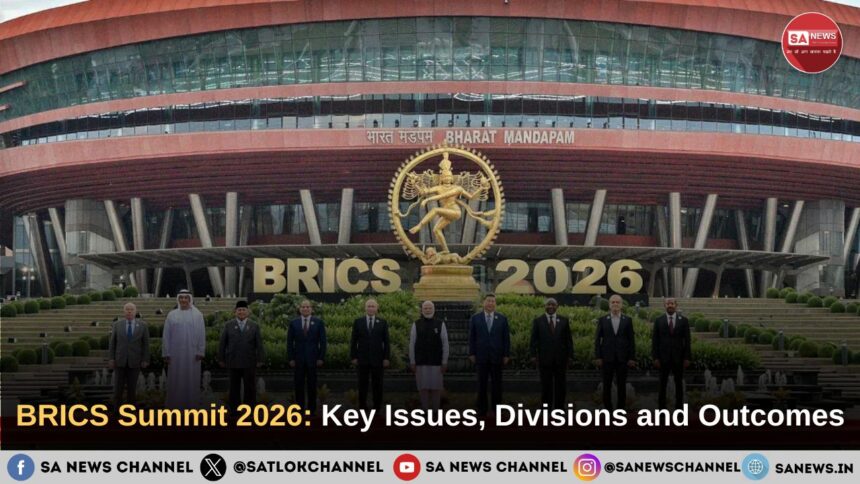
India is hosting the 18th BRICS Summit in New Delhi on September 12–13, 2026, as the expanded grouping faces wars in the Middle East and Ukraine, trade tensions, energy disruptions and internal differences. Leaders are discussing global governance, trade, energy security, artificial intelligence, cross-border payments and the role of the Global South.
- BRICS Summit 2026: Key Takeaways
- India Hosts the 18th BRICS Summit in New Delhi
- New Delhi Declaration Addresses Middle East Crisis
- Modi, Xi and Putin Hold Key Bilateral Talks
- Trade, Energy, AI and Cross-Border Payments
- Russia-Ukraine War Remains on the Agenda
- Internal Differences Test BRICS Unity
- BRICS and the Changing Global Order
- What the New Delhi Summit Signals
- A Spiritual Perspective on Global Cooperation
- FAQs on BRICS 2026 Summit 2026
BRICS Summit 2026: Key Takeaways
- India is hosting the 18th BRICS Summit in New Delhi on September 12–13, 2026.
- India’s 2026 BRICS theme is “Building for Resilience, Innovation, Cooperation and Sustainability.”
- The bloc comprises 11 countries, according to Indian government sources.
- The summit is taking place amid the US-Israel war on Iran, Russia’s war on Ukraine and global economic uncertainty.
- BRICS leaders have adopted the New Delhi Declaration, calling for maximum restraint and peaceful resolution of international disputes through dialogue, consultation and diplomacy.
- Trade, tariffs, energy security, artificial intelligence and cross-border payment mechanisms are major economic issues.
- Narendra Modi and Xi Jinping held talks on the sidelines, while Modi also met Vladimir Putin and Iranian President Masoud Pezeshkian.
- Differences among members, including Iran-UAE tensions, the Yemen conflict and India-China mistrust, continue to test the bloc’s cohesion.
India Hosts the 18th BRICS Summit in New Delhi
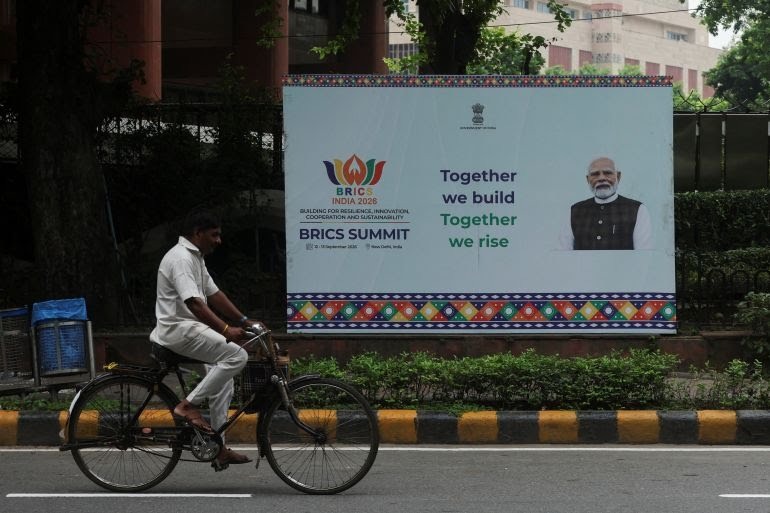
Prime Minister Narendra Modi is hosting the annual BRICS Summit in New Delhi, where more than a dozen world leaders and senior representatives of international organisations are attending. Around 30,000 additional security personnel have been deployed in the capital, while roads around hotels hosting dignitaries have been closed to traffic.
China’s President Xi Jinping is visiting India after seven years. Russian President Vladimir Putin and Iranian President Masoud Pezeshkian are also attending. United Nations Secretary-General Antonio Guterres, World Health Organization chief Tedros Adhanom Ghebreyesus and World Trade Organization Director-General Ngozi Okonjo-Iweala are among international leaders attending.
India’s BRICS presidency is guided by the theme “Building for Resilience, Innovation, Cooperation and Sustainability.” Indian government material describes BRICS as a platform covering development, finance, technology, trade and people-to-people exchanges and says the grouping represents 49.5% of the global population, 40% of global GDP and 26% of global trade.
New Delhi Declaration Addresses Middle East Crisis
One of the most closely watched issues has been the US-Israel war on Iran and the difficulty of finding common ground among BRICS members.
The New Delhi Declaration adopted on September 12 expresses serious concern over escalating violence in the Middle East and calls for maximum restraint. It stresses dialogue, consultation and diplomacy as ways to address international disputes.
The agreement is significant because Iran and the United Arab Emirates are both part of the expanded BRICS grouping, while their interests have been affected differently by the conflict. Earlier, analysts had warned that differences could make a common BRICS position difficult.
The declaration also raises concerns about unilateral tariff and non-tariff measures and their impact on international trade.
Modi, Xi and Putin Hold Key Bilateral Talks
The summit has also provided an important setting for India’s bilateral diplomacy.
Modi and Xi Jinping met on the sidelines of the summit. Xi’s visit is his first to India in seven years and comes after relations between the two countries were strained by the 2020 Himalayan border clash. Their meeting is being closely watched as India and China seek to manage differences over their contested frontier, trade and wider strategic competition.
Modi also met Putin ahead of the summit. According to India’s Prime Minister’s Office, the two leaders reviewed cooperation in political, economic, defence, energy, space, skill mobility and people-to-people areas. They also discussed India-Russia engagement in BRICS and wider regional and global issues.
Modi separately held talks with Iranian President Masoud Pezeshkian, whose visit is his first to India as Iranian president and the first visit by an Iranian president to the country in eight years.
Also Read: BRICS 2026: New Members, India’s Presidency and the Shifting Global World Order
Trade, Energy, AI and Cross-Border Payments
Economic cooperation remains central to the BRICS agenda.
The summit is focusing on strengthening member economies through trade, energy cooperation and technology, including artificial intelligence. Cross-border payment mechanisms are also being discussed amid Western sanctions affecting members such as Russia and Iran.
Russia is expected to discuss trade settlements in digital currencies with BRICS partner countries. At the same time, current reporting indicates that the bloc is considering practical alternatives and payment cooperation rather than establishing a common BRICS currency.
Energy security has become particularly important because conflicts in the Middle East have disrupted energy supplies and shipping. The New Delhi Declaration stresses stable energy markets, resilient supply chains, protection of critical energy infrastructure and cooperation on critical minerals. The declaration also calls for a just, orderly, equitable and inclusive energy transition while recognising that fossil fuels continue to play an important role, particularly for emerging and developing economies.
Russia-Ukraine War Remains on the Agenda
Russia’s war on Ukraine is another major issue confronting the grouping. BRICS leaders have discussed the conflict for several years. At the July 2025 summit in Rio de Janeiro, they avoided criticising Russia and instead condemned attacks on Russia by Kyiv.
India continues to emphasise dialogue and diplomacy as the way forward. The Ukraine conflict is particularly significant for BRICS because Russia is a member while other countries maintain different relationships with Moscow, Kyiv and Western governments.
The wider geopolitical challenge is how BRICS can address conflicts involving its own members without undermining its broader economic and diplomatic cooperation.
Internal Differences Test BRICS Unity
BRICS has expanded considerably, but the enlargement has also brought together countries with different geopolitical priorities.
Iran and UAE have sharply different interests in the Middle East conflict. Iran also has tensions with Saudi Arabia linked to the Yemen conflict, where Iran-backed Houthi forces have targeted Saudi infrastructure while Saudi Arabia supports Yemen’s internationally recognised government.
India and China continue to manage mistrust stemming from their contested border. Analysts also point to a deeper difference over the purpose of BRICS. Russia and China are more comfortable presenting BRICS as a counterweight to Western power. India has generally viewed the grouping as a platform for strategic autonomy and new partnerships that are non-Western but not necessarily anti-Western.
The challenge, therefore, is not necessarily complete political unity but whether countries with different interests can manage disagreements while continuing practical cooperation.
BRICS and the Changing Global Order
The summit is taking place as many countries seek greater influence in global institutions, alternative financing and payment channels, and greater protection from sanctions, tariffs and supply-chain disruptions. For India, the summit provides an opportunity to strengthen Global South cooperation while maintaining relationships across competing geopolitical blocs.
For Russia and China, BRICS provides a platform for wider engagement with emerging economies. For other members, it offers greater room for manoeuvre in international affairs. The New Delhi Summit therefore reflects a broader debate over whether the global order is moving towards greater multipolarity and how emerging economies can gain a stronger voice in international decision-making.
What the New Delhi Summit Signals
The 2026 BRICS Summit shows that the bloc’s expansion has increased both its international weight and the complexity of reaching common positions. The adoption of the New Delhi Declaration demonstrates that members can still reach consensus despite serious geopolitical differences. For India, the summit combines multilateral diplomacy with important engagements involving China, Russia and Iran.
BRICS is not a uniform alliance, but its continuing expansion and focus on trade, energy, technology, payments and Global South representation underline its growing relevance in a changing international system.
A Spiritual Perspective on Global Cooperation
The BRICS Summit highlights the continuing human need for dialogue, cooperation and peaceful resolution of differences.
In the spiritual perspective associated with Tatvdarshi Sant Rampal Ji Maharaj, true progress is linked with righteous conduct, compassion and spiritual knowledge. His teachings emphasise that human beings should rise above conflict and pursue peace, harmony and the welfare of all.
Visit: Sant Rampal Ji Maharaj YouTube Channel
FAQs on BRICS 2026 Summit 2026
1. Where is the BRICS Summit 2026 being held?
The 18th BRICS Summit is being held in New Delhi, India, on September 12–13, 2026.
2. What is the theme of BRICS Summit 2026?
India’s BRICS 2026 theme is “Building for Resilience, Innovation, Cooperation and Sustainability.”
3. What are the main issues at the BRICS Summit 2026?
Key issues include wars, trade, tariffs, energy security, AI, cross-border payments, global governance and Global South cooperation.
4. What is the New Delhi Declaration?
The declaration calls for maximum restraint and peaceful resolution of international disputes through dialogue, consultation and diplomacy.
5. Why is the BRICS Summit important for India?
It gives India a platform to strengthen Global South cooperation, pursue strategic autonomy and engage major powers including China, Russia and Iran.