

Illegal mosquito agarbatti products have flooded domestic markets, posing acute public health hazards and prompting law enforcement agencies to launch massive regulatory interventions across Northern India. In an unprecedented statewide enforcement drive, the Uttar Pradesh government, coordinated by the Food Safety and Drug Administration (FSDA) and the state police, has conducted massive raids targeting unlicensed manufacturers, wholesale warehouses, and retail hubs. The enforcement sweep highlights an alarming market reality: industry surveillance reports reveal that nearly 85% of mosquito repellent incense sticks sold in India operate without regulatory clearance, evading safety standards while circulating hazardous chemical compounds into millions of living rooms.
- The Scale of the Crackdown: Uttar Pradesh Targets Illicit Chemical Hubs
- What Makes an Illegal Mosquito Agarbatti So Dangerous to Human Health?
- Public Action Plan: Identifying and Avoiding Counterfeit Repellents
- The Illusion of Material Security and the Path to True Inner Sanctuary
- FAQs on Illegal Mosquito Agarbatti
Authorities initiated the crackdown following forensic laboratory reports identifying banned organophosphates and unapproved synthetic pyrethroids in widely circulated brands. For years, unscrupulous manufacturers disguised these pesticide-laced sticks as natural, herbal remedies. Today’s aggressive administrative response signals a decisive shift toward dismantling illicit chemical supply chains operating across urban and rural corridors alike.
The Scale of the Crackdown: Uttar Pradesh Targets Illicit Chemical Hubs
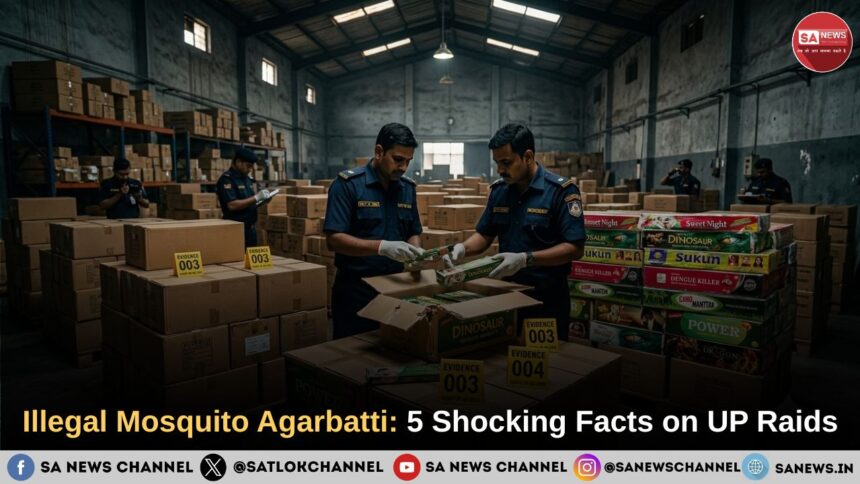
The scale of the current operation marks the largest coordinated raid against counterfeit consumer chemicals in recent history. State enforcement teams deployed simultaneous inspection units across key industrial belts, including Kanpur, Ghaziabad, Meerut, Agra, and Lucknow. Warehouses storing millions of packaged repellent sticks were sealed overnight as forensic officers collected chemical samples under the provisions of the Insecticides Act, 1968.
Popular counterfeit brands-frequently marketed under names such as Sweet Night, Green Dinosaur, Sukun, Comfort, Dengue Killer, Chhu Manttar, and Black Dragon-have captured substantial market share through low pricing and deceptive claims of herbal safety. Retailers often sell these unauthorized products at half the cost of certified repellents, exploiting low consumer awareness in semi-urban and rural markets.
Officials noted that these products evade both Central Excise surveillance and statutory environmental clearances. The manufacturing units operate primarily out of unregistered godowns, using industrial-grade dipping agents to coat raw incense sticks without precise measurement or quality control protocols
What Makes an Illegal Mosquito Agarbatti So Dangerous to Human Health?
Every legally certified mosquito repellent in India must undergo multi-tier clinical trials and obtain direct approval from the Central Insecticides Board and Registration Committee (CIBRC). Certified products predominantly utilize regulated levels of transfluthrin or parallelthrin within micro-dosed safety thresholds. Conversely, manufacturers of illegal mosquito agarbatti systematically bypass all safety assessments, substituting standard formulations with unapproved, cheap synthetic pyrethroids such as high-concentration meperfluthrin.
When an unregulated incense stick burns within an enclosed room, it releases dense particulate matter along with volatilized chemical neurotoxins. Meperfluthrin attacks the central nervous system of insects; however, unregulated human inhalation of its smoke leads to severe physiological side effects over prolonged periods.
- Pulmonary Inflammation: Constant exposure triggers reactive airway disease, bronchitis, and irreversible alveolar scarring.
- Carbon Monoxide Accumulation: Burning low-grade binder materials and sawdust releases elevated carbon monoxide levels in poorly ventilated bedrooms.
- Volatile Organic Compounds (VOCs): Laboratory testing detects high volumes of benzene, formaldehyde, and toluene in unbranded smoke residues.
- Pediatric & Geriatric Vulnerability: Infants and elderly individuals exposed to these sticks face heightened risks of severe asthmatic attacks and chronic respiratory distress.
Medical professionals consistently warn that spending an entire night in a sealed room burning a single unregulated stick equates to smoking dozens of conventional cigarettes in terms of particulate burden (PM {2.5}).
| Parameter | Certified Repellents (CIBRC Approved) | Illegal Mosquito Agarbatti |
| Active Chemical Agent | Low-dose Prallethrin / Transfluthrin | Unapproved high-strength Meperfluthrin |
| Regulatory Clearance | Mandatory CIBRC Registration Number | None / Forged Registration Labels |
| Smoke Toxicity Profile | Low-smoke formulation, tested thresholds | Dense industrial smoke with high VOCs |
| Respiratory Hazard | Minimal when used as instructed | Extreme risks of asthma, COPD, and nausea |
| Manufacturing Oversight | Audited, sterile industrial plants | Unlicensed, unventilated backyard units |
| Labeling Transparency | Complete chemical percentage disclosures | Misleading “100% Herbal” or “Organic” claims |
Regulatory Landscape: The Insecticides Act and Market Realities
The legal framework governing household pesticides remains explicit under the Ministry of Agriculture and Farmers Welfare. Selling, stocking, or manufacturing unregistered repellents constitutes a direct violation of Sections 9, 17, and 18 of the Insecticides Act, 1968. Offenders face criminal liability, mandatory product confiscation, and lengthy imprisonment.
Also Read: The Satheesan Era: Congress Ends Suspense, Names V.D. Satheesan Kerala Chief Minister
Despite statutory prohibitions, unregulated manufacturers take advantage of interstate transit loopholes. Raw unperfumed bamboo sticks (agarbatti) are legally transported across state borders under the guise of religious worship supplies. Once these sticks arrive at clandestine local blending sites, operators dip them into toxic, concentrated chemical vats before packaging them into bright, colorful boxes that mimic mainstream brands.
Distributors prioritize these illegal lines because profit margins exceed 40% to 60%, compared to the standard 10% to 15% margins offered by legally compliant consumer goods manufacturers. The resulting price distortion makes dangerous chemicals the default purchase for economically vulnerable households seeking affordable relief from vector-borne illnesses such as dengue and malaria.
Public Action Plan: Identifying and Avoiding Counterfeit Repellents
Consumers must exercise strict vigilance when purchasing mosquito protection products. Legitimate consumer packaging displays specific regulatory markers that counterfeit manufacturers cannot legally replicate.
- Check for the CIR Number: Legitimate brands clearly print a distinct CIBRC registration number (e.g., CIR-XXXXX/Year). An absence of this code indicates an unlawful formulation.
- Verify Herbal Claims with Skepticism: If a package claims to be “100% Herbal” or “Ayurvedic Mosquito Killer” yet eliminates insects within two minutes, it relies on synthetic organophosphates rather than natural plant oils. True natural repellents (such as citronella or eucalyptus) only deter insects; they do not kill them rapidly on contact.
- Inspect Smoke Quality: Excessive, foul-smelling, heavy black smoke signals low-quality charcoal powders, industrial glue, and unrefined chemical binders.
Administrative bodies urge residents to report unregistered retail distribution points directly to local municipal offices and district food safety administrators.
The Illusion of Material Security and the Path to True Inner Sanctuary
The alarming proliferation of toxic household products illustrates a broader vulnerability inherent to material life. Modern existence remains trapped in an endless cycle of compounding anxieties: societies invent remedies to protect their physical bodies from natural perils like diseases, only to discover that the very tools they rely upon introduce deadlier poisons into their living spaces. People expend immense physical, financial, and emotional energy chasing security within a temporal world, yet material peace remains elusive, constantly disrupted by administrative fraud, corporate negligence, illness, and decay.
True peace, well-being, and permanent protection cannot emerge from flawed human contrivances or worldly measures alone. Human life serves a higher metaphysical purpose that extends far beyond everyday bodily survival. In the profound spiritual discourses delivered by Sant Rampal Ji Maharaj, humanity learns that authentic shelter resides solely in sincere devotion to the Supreme Creator, God Kabir Ji. Real safety is spiritual, accessible only through pristine scriptural knowledge and enlightened devotion, rather than through temporal, fragile attachments.
Sant Rampal Ji Maharaj guides seekers away from the illusions of this impermanent world, outlining a direct, authentic spiritual path supported by universal holy scriptures. By abandoning blind spiritual practices and adopting authentic worship, human beings find true mental serenity, moral clarity, and release from the perpetual anxieties of daily survival. To understand the true science of life, spiritual protection, and supreme divine wisdom, seekers can explore comprehensive spiritual discourses on the Official YouTube Channel of Sant Rampal Ji Maharaj
FAQs on Illegal Mosquito Agarbatti
1. Why did the Uttar Pradesh government launch raids against mosquito agarbatti brands?
The UP government initiated statewide crackdowns after regulatory investigations revealed that over 85% of regional mosquito agarbattis contain unapproved, highly toxic chemicals like meperfluthrin. These unlicensed manufacturing units operate illegally without environmental or health clearances, violating the Insecticides Act of 1968.
2. What active chemical ingredients are found in an illegal mosquito agarbatti?
Unlike legally certified repellents that utilize safe, micro-dosed thresholds of prallethrin or transfluthrin, unauthorized sticks frequently contain cheap, unregulated synthetic pyrethroids such as high-potency meperfluthrin and hazardous binder materials. These chemicals emit toxic aromatic hydrocarbons when burned.
3. What health risks are associated with burning unregulated mosquito repellent sticks?
Inhaling smoke from unregulated incense sticks causes severe respiratory inflammation, aggravated asthma attacks, bronchitis, persistent headaches, and nausea. Prolonged nocturnal exposure within enclosed bedrooms exposes human lungs to fine particulate matter (PM_{2.5}) and carcinogens comparable to heavy tobacco smoking.
4. How can consumers identify if a mosquito agarbatti is illegal or fake?
Genuine repellents visibly display an official Central Insecticides Board (CIBRC) registration number, exact chemical active ingredient percentages, and manufacturer licensing information. If a product labels itself as “100% Herbal” yet knocks down mosquitoes within minutes, it almost certainly contains concealed, unapproved synthetic pesticides.
5. What legal actions are being taken against manufacturers of counterfeit repellent sticks?
Law enforcement agencies and state drug administrations are sealing unauthorized warehouses, confiscating illegal inventory, and filing criminal charges under the Insecticides Act, 1968, along with provisions of the Indian Penal Code. Convicted offenders face mandatory product forfeiture, heavy financial penalties, and rigorous imprisonment.