

Solar and lunar eclipses are among the most fascinating astronomical phenomena observed from Earth. For centuries, eclipses have attracted human attention and have often been surrounded by myths, traditions and cultural beliefs. Modern astronomy, however, explains eclipses through well-established principles of celestial mechanics, orbital motion, geometry and the interaction of sunlight with the Earth and Moon.
- What Is an Eclipse?
- How Does a Solar Eclipse Occur?
- Types of Solar Eclipses
- Why Doesn’t a Solar Eclipse Occur Every Month?
- What Is a Lunar Eclipse?
- Types of Lunar Eclipses
- Why Does the Moon Turn Red During a Lunar Eclipse?
- August 2026 Eclipse Events
- Can Eclipses Be Predicted?
- Historical astronomical observations
- Scientific Importance of Solar Eclipses
- Scientific Importance of Lunar Eclipses
- Are Solar Eclipses Dangerous?
- Is It Safe to Watch a Lunar Eclipse?
- Eclipses and Human Health: What Does Science Say?
- Eclipses and Animals
- The Role of the Moon’s Distance from Earth
- Eclipse and Climate
- Eclipse Myths Versus Scientific Facts
- Why Eclipses Matter to Modern Science
- India’s Connection with Astronomy
- Future of Eclipse Research
- Lunar Eclipse and the Spiritual Message of Sant Rampal Ji Maharaj
- Final Thoughts
- Frequently Asked Questions (FAQs)
An eclipse occurs when the Sun, Earth and Moon come into a particular alignment. Depending on the position of the three celestial bodies, either the Moon’s shadow falls on Earth, producing a solar eclipse, or Earth’s shadow falls on the Moon, producing a lunar eclipse.
The phenomenon is not mysterious from a scientific perspective. The movement of the Earth around the Sun and the Moon around the Earth follows predictable orbital patterns. Scientists can calculate eclipses many years in advance using astronomical models.
The subject has gained renewed public interest in 2026 because the year features several significant eclipses. A total solar eclipse occurred on August 12, 2026, with totality visible along a path crossing areas including Greenland, Iceland, northern Russia and Spain, while partial phases were visible across wider regions.
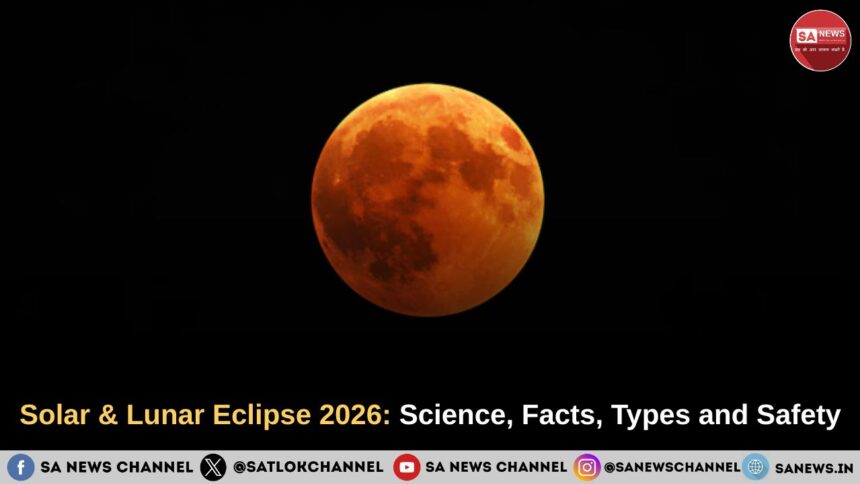
Soon afterward, a deep partial lunar eclipse occurred on August 27–28, 2026. The eclipse is described as a very deep partial lunar eclipse, with about 96.2% of the Moon’s disk entering Earth’s umbral shadow at maximum.
These events provide an excellent opportunity to understand the science behind eclipses and to distinguish astronomical facts from misconceptions.
What Is an Eclipse?
An eclipse occurs when one celestial body moves into the shadow of another or blocks light from a source.
In the Earth-Moon-Sun system, there are two major types:
- Solar Eclipse
- Lunar Eclipse
Although both involve the same three celestial bodies, the geometry is different.
During a solar eclipse, the Moon comes between the Sun and Earth. The Moon blocks some or all of the Sun’s light from reaching certain parts of Earth.
During a lunar eclipse, Earth comes between the Sun and Moon. Earth’s shadow falls on the Moon, causing the Moon to become darker or, in a total lunar eclipse, reddish in appearance.
NASA explains that a solar eclipse occurs when the Moon passes between the Sun and Earth and blocks the Sun’s bright face for observers located in the Moon’s shadow.
How Does a Solar Eclipse Occur?
A solar eclipse takes place during the new Moon phase, when the Moon is positioned approximately between the Sun and Earth.
Normally, the new Moon is not visible because the illuminated side of the Moon faces away from Earth. However, when the Sun, Moon and Earth become sufficiently aligned, the Moon can pass directly in front of the Sun.
The Moon then casts a shadow on Earth’s surface.
There are different parts of this shadow.
Umbra:
The umbra is the darkest central part of the shadow. Observers located within the appropriate path can experience a total solar eclipse.
Penumbra:
The penumbra is the outer portion of the shadow. Observers there experience a partial solar eclipse, in which only part of the Sun is covered.
NASA’s eclipse geometry explains that observers inside the umbra can experience a total eclipse, while those in the penumbra see a partial eclipse.
Types of Solar Eclipses
Solar eclipses are classified mainly into three types.
Total Solar Eclipse:
A total solar eclipse occurs when the Moon completely covers the bright disk of the Sun for observers located within the path of totality.
The sky can become dramatically darker, and the Sun’s corona becomes visible.
The August 12, 2026 total solar eclipse provided such an opportunity for observers along its path. NASA reported that the total eclipse crossed parts of Greenland, Iceland, northern Russia, the Atlantic region and Spain.
Partial Solar Eclipse:
During a partial solar eclipse, the Moon covers only part of the Sun.
Observers outside the narrow path of totality but within the penumbral region may see the Sun appear partially covered.
Annular Solar Eclipse:
An annular eclipse occurs when the Moon passes in front of the Sun but appears slightly smaller in the sky because of its varying distance from Earth.
As a result, the Moon does not completely cover the Sun’s disk. A bright ring, or “ring of fire,” remains visible around the Moon.
Why Doesn’t a Solar Eclipse Occur Every Month?
This is one of the most interesting questions in eclipse science.
A new Moon occurs approximately once every month. If the Moon passes between Earth and the Sun every month, why isn’t there a solar eclipse every month?
The answer lies in the tilt of the Moon’s orbit.
The Moon’s orbit around Earth is tilted by approximately 5 degrees relative to Earth’s orbital plane around the Sun.
Because of this inclination, the Moon generally passes slightly above or below the Sun from our viewpoint.
A solar eclipse occurs only when a new Moon happens near one of the points where the Moon’s orbit crosses the plane of Earth’s orbit.
These periods are known as eclipse seasons.
What Is a Lunar Eclipse?
A lunar eclipse occurs when Earth moves between the Sun and Moon and Earth’s shadow falls on the lunar surface.
Unlike a solar eclipse, a lunar eclipse occurs during a full Moon.
During a full Moon, the Earth is approximately positioned between the Sun and Moon. However, because the Moon’s orbit is tilted, most full Moons pass above or below Earth’s shadow.
Only when the alignment is sufficiently precise does a lunar eclipse occur.
Types of Lunar Eclipses
Lunar eclipses can be classified according to how the Moon interacts with Earth’s shadow.
Penumbral Lunar Eclipse:
A penumbral eclipse occurs when the Moon passes through Earth’s outer shadow, called the penumbra.
The Moon becomes slightly darker, but the change can be difficult to notice with the naked eye.
Partial Lunar Eclipse:
During a partial lunar eclipse, part of the Moon enters Earth’s darker central shadow, known as the umbra, while another part remains outside it.
The August 27–28, 2026 event is a partial lunar eclipse. It is a particularly deep partial eclipse, with approximately 96.2% of the Moon’s disk entering the umbra at maximum.
Total Lunar Eclipse:
A total lunar eclipse occurs when the entire Moon passes into Earth’s umbra.
The Moon can then appear red or orange, producing the popular expression “Blood Moon”.
Why Does the Moon Turn Red During a Lunar Eclipse?
The reddish colour of the Moon during a total lunar eclipse is a scientific phenomenon associated with Earth’s atmosphere.
Sunlight contains different wavelengths of visible light. As sunlight passes through Earth’s atmosphere, shorter wavelengths such as blue light are scattered more strongly.
The remaining reddish and orange light can be refracted through Earth’s atmosphere and reach the Moon.
This produces the characteristic red or copper colour during total lunar eclipses.
The same atmospheric scattering process contributes to the colours seen during sunrises and sunsets.
Therefore, the red appearance of an eclipsed Moon does not indicate anything supernatural or harmful.
August 2026 Eclipse Events
The year 2026 has been particularly interesting for skywatchers.
According to NASA’s eclipse information, a total solar eclipse occurred on August 12, 2026. Its totality path crossed regions including Greenland, Iceland, northern Russia and Spain, with partial phases visible over much wider areas.
The second major eclipse of this eclipse season is the partial lunar eclipse of August 27–28, 2026. It is visible across much of North and South America, western Europe, and Africa, with visibility depending on local time and viewing conditions.
This close sequence is not unusual. Solar and lunar eclipses commonly occur within the same eclipse season, roughly two weeks apart.
Can Eclipses Be Predicted?
Yes. One of the strongest demonstrations of modern astronomy is the ability to predict eclipses accurately.
Scientists use precise measurements of:
- Earth’s orbit
- Moon’s orbit
- Earth’s rotation
- Moon’s orbital inclination
- Positions of the Sun, Earth and Moon
- Gravitational interactions
Historical astronomical observations
Using these parameters, astronomers can calculate when and where eclipses will occur.
NASA maintains databases and information about future solar and lunar eclipses.
This predictability demonstrates that eclipses are natural astronomical events governed by physical laws.
Scientific Importance of Solar Eclipses
Solar eclipses are not merely spectacular sky events. They also provide scientists with valuable opportunities for research.
During a total solar eclipse, the bright surface of the Sun is temporarily blocked, allowing scientists to observe the Sun’s outer atmosphere, known as the corona.
The corona is normally difficult to observe directly because the Sun’s bright surface overwhelms it.
NASA has conducted scientific research during eclipses to study the Sun, Earth’s atmosphere and interactions between solar radiation and our planet. In 2026, NASA research teams used aircraft and scientific balloons around the total solar eclipse to investigate solar and atmospheric phenomena.
Scientific Importance of Lunar Eclipses
Lunar eclipses also provide valuable scientific opportunities.
Because Earth’s shadow moves across the Moon, scientists can study the geometry of the Earth-Moon system.
The colour and brightness of an eclipsed Moon can also provide information about Earth’s atmosphere.
Historically, lunar eclipses played an important role in understanding the shape of Earth. The curved shape of Earth’s shadow on the Moon during lunar eclipses provided early evidence that Earth is spherical.
Modern astronomy has of course established Earth’s shape through many independent observations and measurements.
Are Solar Eclipses Dangerous?
A solar eclipse itself is not dangerous.
The danger comes from looking directly at the Sun without appropriate eye protection.
Even when the Sun is partially covered, the remaining visible sunlight can cause serious eye injury.
NASA specifically warns that during partial and annular solar eclipses, it is never safe to look directly at the Sun without proper eye protection.
People observing a solar eclipse should therefore use appropriate certified solar viewing equipment designed specifically for direct solar observation.
Ordinary sunglasses are not a substitute for proper solar viewers.
Is It Safe to Watch a Lunar Eclipse?
Yes. A lunar eclipse can generally be observed safely with the naked eye.
Unlike a solar eclipse, the Moon is not producing dangerous levels of visible sunlight. It is reflecting sunlight.
Therefore, no special eye protection is normally required to observe a lunar eclipse.
Binoculars or a telescope can also be used to enhance the view, provided they are used appropriately.
Eclipses and Human Health: What Does Science Say?
Various beliefs have historically associated eclipses with illness, food contamination, pregnancy-related risks and other health effects.
From an astronomical and scientific perspective, there is no established mechanism by which an ordinary solar or lunar eclipse would make food poisonous or directly cause illness simply because an eclipse is occurring.
The physical cause of an eclipse is the alignment of the Sun, Earth and Moon.
Scientific research distinguishes between cultural traditions and experimentally demonstrated physical effects.
People may follow cultural or religious practices during eclipses as part of their personal traditions, but these practices should not be confused with scientifically established astronomical effects.
Eclipses and Animals
Eclipses can sometimes cause temporary changes in animal behaviour.
During a total solar eclipse, the sudden reduction in daylight can cause some animals to behave as though evening has arrived.
Birds may return to roosting areas, insects can become active, and some animals may change their activity patterns.
These observations are interesting to scientists because they provide opportunities to study how organisms respond to sudden changes in light and temperature.
Such behavioural changes do not mean that an eclipse is harmful to animals.
The Role of the Moon’s Distance from Earth
The apparent size of the Moon in the sky changes slightly because its orbit around Earth is not a perfect circle.
Sometimes the Moon is closer to Earth, and sometimes it is farther away.
This variation contributes to the different types of solar eclipses.
When the Moon appears large enough to completely cover the Sun, a total solar eclipse can occur.
When it appears smaller, an annular eclipse may occur, leaving a bright ring around the Moon.
This is a remarkable example of orbital geometry determining what observers see from Earth.
Eclipse and Climate
A solar eclipse can produce short-term local changes in environmental conditions.
When sunlight is temporarily reduced, temperatures can fall slightly in the affected region.
Scientists can measure changes in:
- Air temperature
- Wind speed
- Atmospheric pressure
- Humidity
- Solar radiation
- Ionospheric conditions
These effects are generally temporary and localized.
A normal eclipse should not be confused with long-term climate change.
Eclipse Myths Versus Scientific Facts
Myth: A lunar eclipse is dangerous to watch.
Scientific fact: Lunar eclipses are safe to view with the naked eye.
Myth: An eclipse makes food poisonous.
Scientific fact: There is no established scientific mechanism by which an eclipse makes normally safe food poisonous.
Myth: A solar eclipse can be viewed safely with ordinary sunglasses.
Scientific fact: Ordinary sunglasses do not provide sufficient protection for direct solar viewing. Proper solar viewing equipment is required.
Myth: Eclipses are unpredictable events.
Scientific fact: Astronomers can predict eclipses years and even centuries in advance.
Myth: The Moon turns red because of something supernatural.
Scientific fact: During total lunar eclipses, Earth’s atmosphere filters and bends sunlight, allowing more reddish light to reach the Moon.
Why Eclipses Matter to Modern Science
Eclipses demonstrate the remarkable predictability of the solar system.
They provide opportunities to study:
- Solar physics
- Earth’s atmosphere
- Lunar surface conditions
- Orbital mechanics
- Atmospheric scattering
- Animal behaviour
- Space weather
- Sun-Earth interactions
Modern eclipse research also involves satellites, aircraft, balloons, ground-based observatories and advanced imaging technologies.
The 2026 total solar eclipse, for example, provided NASA scientists with opportunities to investigate the solar corona and atmospheric changes.
India’s Connection with Astronomy
India has a long history of astronomical observation.
Ancient Indian astronomers made observations of celestial bodies and developed methods for calculating astronomical events.
Today, India continues this tradition through modern scientific institutions, observatories and space missions.
Organizations such as the Indian Space Research Organisation (ISRO), Indian Institute of Astrophysics and other research institutions contribute to astronomy and space science.
Modern astronomy combines ground-based observations, space-based instruments, mathematics, physics and computational modelling.
Future of Eclipse Research
Future eclipse research will increasingly involve advanced instruments and space-based observations.
Scientists can use eclipses to study the Sun’s corona, solar activity and the effects of solar radiation on Earth’s atmosphere.
The increasing availability of satellites and high-resolution cameras also allows researchers to observe eclipses from multiple locations simultaneously.
Artificial intelligence and advanced data analysis may further help scientists process large quantities of astronomical observations.
Eclipses therefore remain scientifically valuable even in the age of advanced space technology.
Lunar Eclipse and the Spiritual Message of Sant Rampal Ji Maharaj
A lunar eclipse is a natural astronomical phenomenon that occurs when the Earth comes between the Sun and the Moon, causing the Earth’s shadow to fall on the Moon. While science explains the eclipse through the positions and movements of celestial bodies, the spiritual message presented in the “Saaton Vaar Ki Ramaini” encourages people to rise above fear and superstition related to planetary influences and focus on true spiritual knowledge.
The verses state, “Rahu Ketu roken nahi ghata, Satguru kholen bajra kapata” and “Nau grah naam karaye nirbana, Abigat naam niraalambh jaana.” The underlying message is that human beings should not remain trapped in fear of Rahu, Ketu, or other planetary influences. Instead, they should seek true spiritual knowledge and guidance from the Satguru. The line “Niraalambh nirbhay pad joya” further conveys the idea of attaining a fearless spiritual state.
In this context, a lunar eclipse can become an opportunity for self-reflection rather than fear. According to the teachings of Sant Rampal Ji Maharaj, true liberation is not achieved merely through fear of celestial events or rituals, but through understanding the correct spiritual path and engaging in true devotion. Thus, the message of these verses encourages people to look beyond the temporary effects of celestial phenomena and concentrate on the ultimate purpose of human life—true spiritual knowledge, devotion and liberation.
Final Thoughts
Solar and lunar eclipses are natural consequences of the precise orbital relationship between the Sun, Earth and Moon. A solar eclipse occurs when the Moon moves between the Sun and Earth, while a lunar eclipse occurs when Earth moves between the Sun and Moon.
The August 2026 eclipse season has provided a particularly interesting opportunity for public scientific awareness. The August 12 total solar eclipse was visible in totality across a path including Greenland, Iceland, northern Russia and Spain, while the August 27–28 partial lunar eclipse is visible across parts of the Americas, Europe and Africa.
The scientific explanation of eclipses demonstrates that these events can be understood through astronomy, mathematics and physics. There is no need to associate the astronomical phenomenon with fear or supernatural explanations.
At the same time, eclipses provide scientists with valuable opportunities to study the Sun, Moon, Earth and their interconnected environment.
Public awareness is particularly important during solar eclipses because improper viewing can damage the eyes. Lunar eclipses, by contrast, can be observed safely without special eye protection.
Ultimately, eclipses remind us of the remarkable precision of the universe. What may once have appeared mysterious is now a predictable and scientifically measurable phenomenon—one that continues to inspire curiosity, research and exploration.
Frequently Asked Questions (FAQs)
1. What is a solar eclipse?
A solar eclipse occurs when the Moon passes between the Sun and Earth and blocks some or all of the Sun’s light for observers in certain parts of Earth.
2. What is a lunar eclipse?
A lunar eclipse occurs when Earth comes between the Sun and Moon and Earth’s shadow falls on the Moon.
3. Is a lunar eclipse safe to watch?
Yes. A lunar eclipse can generally be viewed safely with the naked eye.
4. Is it safe to look directly at a solar eclipse?
No—except during the brief totality phase of a total solar eclipse when you are within the path of totality. During all partial and annular phases, proper solar eye protection is required.
5. Why does the Moon become red during a total lunar eclipse?
Earth’s atmosphere scatters and filters sunlight. Reddish light can pass through the atmosphere and reach the Moon, giving it a red or copper appearance.
6. Why doesn’t an eclipse happen every month?
Because the Moon’s orbit is tilted relative to Earth’s orbital plane. The necessary alignment occurs only during specific eclipse seasons.
7. How many types of solar eclipses are there?
The main types are total, partial and annular solar eclipses.
8. How many types of lunar eclipses are there?
The main categories are total, partial and penumbral lunar eclipses.
9. Can scientists predict eclipses?
Yes. Astronomers can accurately calculate future eclipses using the orbital movements of the Earth and Moon and other astronomical parameters.
10. What makes the 2026 eclipse season significant?
In 2026, a total solar eclipse occurred on August 12, followed by a deep partial lunar eclipse on August 27–28. These events have generated significant interest among skywatchers and researchers.
11. Is the August 27–28, 2026 lunar eclipse visible everywhere?
No. Visibility depends on location. The 2026 August partial lunar eclipse is visible mainly from parts of the Americas, Europe and Africa.
12. Do eclipses have scientifically proven qharmful effects on human health?
There is no established scientific evidence that an ordinary eclipse itself causes general illness or makes food poisonous. The major established viewing-related hazard is direct observation of the Sun without proper eye protection.