


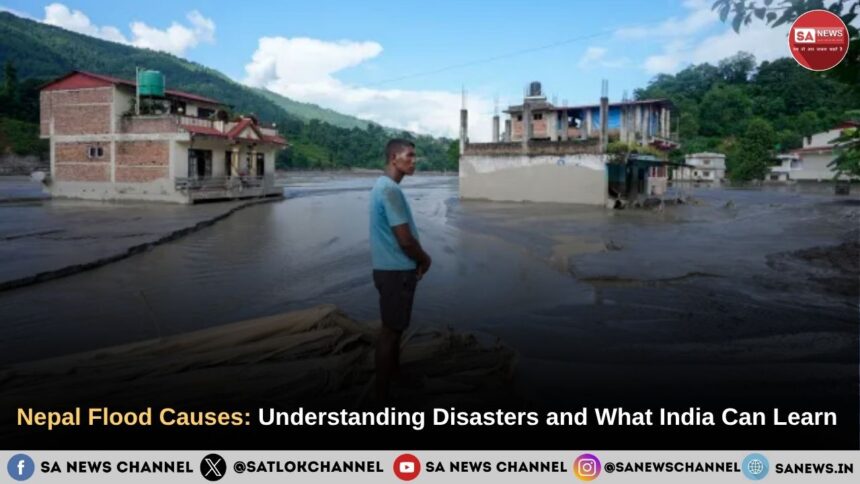
Nepal’s flood problem is caused by a number of factors including heavy monsoon rains, steep mountainous topography, landslides, changes in glacial conditions, deforestation, construction and insufficient water-storage infrastructure. These forces and structures can interact and intensify each other, contributing to disastrous flooding and flash floods.
Nepal experiences the heaviest rains during the monsoon season, during which time water quickly flows down steep slopes due to the country’s Himalayan topography. Additionally, Nepal possesses thousands of glacial lakes that also threaten to release large volumes of water at once.
The problem is particularly acute for downstream states in India, as the river systems in Nepal feed into the states of Bihar, U.P. and Uttarakhand. Thus, not only is Nepal itself at risk from flooding, but India is as well.
Why Do Floods Occur in Nepal?
Heavy Monsoon Rains
Heavy rains, particularly during the monsoon season, can cause rivers to overflow their banks and cause significant damage. In mountainous areas, water will flow down rocky slopes in large volumes in a short amount of time, overwhelming any natural or manmade barriers.
In addition, mountainous topography can cause flash flooding, particularly when there is a steep incline or mountains close to rivers, as these factors increase the speed of water flow. This reduces the warning time for downstream areas and increases the damage potential.
Flash floods can also occur if landslides block a river and then later release the accumulated debris.
Changes in Glacial Conditions
Glacial melting due to climate change is an additional threat that is specific to the Himalayan region. Some glacial lakes may grow exponentially due to rising temperatures, and can release an extremely large volume of water if the moraine or other blockage holding them back is eroded or ruptured. This can cause a destructive flood known as a Glacial Lake Outburst Flood (GLOF), which can devastate infrastructure, homes, and entire communities while gaining speed and momentum.
Deforestation, Landslide Activity and Sediment Blockage
Not only can water from heavy rainfall or glacial melting overwhelm natural and manmade barriers, but it can carry large volumes of sediment with it. Activities such as deforestation, mining, building construction, and other such operations can lead to increased landslide activity and the creation of sediment dams in riverbeds, which can then break or erode, leading to flooding.
Lack of Water Storage Infrastructure
Although Nepal has potential to create vast multipurpose reservoirs, its river systems are currently underdeveloped. Although properly placed reservoirs can store floodwater, provide hydroelectric power, and serve as an economic development, dams cannot entirely prevent catastrophic flooding.
It is vital that Nepal uses proper construction techniques and follows up dam construction with floodplain management, early warning systems, and natural flood defenses to prevent disasters.
Building Constructions Near Rivers
It is crucial to note that human infrastructure is often to blame for large-scale flood damage. While natural floods occur, the addition of residential and commercial buildings often raise flood levels and restrict natural water flow, creating even greater destruction.
Why Nepal’s Flood Problem Should Matter to India
As discussed above, Nepal is a source of river systems for downstream states in India, which will experience secondary effects of flooding in Nepal. In particular, the Ganges, Kosi, Gandak, Rapti, Ghaghra, and Sarda river systems are shared between India and Nepal and support millions of people in both countries.
India and Nepal already have cooperative mechanisms in place to manage the flood situation, but closer cooperation would allow for quicker mobilization of resources and better organization. The most important point to consider is that water does not recognize political borders. What happens in Nepal has direct consequences for life in India and vice versa.
What Can India Learn from Nepal?
India has its own Himalayan regions including Himachal Pradesh, Uttarakhand, Sikkim, Arunachal Pradesh, and Jammu and Kashmir. Similarly to Nepal, these areas are subject to extreme rainfall, landslides, flash floods, and glacial meltwater. Therefore, it is crucial that India learns from Nepal’s experience and implements flood management measures at an early stage rather than reacting once a disaster has occurred. It should consider the following:
1. Better rainfall and river monitoring and more sophisticated flood forecasting
2. Creation of flood hazard maps and early warning systems
3. Preservation of natural floodplains and wetlands
4. Implementation of construction bans in ecologically sensitive areas
5. Geological surveys in mountainous flood-prone areas before large-scale construction begins
Should India Construct More Dams?
India should only construct new dams in areas where they can serve multipurpose functions and provide maximum flood protection. It is vital that the dam’s location is scientifically viable and that the reservoir will be able to withstand extreme weather conditions. Furthermore, concrete structures should supplement – rather than replace – natural wetlands and floodplains; rivers also need space to expand.
Early Warning Systems Can Save Lives
Early warning systems are essential if communities are to avoid the worst consequences of flooding. India can adopt Nepal’s model of mobile phone alerts, sirens, and other means of communication to get residents to higher ground. In addition, mountainous areas require additional monitoring of glaciers, glacial lakes, and landslides.
India, Nepal, and the Geopolitical Situation
Himalayan river systems are a geopolitical issue not only for Nepal and India, but also for China, which has a vested interest in maintaining stability along the Sino-Indian border. Water cooperation between India and Nepal can serve to strengthen the strategic partnership between the two countries, and both nations should dedicate more resources to studying the Himalayas.
Joint river monitoring, emergency response mechanisms, disaster preparedness drills, and strategic hydropower development can be used to further regional stability and economic ties, as they provide a framework for India-Nepal relations that serves both parties interests.
Moreover, rivers are an essential source of water, food, energy, and prosperity; therefore, their protection and regulated use should be a priority for all Himalayan nations.
A Better Flood Policy for India
India’s flood policy should entail the following five pillars:
1. Construction of scientifically viable large reservoirs and flood management infrastructure
2. Installation of rain, river and glacial monitoring systems
3. Regulation of construction in ecologically sensitive areas
4. Preservation of forests, wetlands, and floodplains
5. Development of long-term India-Nepal water cooperation
It is impossible to prevent all floods, particularly in a region as challenging as the Himalayas. However, with adequate planning and infrastructure, it is possible to reduce damage and loss of life while allowing rivers to perform their natural functions.
Conclusion
The Nepal flood case study highlights that Himalayan floods are a multisectoral, multifactorial phenomenon. Heavy rains, mountainous terrain, landslides, glacial melting, deforestation, construction activity, and insufficient water storage infrastructure all contribute to large-scale disasters. India should take Nepal’s warnings to heart and invest more in long-term flood management infrastructure while using early warning systems and scientifically viable preparations to reduce damage and loss of life.
Most importantly, India should recognize the importance of sustainable management of shared rivers with downstream neighbors to ensure long-term regional stability. Not only will this reduce the impact of disasters, but it will also foster deeper strategic partnerships between India and its neighbors based on cooperation, sustainability, and security.