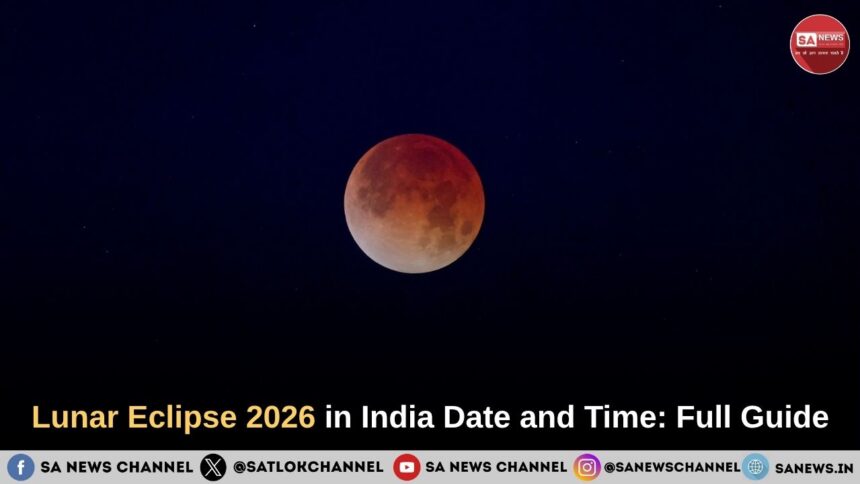
Tracking the lunar eclipse 2026 in india date and time is vital for skywatchers, astronomy enthusiasts, and cultural observers across the country. The 2026 astronomical calendar features two distinct lunar eclipse events, traditionally designated as Chandra Grahan. While one offers a prominent evening viewing window across Indian skies, the second remains strictly below the local horizon.
- Complete Calendar: Lunar Eclipse 2026 in India Date and Time Overview
- The March 3 Total Lunar Eclipse: Timings, Phases, and Visibility
- City-Wise Lunar Eclipse 2026 in India Date and Time Schedule
- The August 28 Partial Lunar Eclipse: Global Coordinates and Indian Status
- Astronomical Science: Rayleigh Scattering and the Blood Moon
- Sutak Kaal Rules and Traditional Observance in India
- Safe Viewing Practices and Skywatching Equipment
- FAQs on Lunar Eclipse 2026
Astronomers at the India Meteorological Department (IMD) and global observatories have mapped the trajectory of both celestial alignments. The first is a total lunar eclipse taking place on March 3, 2026, while the second is a deep partial lunar eclipse scheduled for August 28, 2026.
Complete Calendar: Lunar Eclipse 2026 in India Date and Time Overview
A lunar eclipse happens exclusively during a full moon (Purnima) when Earth passes directly between the Sun and the Moon. This orbital configuration projects Earth’s vast shadow cone onto the lunar surface.
Earth casts two specific shadow layers during this transit: the diffuse outer penumbra and the dense inner umbra. The visibility of each phase depends directly on local moonrise coordinates across individual states and union territories.
| Eclipse Event | Global Calendar Date | India Standard Date | Eclipse Classification | Visibility Status in India | Umbral Magnitude |
|---|---|---|---|---|---|
| First Chandra Grahan | March 3, 2026 | March 3, 2026 (Tuesday) | Total Lunar Eclipse (Blood Moon) | Visible across most states at Moonrise | 1.155 |
| Second Chandra Grahan | August 27–28, 2026 | August 28, 2026 (Friday) | Deep Partial Lunar Eclipse | Not Visible (Daytime in India) | 0.9319 |
The March 3 Total Lunar Eclipse: Timings, Phases, and Visibility
The primary astronomical highlight for Indian skywatchers is the total lunar eclipse on March 3, 2026. Official ephemeris data from the Positional Astronomy Centre (PIB Release) confirms that the initial shadow contacts begin during afternoon hours in Indian Standard Time (IST).
Because the Moon is below the horizon during early totality, observers in India will witness the eclipse as the Moon rises above the eastern horizon. Eastern and northeastern regions enjoy the longest duration, catching the concluding moments of totality alongside the partial umbral phase.
Phase-by-Phase Astronomical Schedule (March 3, 2026)
| Eclipse Phase | Time (IST) | Lunar Position in India | Visual Appearance |
|---|---|---|---|
| Penumbral Eclipse Begins (P1) | 02:14 PM IST | Below Horizon | Subtle darkening (Not visible in India) |
| Partial Umbral Eclipse Begins (U1) | 03:20 PM IST | Below Horizon | Dark shadow bite (Not visible in India) |
| Totality Commences (U2) | 04:34 PM IST | Below Horizon | Coppery reddish tint forms |
| Maximum Eclipse (Peak Totality) | 05:03 PM IST | Horizon Line in Far East | Deep crimson Blood Moon |
| Totality Ends (U3) | 05:33 PM IST | Rising in Northeast India | Red glow recedes from lunar limb |
| Partial Umbral Phase Ends (U4) | 06:48 PM IST | Visible Nationwide | Dark shadow leaves lunar disc |
| Penumbral Phase Ends (P4) | 07:53 PM IST | Visible Nationwide | Full moon illumination fully restored |
City-Wise Lunar Eclipse 2026 in India Date and Time Schedule
To observe the March 3 event effectively, observers should consult their precise local moonrise timings. The table below provides verified moonrise times and visible eclipse durations across major metropolitan centers:
| City / Urban Center | State / UT | Local Moonrise Time | Totality Visible? | Visible Umbral Window | Total Observable Window |
|---|---|---|---|---|---|
| Dibrugarh | Assam | 05:09 PM IST | Yes (24 mins) | 1 Hour 39 Minutes | Until 07:53 PM IST |
| Itanagar | Arunachal Pradesh | 05:15 PM IST | Yes (18 mins) | 1 Hour 33 Minutes | Until 07:53 PM IST |
| Imphal | Manipur | 05:15 PM IST | Yes (18 mins) | 1 Hour 33 Minutes | Until 07:53 PM IST |
| Agartala | Tripura | 05:27 PM IST | Yes (6 mins) | 1 Hour 21 Minutes | Until 07:53 PM IST |
| Kolkata | West Bengal | 05:39 PM IST | No (Partial Umbra) | 1 Hour 09 Minutes | Until 07:53 PM IST |
| Patna | Bihar | 05:44 PM IST | No (Partial Umbra) | 1 Hour 04 Minutes | Until 07:53 PM IST |
| Bhubaneswar | Odisha | 05:51 PM IST | No (Partial Umbra) | 0 Hours 57 Minutes | Until 07:53 PM IST |
| Lucknow | Uttar Pradesh | 06:07 PM IST | No (Partial Umbra) | 0 Hours 41 Minutes | Until 07:53 PM IST |
| Chennai | Tamil Nadu | 06:17 PM IST | No (Partial Umbra) | 0 Hours 31 Minutes | Until 07:53 PM IST |
| New Delhi | NCR | 06:22 PM IST | No (Partial Umbra) | 0 Hours 26 Minutes | Until 07:53 PM IST |
| Hyderabad | Telangana | 06:22 PM IST | No (Partial Umbra) | 0 Hours 26 Minutes | Until 07:53 PM IST |
| Bengaluru | Karnataka | 06:28 PM IST | No (Partial Umbra) | 0 Hours 20 Minutes | Until 07:53 PM IST |
| Mumbai | Maharashtra | 06:41 PM IST | No (Partial Umbra) | 0 Hours 07 Minutes | Until 07:53 PM IST |
| Ahmedabad | Gujarat | 06:44 PM IST | No (Partial Umbra) | 0 Hours 04 Minutes | Until 07:53 PM IST |
The August 28 Partial Lunar Eclipse: Global Coordinates and Indian Status
The second lunar eclipse of the year takes place on August 28, 2026. This is a deep partial lunar eclipse belonging to Lunar Saros Series 138, reaching an umbral magnitude of 0.9319, which covers nearly 93% of the moon’s surface.
Also Read: Blood Solar Lunar Eclipse Aug 27–28: North America Set For Near-Blood Moon Eclipse This August
However, this event cannot be observed from India. In Indian Standard Time, the eclipse unfolds entirely during daytime hours between 06:53 AM and 12:32 PM IST, when the Moon remains below the Indian horizon.
| Astronomical Stage | Coordinated Universal Time (UTC) | Indian Standard Time (IST) | Major Global Visibility Zones |
|---|---|---|---|
| Penumbral Start (P1) | 01:23:32 UTC | 06:53:32 AM IST | North America, South America, Pacific Ocean |
| Partial Umbral Start (U1) | 02:33:25 UTC | 08:03:25 AM IST | Americas, Atlantic Ocean, Western Europe |
| Greatest Eclipse Peak | 04:12:55 UTC | 09:42:55 AM IST | Central & North America, South America |
| Partial Umbral End (U4) | 05:52:13 UTC | 11:22:13 AM IST | Western Africa, North & South America |
| Penumbral End (P4) | 07:02:03 UTC | 12:32:03 PM IST | Pacific Basin, Western North America |
International observers across North and South America, Europe, and the Pacific will have prime viewing conditions. Skywatchers in India can monitor live telemetry and feeds via the NASA Eclipse Web Portal.

Astronomical Science: Rayleigh Scattering and the Blood Moon
During totality, the Moon does not turn completely black. Instead, it takes on a copper-red glow commonly referred to as a Blood Moon.
This optical phenomenon occurs due to Rayleigh Scattering, the same physical process that causes sunsets to appear red. As sunlight travels through Earth’s atmosphere, shorter blue wavelengths scatter away. Longer red and amber wavelengths bend inward through our atmospheric ring, projecting a warm glow onto the lunar surface inside the umbra.
Sutak Kaal Rules and Traditional Observance in India
In traditional Indian astronomy and Vedic almanacs such as Drik Panchang, a lunar eclipse is linked with Sutak Kaal, a period designated for spiritual reflection and precautionary customs.
| Sutak Determination Rule | Vedic Parameter | Practical Application in 2026 |
|---|---|---|
| Commencement Window | 3 Prahars (9 Hours) before Umbral Contact | March 3: Morning hours prior to Moonrise |
| Visibility Requirement | Only applicable if physically visible to naked eye | Applied on March 3; Not applied on August 28 |
| Conclusion Point | Instant of complete shadow exit | Concludes at 06:48 PM IST on March 3 |
| Daytime Eclipse Exemption | Adrishya Grahan (Invisible Eclipse) | August 28 eclipse has zero Sutak restrictions |
Sutak Kaal Summary for 2026 Eclipses
- March 3, 2026: Sutak rules apply across visible Indian regions starting in the morning hours and concluding at 06:48 PM IST when the Moon exits the umbral shadow.
- August 28, 2026: Because this eclipse occurs during daytime in India and remains invisible, traditional guidelines state that Sutak Kaal is Not Applicable.
Safe Viewing Practices and Skywatching Equipment
Unlike solar eclipses, which require certified ISO 12312-2 solar filters to protect against eye damage, lunar eclipses are 100% safe for direct naked-eye viewing. The Moon only reflects softened, refracted light.
| Viewing Method | Recommended Gear | Observational Advantage |
|---|---|---|
| Naked Eye | No equipment needed | Best for wide-field horizon viewing during moonrise |
| Binoculars | 7×50 or 10×50 standard models | Highlights lunar craters and color shifts along the shadow line |
| Telescopes | 70mm–100mm refractor or reflector | Offers high magnification of lunar topography within the umbra |
| Astrophotography | DSLR/Mirrorless with 300mm–600mm lens | Captures detailed long-exposure shots of the coppery hue |
To secure the best view for the March 3, 2026 eclipse, locate an elevated spot with an unobstructed eastern horizon, away from heavy city light pollution.
7. Beyond the Shadow: Discovering the Eternal Light of Supreme Spiritual Knowledge
Astronomical events like lunar eclipses illustrate the temporary and cyclical nature of the physical universe. Just as Earth’s shadow temporarily covers the Moon before moving away, human life is frequently clouded by recurring cycles of distress, anxiety, illness, and uncertainty. Throughout history, individuals have sought relief through physical rituals, astrological remedies, and eclipse traditions. However, material practices cannot resolve the root causes of karmic bondage and existential unrest.
True inner peace and complete spiritual liberation are attained through authentic spiritual knowledge (Tatvagyan).
Sant Rampal Ji Maharaj provides an evidence-based exposition of sacred scriptures, including the Holy Vedas, Bhagavad Gita, Guru Granth Sahib, Quran Sharif, and the Holy Bible. His teachings explain that the Supreme Lord, Kabir Saheb, is the eternal creator of all universal systems, ruling over a sorrow-free realm (Satlok) where birth, death, and planetary afflictions do not exist.
Sant Rampal Ji Maharaj highlights that apprehension regarding celestial movements dissolves when a seeker receives true initiation (Naam Diksha) from an authorized Saint and engages in scripture-aligned devotion (Sat-Bhakti). By rising above transient cosmic cycles and living in alignment with authentic spiritual principles, humanity can attain lasting spiritual protection and complete salvation.
To explore verified scriptural discourses, spiritual evidence, and in-depth teachings, visit the Official YouTube Channel of Sant Rampal Ji Maharaj.
FAQs on Lunar Eclipse 2026
1.When is the next visible lunar eclipse in India in 2026?
The next visible lunar eclipse in India takes place on Tuesday, March 3, 2026. Observers across most states can watch the partial umbral exit during evening moonrise, while far eastern regions will see the concluding moments of totality.
2.Will the August 28, 2026 lunar eclipse be visible anywhere in India?
No, the deep partial lunar eclipse on August 28, 2026, will not be visible from India. The astronomical alignment occurs during Indian daytime hours between 06:53 AM and 12:32 PM IST, while the Moon is below the horizon.
3.What is the maximum duration of totality for the March 3, 2026 eclipse?
The total phase of the March 3, 2026 lunar eclipse lasts 59 minutes globally, running from 04:34 PM IST to 05:33 PM IST, with the maximum eclipse point occurring at 05:03 PM IST.
4.Is Sutak Kaal applicable in India for the August 2026 lunar eclipse?
No, Sutak Kaal does not apply in India for the August 28, 2026 eclipse. Vedic astronomical principles specify that eclipse customs and Sutak periods apply solely to geographical areas where the eclipse is physically visible.
5.Do you need protective solar filters or eclipse glasses to view a lunar eclipse?
No, special eye protection or filters are not required to watch a lunar eclipse. Lunar eclipses reflect gentle, scattered sunlight and can be safely viewed directly with the naked eye, binoculars, or telescopes.