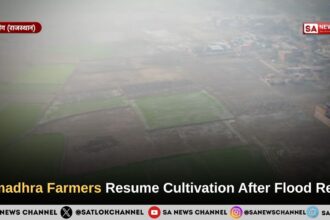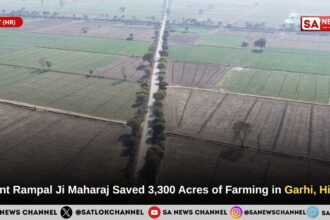


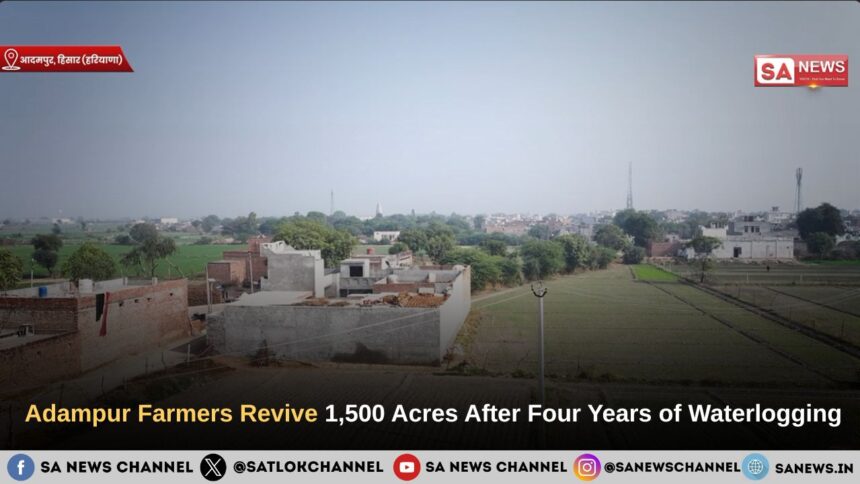
This is the story of Adampur in Hisar district—a village where fertile agricultural fields had turned into vast pools of water, and with them, the hopes of hundreds of farmers seemed to sink as well. Until a few months ago, looking across the landscape, one could see more water than farmland. Elderly residents say they had witnessed heavy rains and waterlogging many times in their lives, but had never experienced a situation as severe as the one that had persisted over the past few years.
- The Same Question Echoed Throughout the Village: “What Will Happen Now?”
- Government Efforts Were Made, but the Problem Remained Unresolved
- The Village Appealed for Help, and Relief Arrived Within Days
- Around-the-Clock Efforts Gradually Removed Years of Standing Water
- After Four Years, Agricultural Activity Returns to the Fields
- Villagers See the Relief Effort as an Inspiring Example of Service
- Villagers Express Special Respect for the Service Activities of Sant Rampal Ji Maharaj
- A Village Better Prepared for the Future
- When Hope Was Fading, Service Offered a Helping Hand
Nearly 1,500 acres of fertile farmland remained continuously submerged under stagnant water. In many fields, the water stood two to three feet deep, and in some places it reached as much as five feet. The groundwater level had risen so high that even a small amount of rainfall would transform the entire area into a lake. The kharif crop had already been destroyed, and farmers faced a pressing question: would they even be able to sow wheat this season?
The Same Question Echoed Throughout the Village: “What Will Happen Now?”
In the village lanes, at community gathering places, and along the edges of the fields, everyone was asking the same question: “What will happen now?”
Many farmers had leased agricultural land for cultivation. Some had invested lakhs of rupees, while others had poured their family’s lifetime savings into farming. But the persistent waterlogging brought everything to a standstill. As standing crops rotted in the fields, anxiety settled into every household.
Farmer Santlal recalls that the prolonged waterlogging caused crops to decay. Although his voice now reflects relief, he remembers those difficult days:
“There was two to three feet of standing water everywhere. It became impossible to even enter the fields. Our sorghum crop was ruined. There was no fodder left for the livestock. Many families were forced to sell their cattle.”
Another farmer, Satish, says that at the time, no one believed the situation would improve.
“The place where we are standing today had nearly three feet of water. The previous crop was completely destroyed, and we had no hope for the next one either. It seemed the land would remain uncultivated.”
The farmers’ worries extended beyond their crops. They were concerned about their children’s education, household expenses, farming debts, and an uncertain future.
Government Efforts Were Made, but the Problem Remained Unresolved
According to the villagers, several attempts had previously been made to solve the waterlogging problem. The village council repeatedly approached the administration for assistance. Village Sarpanch Sunil Kumar explains that the government provided some pipes and other resources, but they were insufficient considering the scale of the crisis.
“At that time, floods and waterlogging were affecting many parts of Haryana. The government was doing what it could within its limitations. However, our village’s problem was so extensive that the available resources simply weren’t enough.”
As the situation continued to worsen, farmers grew exhausted from repeatedly visiting government offices. Gradually, hope began to fade.
The Village Appealed for Help, and Relief Arrived Within Days
The villagers gathered information about relief efforts carried out in nearby areas. They learned that water drainage and public service projects had been successfully implemented in several villages. Following this, the village council and residents appealed for assistance. According to the villagers, their request was accepted, and relief materials arrived within a short time.
Sarpanch Sunil Kumar states that the village received approximately 8,000 to 10,000 feet of durable pipeline along with a 15 HP water pump. In addition to the pump, all the necessary equipment—including the starter, electrical cables, pipe fittings, adhesive, and other installation materials—was also provided so that the village would not incur any additional expenses.
The villagers say that all of this equipment was handed over as a permanent community asset, allowing them to tackle future waterlogging problems as well.
Around-the-Clock Efforts Gradually Removed Years of Standing Water
Once the equipment arrived, villagers and volunteers immediately began the drainage operation.
The pumps operated day and night as water was continuously discharged from the fields and waterlogged areas through the pipeline system.
Village elder Atar Singh recalls:
“As soon as the pipes and pumps were installed, we could see the difference. Water that had remained stagnant for months slowly began to disappear. Today, the situation is completely different.”
Farmer Santlal adds:
“The water level has dropped by nearly three to four feet. Fields that were once submerged are now being prepared for wheat sowing.”
Within a relatively short period, the campaign achieved what many villagers had thought impossible. Farmers say that if the water had not been removed in time, losses amounting to lakhs of rupees would have been inevitable.
Many farmers had leased land after making substantial investments. One farmer shared that he had paid nearly ₹600,000 to lease farmland. Had the water remained, his entire investment would have been lost.
According to the villagers, without timely drainage, not only would the crops have been destroyed, but many farming families would have suffered severe financial hardship.
Farmer Dilip Singh says that earlier, he believed farming would not be possible this season. But today, sowing has been completed, and farmers have returned to their fields with renewed hope.
The villagers estimate that the relief work helped prevent financial losses worth crores of rupees.
After Four Years, Agricultural Activity Returns to the Fields
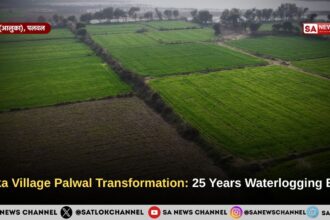
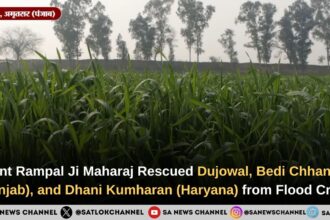
There was a time when the fields reflected nothing but water. Today, tractors once again move across those same fields. Some farmers are preparing the soil with rotavators, while others are busy sowing wheat.
Sarpanch Sunil Kumar says:
“After nearly four years, we are witnessing this level of agricultural activity again. Farmers have resumed cultivation, and there is a sense of happiness throughout the village.”
He notes with satisfaction that nearly 80 percent of the affected area has already been sown, while work on the remaining land is progressing rapidly.
Villagers See the Relief Effort as an Inspiring Example of Service
Residents of Adampur say that the assistance they received during this difficult period transformed their lives. Many become emotional while recalling how they had almost lost hope before the support arrived.
One farmer says he had believed agriculture in the village had come to an end. Today, seeing the fields ready for cultivation again feels like the beginning of a new life.
Discussions in the village gathering places have shifted from despair to future plans and renewed optimism.
Villagers Express Special Respect for the Service Activities of Sant Rampal Ji Maharaj
The residents of Adampur expressed special gratitude toward Sant Rampal Ji Maharaj. They say that the timely assistance provided during the crisis positively impacted the lives of thousands of people.
According to the villagers, true service is demonstrated not merely through words but through meaningful action taken at the right time. They believe that extending help to those in need without discrimination is an inspiring example for society.
The villagers state that the drainage resources not only saved their fields but also restored the farmers’ confidence. From village elders to young people, many described this assistance as an example of compassion, social responsibility, and humanitarian service.
A Village Better Prepared for the Future
The villagers believe that this relief effort has provided not only an immediate solution but also long-term protection against future waterlogging.
The village council plans to preserve and maintain the pipeline system so that if similar flooding occurs again, action can be taken immediately. This preparedness has given farmers renewed confidence about the future.
When Hope Was Fading, Service Offered a Helping Hand
The story of Adampur is about much more than draining water from flooded fields. It is the story of farmers worried about saving their land, of families fearful of an uncertain future, and of a village that was gradually losing hope.
Yet, when circumstances were at their most difficult, a helping hand reached out. The water was drained, tractors returned to the fields, sowing resumed, and smiles reappeared on the faces of the farmers.
Today, the fields of Adampur are growing more than just wheat—they are nurturing hope, confidence, and a renewed spirit of collective cooperation. The villagers say that when society begins to lose hope, genuine service becomes the greatest source of strength. Perhaps that is why the soil of Adampur is once again turning green, and the dreams of a brighter future are beginning to take root in the hearts of its farmers.