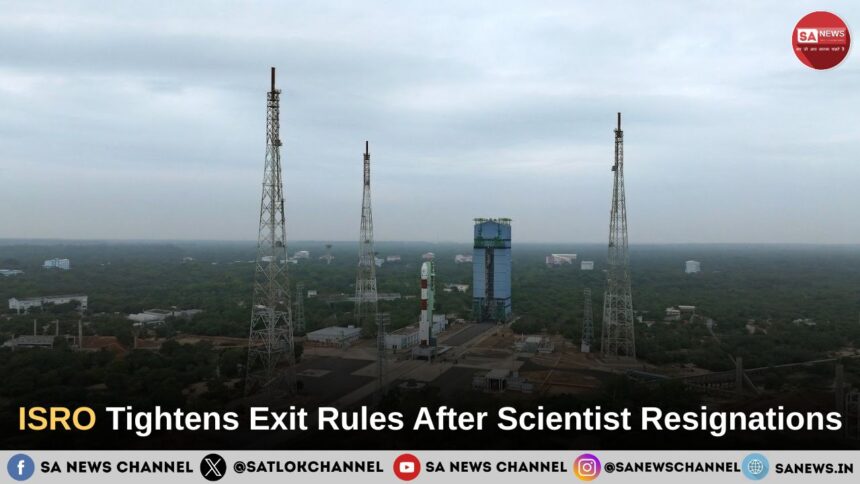
The Department of Space (DoS) has tightened rules governing voluntary retirement and resignations of ISRO’s Group ‘A’ scientific and technical personnel after reports that more than 100 scientists left the organisation in recent months. The move aims to prevent disruption to nationally important projects, including the Gaganyaan human spaceflight programme and other strategic missions. The new directive centralises approval of exit requests and comes as India’s space sector continues to expand with growing private participation.
- Key Takeaways: ISRO Scientist Resignations and New Exit Rules
- Department of Space Tightens ISRO Exit Rules
- Why the Government Issued the New Directive
- Reports Point to More Than 100 Scientist Departures
- Senior Scientist Among Those Who Left
- Private Space Sector Emerging as a Destination
- ISRO Chairman Responds to Reports of Resignations
- Recent Mission Challenges and Upcoming Projects
- Government Focus Remains on Mission Continuity
- Scientific Progress and the Search for Eternal Truth
- FAQs on ISRO Latest News
Key Takeaways: ISRO Scientist Resignations and New Exit Rules
- The Department of Space issued a directive on July 14 tightening exit rules for ISRO scientists.
- The move followed reports that over 100 Group ‘A’ scientific and technical personnel resigned or sought voluntary retirement in recent months.
- Scientists associated with Gaganyaan and other important national missions will no longer have resignation or voluntary retirement requests accepted as a routine administrative process.
- All such requests must now be forwarded to the Department of Space with recommendations from the respective centre directors for a final decision.
- The directive reverses a 2020 administrative order that had delegated approval powers to ISRO centre directors.
- ISRO Chairman V. Narayanan acknowledged the departures and said the organisation is ensuring that critical projects continue without disruption.
- Reports indicate many former ISRO scientists have joined India’s rapidly growing private space sector.
Department of Space Tightens ISRO Exit Rules
The Department of Space (DoS) has issued a new directive to major centres of the Indian Space Research Organisation (ISRO), tightening the process for voluntary retirement and resignations of Group ‘A’ scientific and technical personnel.
The memorandum, issued on July 14, was circulated to major ISRO centres, including the UR Rao Satellite Centre (URSC), Vikram Sarabhai Space Centre (VSSC), Satish Dhawan Space Centre (SDSC), Liquid Propulsion Systems Centre (LPSC), Space Applications Centre (SAC), National Remote Sensing Centre (NRSC), ISRO Telemetry, Tracking and Command Network (ISTRAC) and the Master Control Facility (MCF).
Also Read: From Bicycles to Rockets: ISRO’s 46-Year Journey to 100 Missions
According to the directive accessed by NDTV and reported by India Today, resignation and voluntary retirement requests from scientific and technical personnel associated with Gaganyaan and other important missions should not be accepted as a matter of routine.
Why the Government Issued the New Directive
The memorandum stated that there has been a “spate of requests” for voluntary retirement and resignations from Group ‘A’ scientific and technical personnel, including those working on the prestigious Gaganyaan mission and other nationally important projects.
Also Read: Gaganyaan Mission Progress Update
According to the Department of Space, these departures have been “severely impacting the implementation of projects of national importance.”
Under the revised procedure:
- Resignation and voluntary retirement requests from scientists associated with Gaganyaan and other important missions will receive additional scrutiny.
- Every request must be forwarded to the Department of Space.
- The proposal must include clear recommendations from the respective centre director before a final decision is taken.
The directive reverses a 2020 administrative arrangement under which ISRO centre directors and heads were authorised to approve resignation and voluntary retirement requests from Group ‘A’ scientific and technical personnel up to the Scientist/Engineer-SG level.
Reports Point to More Than 100 Scientist Departures
The policy change comes amid reports that more than 100 ISRO personnel have resigned in recent months. While the Department of Space has not officially confirmed the exact number of departures, multiple reports cited by The Times of India indicate that between 100 and 120 scientists may have left the organisation.
According to the reported figures:
| ISRO Centre | Reported Departures |
| UR Rao Satellite Centre (URSC), Bengaluru | Nearly 80 |
| Vikram Sarabhai Space Centre (VSSC), Thiruvananthapuram | Around 20 |
| Total reported across ISRO | Approximately 100–120 |
The UR Rao Satellite Centre and the Vikram Sarabhai Space Centre have reportedly witnessed the highest number of resignations.
Senior Scientist Among Those Who Left
Among those who reportedly left ISRO was Victor Joseph T, who served as the Project Director of the Geosynchronous Satellite Launch Vehicle (GSLV) Mk III Project at the Vikram Sarabhai Space Centre.
Also Read: नई अंतरराष्ट्रीय स्टडी से खुलासा धरती पर बढ़ता दबाव, इंसानों की खपत से पृथ्वी का संतुलन खतरे में
Reports said he resigned in February after serving for about 13 months as the head of the LVM3 project, the launch vehicle designated for India’s Gaganyaan human spaceflight mission.
Private Space Sector Emerging as a Destination
Reports indicate that several scientists who resigned from ISRO have joined private space startups.
India’s private space ecosystem has expanded significantly after the Central Government opened the sector to private participation in 2020 and introduced the Indian Space Policy in 2023.
According to the reports:
- India now has more than 400 registered space startups.
- These startups have attracted investments worth approximately $500 million.
- Nearly $150 million of that investment came in 2025 alone.
Among the companies highlighted in the reports are:
- Pixxel
- Dhruva Space
- Skyroot Aerospace
- Agnikul Cosmos
- Bellatrix Aerospace
ISRO Chairman Responds to Reports of Resignations
Responding to reports of scientist departures, ISRO Chairman V. Narayanan acknowledged that personnel movement has taken place.
Speaking to The Times of India, he said:
“Yes, a lot of people go, but that’s part of every organisation. The move isn’t only to retain, but also to ensure that important projects don’t suffer all of a sudden. But if someone is still going, someone else will take responsibility. We’re taking care of it.”
His remarks emphasised that ISRO is working to ensure continuity of critical national missions despite the reported departures.
Recent Mission Challenges and Upcoming Projects
Alongside the resignations, ISRO has also faced setbacks in some recent launch missions.
The Polar Satellite Launch Vehicle (PSLV) experienced two consecutive failures within one year.
Recent mission developments include:
- January: PSLV-C62 carrying the EOS-N1 Earth observation satellite and commercial payloads deviated from its planned trajectory after disturbances near the end of the third stage.
- May last year: PSLV-C61/EOS-09 (RISAT-1B) failed to achieve its planned 529-kilometre sun-synchronous orbit after a sudden chamber-pressure drop around 203 seconds into flight, resulting in mission failure and the loss of the radar satellite.
Despite these setbacks, ISRO continues to focus on several major upcoming programmes, including:
- Gaganyaan
- Chandrayaan-4
- Bharatiya Antariksh Station (BAS)
- Mangalyaan-2
Government Focus Remains on Mission Continuity
The latest directive reflects the Department of Space’s effort to ensure that India’s strategic space programmes continue without disruption amid reported increases in scientist resignations and voluntary retirement requests. While reports indicate significant personnel movement, ISRO has stated that responsibilities will continue to be reassigned to maintain progress on nationally important missions, including Gaganyaan and other future space exploration projects.
Scientific Progress and the Search for Eternal Truth
Scientific discoveries continue to expand humanity’s understanding of the universe and strengthen capabilities in areas such as space exploration. At the same time, many spiritual traditions remind us that knowledge and human intelligence are ultimately gifts from the Supreme Power. According to the spiritual discourses of Tatvadarshi Sant Rampal Ji Maharaj, true wisdom lies not only in advancing scientific knowledge but also in understanding the eternal purpose of human life and recognising the Supreme God.
He explains that while human achievements contribute to progress, the material world remains temporary, whereas the eternal abode described in the Bhagavad Gita is everlasting. His message encourages people to listen to His Spiritual Discourses, seek True Spiritual Knowledge, and understand the ultimate purpose of human life with humility and devotion.
For more information visit our:
- Website: www.jagatgururampalji.org
- YouTube: Sant Rampal Ji Maharaj
- Facebook: Spiritual Leader Saint Rampal Ji
- X (Twitter): @SaintRampalJiM
FAQs on ISRO Latest News
1. Why has the Department of Space tightened ISRO exit rules?
It cited a rise in resignation and voluntary retirement requests affecting Gaganyaan and other nationally important missions.
2. How many ISRO scientists reportedly resigned?
Media reports said more than 100 scientists resigned, with estimates ranging from 100 to 120 personnel.
3. Which ISRO centres reported the highest departures?
The UR Rao Satellite Centre in Bengaluru and the Vikram Sarabhai Space Centre in Thiruvananthapuram reported the highest departures.
4. What changed under the new Department of Space directive?
Exit requests linked to important missions must now be sent to the Department of Space with recommendations from centre directors.
5. Which major ISRO missions are highlighted in the reports?
The reports mention Gaganyaan, Chandrayaan-4, Bharatiya Antariksh Station (BAS), and Mangalyaan-2 as key upcoming missions.