

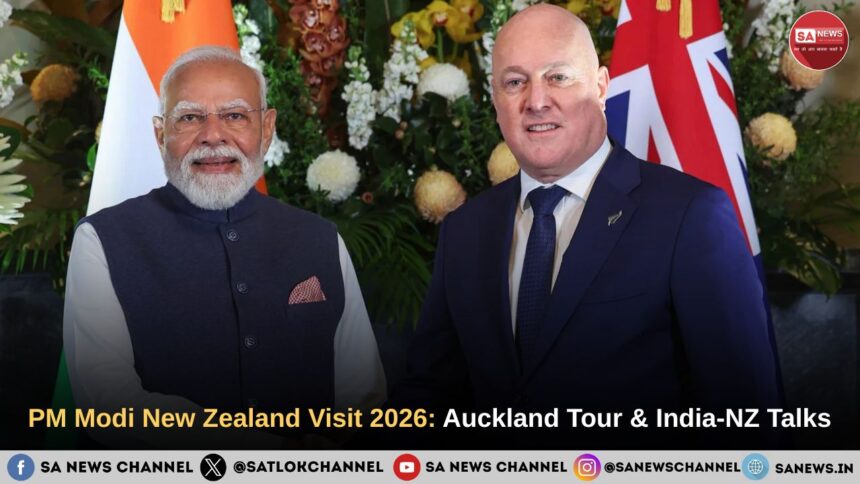
Prime Minister Narendra Modi arrived in Auckland on Friday for the final leg of his three-nation tour covering Indonesia, Australia, and New Zealand. His two-day official visit from July 10 to July 11 is being viewed as a landmark moment in India–New Zealand relations and a significant step in strengthening India’s engagement across the Indo-Pacific region.
- PM Christopher Luxon Personally Receives Modi at the Airport
- Trade, Investment and Economic Cooperation High on the Agenda
- Expanding Cooperation Across Strategic Sectors
- Prime Minister to Address the Indian Diaspora
- Visit Follows Successful Stops in Indonesia and Australia
- Reinforcing India’s Act East Policy and Indo-Pacific Vision
- A Short Visit with Long-Term Strategic Significance
The visit holds particular historical significance as it is the first official visit by an Indian Prime Minister to New Zealand in nearly four decades. The previous visits were made by Prime Minister Indira Gandhi in 1968 and Prime Minister Rajiv Gandhi in 1986. Modi’s visit is therefore expected to open a new chapter in bilateral ties.
PM Christopher Luxon Personally Receives Modi at the Airport
Upon his arrival in Auckland, Prime Minister Narendra Modi was personally welcomed at the airport by New Zealand Prime Minister Christopher Luxon. The gesture has drawn considerable diplomatic attention because it departs from standard protocol, under which a country’s prime minister does not usually receive a visiting head of government at the airport.
Diplomatic observers see Luxon’s personal welcome as a strong signal of New Zealand’s commitment to deepening its strategic partnership with India and reinforcing the growing political trust between the two nations.
Trade, Investment and Economic Cooperation High on the Agenda
During the two-day visit, Prime Minister Modi will hold bilateral talks with Prime Minister Christopher Luxon and other senior leaders. The discussions are expected to focus on strengthening economic, trade, and commercial relations between India and New Zealand.
The agenda builds upon the momentum created by Christopher Luxon’s visit to India in March 2025 and the progress made toward a Free Trade Agreement (FTA). Both sides are expected to explore measures aimed at expanding trade, encouraging investment, and enhancing commercial cooperation.
Among the key issues likely to receive attention is trade liberalization, including the possibility of tariff-free exports, which could significantly boost bilateral trade and create new opportunities for businesses in both countries.
Expanding Cooperation Across Strategic Sectors
Beyond trade, the two leaders are expected to discuss expanding cooperation across several strategic sectors, including defence, education, technology, agriculture, and people-to-people ties.
With the Indo-Pacific emerging as a region of increasing geopolitical importance, both countries are keen to deepen their comprehensive partnership. Enhanced collaboration in education and technology is expected to promote innovation and skill development, while cooperation in agriculture could facilitate the exchange of expertise and modern farming practices.
Prime Minister to Address the Indian Diaspora
As part of his visit, Prime Minister Modi will also address members of the Indian diaspora in New Zealand. The Indian community has played an important role in strengthening the social, cultural, and economic ties between the two countries, making the event a significant highlight of the visit.
Community celebrations are also expected to feature prominently, including the symbolic illumination of Auckland’s iconic Sky Tower in the colours of the Indian tricolour. The gesture is being viewed as a celebration of the enduring friendship and growing partnership between India and New Zealand.
Visit Follows Successful Stops in Indonesia and Australia
Before arriving in New Zealand, Prime Minister Modi completed successful visits to Indonesia and Australia, both of which yielded significant diplomatic outcomes.
During the Indonesia visit, 14 bilateral agreements were signed, further strengthening cooperation across multiple sectors.
In Australia, India and Australia concluded key agreements covering civil nuclear energy and uranium exports, maritime security, critical minerals, and defence cooperation. These developments are widely regarded as major milestones in enhancing strategic collaboration in the Indo-Pacific.
Reinforcing India’s Act East Policy and Indo-Pacific Vision
Throughout the three-nation tour, Prime Minister Modi has emphasized India’s commitment to its Act East Policy and its broader Indo-Pacific vision. The visits to Indonesia, Australia, and New Zealand reflect New Delhi’s continuing efforts to strengthen regional partnerships, expand economic engagement, and promote a free, open, inclusive, and secure Indo-Pacific.
A Short Visit with Long-Term Strategic Significance
Although Prime Minister Modi’s visit to New Zealand spans only two days, its diplomatic and strategic importance extends well beyond its duration. The first official visit by an Indian Prime Minister in nearly 40 years, Prime Minister Christopher Luxon’s personal welcome at the airport, discussions on a Free Trade Agreement, efforts to deepen economic and commercial engagement, expanded cooperation in defence, education, technology, and agriculture, and meaningful outreach to the Indian diaspora together make this a landmark visit.
Analysts believe that meaningful progress on trade liberalization, tariff-free exports, and broader strategic cooperation could elevate India–New Zealand relations to a new level in the coming years. More than a bilateral engagement, the visit represents another important step in India’s broader Indo-Pacific strategy, underscoring its commitment to stronger regional diplomacy and long-term strategic partnerships.