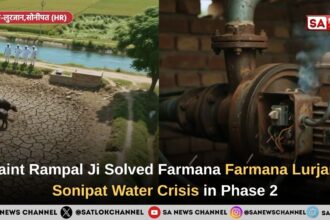


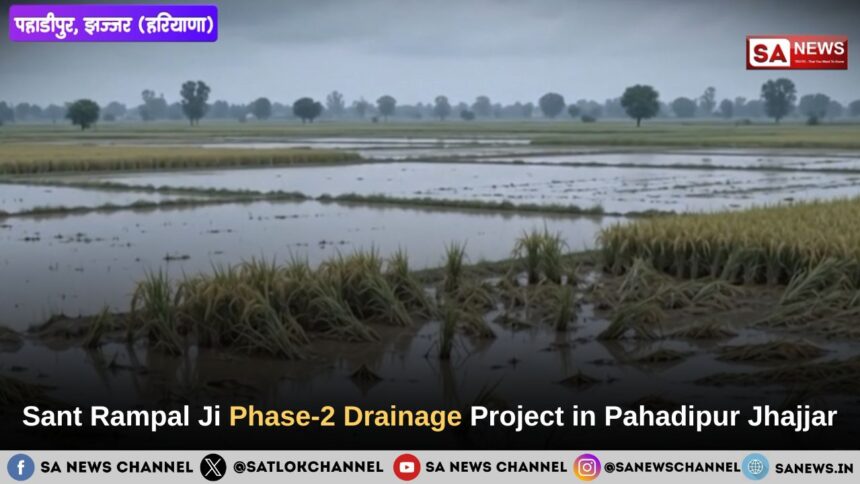
Pahadipur village, situated within the Beri tehsil of Jhajjar district in Haryana, has experienced severe waterlogging and seasonal flooding for approximately 20 to 25 years. During every annual monsoon season, hundreds of acres of fertile agricultural land in this region are completely submerged under water.
- Gram Panchayat Deputation And Comprehensive Technical Assessment
- Survey Findings And Upgraded Allocation Of Technical Infrastructure
- Logistical Turnaround And Specifications Of Dispatched Assets
- Phased Project Execution Protocol And Permanent Asset Handover
- Technical and Logistical Profile of the Pahadipur Drainage Project
- Community Reception and Local Environmental Perspectives
- Long-Term Agricultural Reclamation and Economic Impact
The prolonged accumulation of floodwater systematically destroys standing seasonal crops, inflicting heavy financial losses on local farmers and driving many families into agricultural debt.
The scope of this flooding extends beyond arable fields, as the excess water regularly overflows into village streets, residential properties, government schools, and vital public infrastructure.
For over two decades, the absence of an engineered drainage outlet left the community vulnerable, as formal administrative representations to government departments failed to yield any functional infrastructure or relief.
Gram Panchayat Deputation And Comprehensive Technical Assessment
Faced with persistent crop failures and administrative delays, the Gram Panchayat of Pahadipur and local farmer representatives sought alternative assistance. A formal village delegation travelled to Satlok Ashram to submit an official petition for relief.
Upon receiving the village’s representation, Sant Rampal Ji Maharaj directly ordered an immediate deployment of a technical survey team to inspect the physical terrain of Pahadipur.
The assigned evaluation team arrived in the village on the exact same day the petition was presented. To ensure complete logistical and geographical accuracy, the survey team performed a thorough ground-level inspection of all affected sectors and concurrently utilized Google Maps digital mapping technology to analyze the exact contours, elevation points, and flow paths of the flooded zone.
Survey Findings And Upgraded Allocation Of Technical Infrastructure
The initial proposal from the village community requested an allocation of 26,000 feet of pipeline and four water pumping motors. However, the comprehensive technical analysis conducted by the survey team determined the precise requirements needed to establish a functional, permanent drainage route to the main district drain.
- The survey team finalized the structural requirement at a total of 15,300 feet of pipeline.
- The team confirmed the mechanical requirement for four heavy-duty pumping units to successfully move the volume of stagnant water across the finalized distance.
- Upon receiving the finalized survey documentation, Sant Rampal Ji Maharaj immediately issued executive authorization for the project under Phase-2 of the Kisan Mazdoor Bachao Abhiyan.
Logistical Turnaround And Specifications Of Dispatched Assets
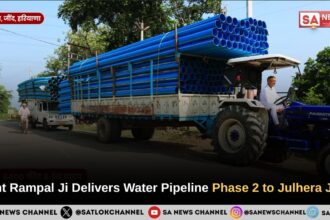
Following the direct authorization by Sant Rampal Ji Maharaj, the entire inventory of infrastructure materials was compiled, loaded, and dispatched. The logistical convoy arrived in Pahadipur village within 24 hours of the Gram Panchayat’s initial request at the ashram. The technical assets and construction consumables delivered to the village council include:
- Conduit Pipes: Exactly 15,300 feet of heavy-duty, industrial-grade water drainage piping featuring an 8-inch structural diameter.
- Joints and Fittings: A complete allocation of technical accessories, including specialized pipe bends (elbows), industrial coupling joints, and secure locking chains.
- Chemical Sealants: High-strength solvent adhesive compounds required to execute completely airtight and watertight seals at every pipe junction.
- Pumping Units: Four industrial-grade electric water pumping motors, with each individual unit rated at an operating capacity of 10 Horsepower (HP).
Phased Project Execution Protocol And Permanent Asset Handover
The distribution team executed the official handover of all structural assets to the Pahadipur Gram Panchayat under precise operational guidelines. Sant Rampal Ji Maharaj directed a structured, multi-phase execution strategy to ensure the permanent efficacy of the drainage network:
- Phase 1 (Underground Earthworks): The Gram Panchayat and local residents are required to organize local machinery, tractors, and community labor to excavate trenches and completely lay the 15,300 feet of 8-inch pipeline underground.
- Phase 2 (Technical Inspection): Upon the physical completion of the underground pipe layout, the village council must notify the central technical team, which will perform a secondary field verification to inspect the structural integrity and alignment of the pipeline.
- Phase 3 (Machinery Activation): Following a successful verification report, the four authorized 10 HP electric motors will be immediately delivered, mounted at the designated discharge stations, and commissioned for active water extraction.
- Permanent Transfer: The distribution team formally stated that the entire 15,300-foot pipeline and all accompanying machinery are handed over as a permanent, irrevocable public asset belonging entirely to Pahadipur village.
Technical and Logistical Profile of the Pahadipur Drainage Project
| Project Parameters | Verified Documented Specifications |
| Geographic Location | Pahadipur Village, Beri Tehsil, Jhajjar District, Haryana |
| Duration of Unresolved Crisis | Approximately 20 to 25 Years |
| Impacted Infrastructure | Hundreds of Acres of Farmland, Homes, Streets, and Schools |
| Operational Campaign Framework | Kisan Mazdoor Bachao Abhiyan (Phase-2 / चरण 2) |
| Initial Community Request | 26,000 Feet of Pipeline and 4 Pumping Motors |
| Final Authorized Conduit Length | Exactly 15,300 Feet of Heavy-Duty Piping |
| Pipeline Diameter Specification | 8 Inches (8-inch Structural Diameter) |
| Consumable Installation Components | Solvent Adhesives, Pipe Bends, Joint Seals, Locking Chains |
| Pumping Machinery Infrastructure | 4 Heavy-Duty Electric Water Pumping Units |
| Individual Motor Power Rating | 10 Horsepower (HP) Per Unit |
| Logistical Delivery Velocity | Completed Within 24 Hours of the Official Ashram Petition |
| Asset Ownership Status | Permanent and Irrevocable Public Property of the Village |
Community Reception and Local Environmental Perspectives
The arrival of the logistical convoy in Pahadipur village was met with a large public gathering consisting of local farmers, village elders, women, and youth groups. Despite intense summer temperatures, the community organized a formal welcoming ceremony. The entry of the material transport vehicles was accompanied by the playing of traditional drums (dhol-nagada).
The Gram Panchayat officially received the convoy, and the Sarpanch placed ceremonial garlands on the portrait of Sant Rampal Ji Maharaj as an expression of institutional gratitude.
Local youth and senior agriculturalists noted during interviews that while multi-year appeals to state administrative departments had yielded no practical infrastructure, the 24-hour delivery window achieved under this initiative provided an immediate resolution to their generational crisis, offering local youth an opportunity to return to sustainable farming instead of migrating to urban factory labor.
Long-Term Agricultural Reclamation and Economic Impact
Sant Rampal Ji Maharaj directly resolved a multi-decade structural bottleneck in Pahadipur by providing a complete, high-capacity underground drainage grid. The deployment of 15,300 feet of 8-inch piping coupled with 40 HP of total pumping capacity establishes an enduring water management system capable of rapidly evacuating monsoon floodwaters into the main regional drainage channels.
By systematically eliminating prolonged water stagnation, the infrastructure preserves the topsoil quality, protects residential and educational buildings from structural water damage, and ensures that hundreds of acres of farmland remain continuously cultivable across both the Kharif and Rabi crop cycles.
This stable agricultural environment directly mitigates seasonal crop losses, reducing the community’s reliance on high-interest loans and building a reliable economic foundation for future generations in Pahadipur.