

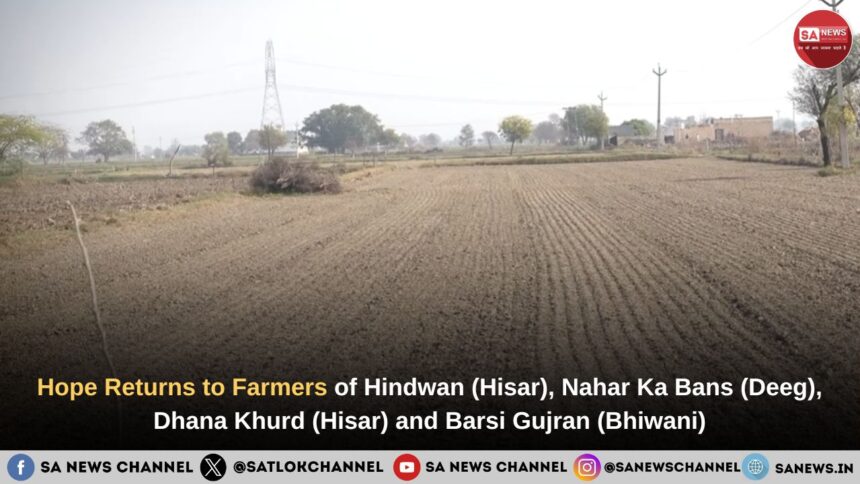
Natural disasters do not only damage standing crops in the fields, but they also deal a severe blow to the years of hard work put in by farmers, the livelihood of their families, and their hopes for the future. During the past few years, many villages in Haryana and Rajasthan struggled with severe waterlogging. In some places, water remained accumulated in the fields for one to two years, while in others, sudden floods submerged hundreds of acres of fertile agricultural land within just a few days. Farmers’ Kharif crops were completely destroyed, timely wheat sowing came under threat, and thousands of families began facing financial hardship.
- When Waterlogging Pushed Farmers’ Lives into Crisis
- When the Villagers Placed Their Hope in Sant Rampal Ji Maharaj
- Hindwan (Hisar, Haryana): Where the Flood Brought the Entire Village’s Life to a Standstill Along with the Fields
- Immediate Assistance According to the Village’s Requirement
- Resources Provided to Hindwan Village
- Day-and-Night Efforts Changed the Face of the Village
- Normal Life Returned
- Nahar Ka Bans (Deeg, Rajasthan): Hope for Farming Returned to Fields That Had Remained Waterlogged for Two Years
- Assistance Provided in Two Phases
- Total Resources Provided
- Grand Welcome by the Village
- Panchayat Accepted Responsibility for the Future
- Dhana Khurd (Hisar, Haryana): Farming Returned to More Than 700 Acres of Land After Assistance Was Provided in Two Phases
- Relief Received Through the First Phase of Assistance
- Immediate Assistance Was Again Provided in the Second Phase
- During the Second Phase, the Village Received—
- Total Resources Available After Both Phases
- Greenery Returned to the Fields
- Normal Life Returned to the Village
- Barsi Gujran (Bhiwani, Haryana): Wheat Flourished Again in Flooded Fields After Assistance Was Provided in Two Phases
- Relief Received During the First Phase
- Additional Assistance Was Also Provided When the Requirement Increased
- Total Resources Received in Both Phases
- Farming Flourished Once Again
- Resources Preserved for the Future
- Assistance Provided in All Four Villages at a Glance
- Farmers’ Hope Returned Through Timely Assistance
- Other Humanitarian Service Activities of Sant Rampal Ji Maharaj
- Greenery and New Confidence Returned to the Villages
In several villages, the situation became so serious that water reached not only the fields but also houses, roads, and settlements. Livestock had to be shifted to safer places, children’s education was disrupted, and the normal daily life of villagers was completely disturbed. Despite continuous efforts, when no permanent solution was found, the hopes of the farmers began to fade.
During such difficult times, the Annapurna Muhim, operated under the guidance of Sant Rampal Ji Maharaj, emerged as a new source of hope for farmers. According to the requirements of each village, pipelines, motors, tractor coupling sets, and other necessary equipment were provided, through which the work of water drainage began at a rapid pace. This timely assistance not only made the fields suitable for cultivation once again but also gave thousands of farming families an opportunity to recover from financial hardship.
When Waterlogging Pushed Farmers’ Lives into Crisis
In these villages, the impact of waterlogging was not limited only to agriculture. In many places, water accumulated up to three to six feet deep. In some villages, farming remained suspended for two years, while in others, sudden floods engulfed the entire village within only a few days.
Because of this waterlogging, farmers faced numerous problems—
- Kharif crops were completely destroyed.
- Timely wheat sowing came under serious threat.
- Reaching fields and roads became difficult.
- Water entered many houses and settlements.
- Livestock had to be shifted to safer places.
- Children’s education and the normal life of the village were affected.
- Farmers’ income almost disappeared, and the financial crisis became more severe.
According to the villagers, if the water had not been removed in time, not only one crop but farming for the coming years could also have been affected.
When the Villagers Placed Their Hope in Sant Rampal Ji Maharaj
When the expected solution was not received at the administrative level despite continuous efforts, the Panchayats and farmers of different villages decided to present their problems before Sant Rampal Ji Maharaj.
Representatives of the villages reached Barwala and submitted a request for assistance after explaining the waterlogging situation, crop losses, and the financial condition of the farmers. According to the villagers, they never expected that the resources required to solve their problem would become available within such a short period.
After their prayer was accepted, relief materials were prepared according to the requirements of the villages and delivered within only a few days. From that point onward, the sinking hopes of the farmers once again began moving in a new direction.
Hindwan (Hisar, Haryana): Where the Flood Brought the Entire Village’s Life to a Standstill Along with the Fields
Hindwan village in Hisar district of Haryana was severely affected by the recent devastating floods. Approximately 700 acres of fertile agricultural land were submerged under five to six feet of water. Along with the fields, village roads, settlements, and several houses also went underwater. Water entered many homes up to a depth of two to three feet, causing walls to collapse and forcing villagers to move to safer places along with their families and livestock.
The situation became so serious that even the village graveyard was submerged, due to which members of the Muslim community faced great difficulty in performing last rites. The farmers’ pearl millet crop had already been completely destroyed, and if the water had not been removed in time, wheat sowing would also have become impossible.
Immediate Assistance According to the Village’s Requirement
Keeping in view the condition of the village, Sant Rampal Ji Maharaj immediately.
Resources Provided to Hindwan Village
- Approximately 14,160 feet long 8-inch pipeline
- Three powerful 10 HP motors
- Starters
- Electrical cables
- Pipe joining solution
- Nuts, bolts, and other necessary equipment
As soon as the relief material reached the village, the work of laying the pipeline began the very next day, and a continuous water drainage campaign was launched.
Day-and-Night Efforts Changed the Face of the Village
Under the leadership of the Panchayat, the villagers operated the motors day and night to remove the accumulated water. According to retired Principal Satbir Singh of the village, they often had to personally monitor the motors until midnight to ensure that the drainage work continued without interruption.
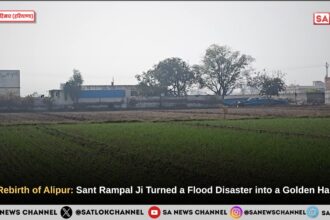
The continuous efforts produced remarkable results. Out of approximately 700 acres, nearly 650 acres of land once again became suitable for cultivation. Wheat sowing started in most of the fields, and tractors could once again be seen operating in the farmland.
Normal Life Returned
After the water was drained, not only did the fields recover, but normal life in the village also gradually returned. Water was removed from the graveyard, access to the settlements was restored, and people gradually returned to their homes.
The villagers stated that if timely assistance had not been received, it would have taken a much longer time for the village to recover from this crisis, and the farmers would have suffered enormous financial losses.
Today, the returning greenery in Hindwan village and the restoration of normal daily life stand as proof that the resources provided at the right time gave an entirely new direction to the whole village.
Nahar Ka Bans (Deeg, Rajasthan): Hope for Farming Returned to Fields That Had Remained Waterlogged for Two Years
Nahar Ka Bans village in Deeg district of Rajasthan struggled continuously with the problem of waterlogging for two years. The fertile agricultural land had turned into marshland, and farmers were unable to drive even tractors on their own fields. Farming had come to a complete halt, forcing villagers to purchase food grains from the market to feed their families.
As cultivation remained impossible for two consecutive years, the financial condition of the farmers continued to deteriorate. The Panchayat and villagers sought assistance at several levels, but no permanent solution was found. Finally, the village Panchayat submitted a request for assistance to Sant Rampal Ji Maharaj.
Assistance Provided in Two Phases
Keeping in view the actual requirement of the village, Sant Rampal Ji Maharaj provided assistance in two phases.
Total Resources Provided
- 6,500 feet long 8-inch pipeline
- Two 10 HP motors
- Two tractor coupling sets
- Suction pipes
- Diesel arrangement
- Generator rental arrangement
- All other necessary equipment
According to the villagers, the first phase of assistance initiated the water drainage work. Later, when the Panchayat informed that additional assistance was required, extra resources reached the village within only 24 hours of the second request.
Grand Welcome by the Village
When the relief material arrived in the village, the entire village welcomed the service team with drums and traditional musical instruments. Women, youth, and elderly people gathered in large numbers and expressed their gratitude towards Sant Rampal Ji Maharaj.
The village Sarpanch, who is a retired member of the Indian Army, stated that He had never witnessed such prompt assistance in His entire life.
Panchayat Accepted Responsibility for the Future
While handing over the relief material, the Gram Panchayat accepted the responsibility of ensuring that the resources provided would be used for timely water drainage and restarting cultivation.
The villagers also expressed confidence that these resources would be preserved for future use so that they could be immediately utilized if waterlogging occurred again.
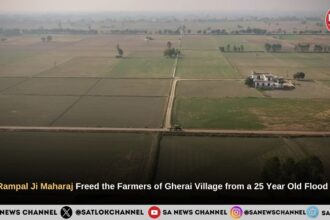
After facing two years of despair, Nahar Ka Bans village once again witnessed an atmosphere of hope. Farmers believe that once the water drainage is fully completed, they will be able to restart cultivation on their land, and the financial condition of their families will improve.
Dhana Khurd (Hisar, Haryana): Farming Returned to More Than 700 Acres of Land After Assistance Was Provided in Two Phases
Dhana Khurd village in Hisar district of Haryana was passing through a severe crisis because of extensive waterlogging. Continuous accumulation of water had turned the fields into ponds. The Kharif crop had already been destroyed, and now the biggest concern before the farmers was saving the Rabi crop. Water up to three to four feet deep had accumulated in several parts of the village, while waterlogging was even more severe in some low-lying areas.
The situation had become so serious that more than 700 acres of land had gone underwater. Reaching the fields had become difficult, and many farmers had lost hope that wheat sowing would be possible during the current season. The impact of waterlogging was not limited only to farming. Several settlements became disconnected from the village, roads were submerged, and children’s education was affected because they were unable to attend schools and colleges.
Relief Received Through the First Phase of Assistance
Considering the village’s condition, Sant Rampal Ji Maharaj provided relief material for the village for the first time.
The first phase of assistance included—
- One 15 HP motor
- Approximately 5,600 feet long 8-inch pipeline
With the help of these resources, the Gram Panchayat and farmers continuously carried out water drainage work, as a result of which nearly 60 to 65 percent of the village’s accumulated water was removed.
However, the lower areas of the village were still affected by waterlogging, and additional resources became necessary to enable farmers to sow wheat on time.
Immediate Assistance Was Again Provided in the Second Phase
When the Gram Panchayat submitted another request, additional assistance was immediately provided by Sant Rampal Ji Maharaj.
During the Second Phase, the Village Received—
- Additional 2,500 feet of 8-inch pipeline
- One additional 7.5 HP motor
- Starter
- Electrical cables
- Other necessary equipment
Total Resources Available After Both Phases
- Two motors
- Approximately 8,100 feet of pipeline
Greenery Returned to the Fields
After continuous water drainage, water was removed from most of the fields. Only a few low-lying areas remained partially affected, and work to remove the remaining water also continued.
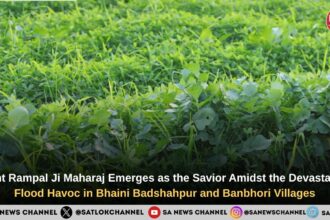
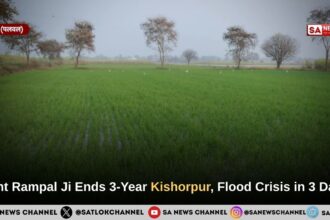
Most farmers in the village completed wheat sowing on time, and in many fields the crop had already germinated and grown to nearly six inches in height. The fields that had displayed nothing but water only a short time earlier had once again turned green.
Normal Life Returned to the Village
After the water receded, village roads reopened, children’s education resumed, and normal life gradually returned.
According to the villagers, the timely second phase of assistance played a crucial role in removing the remaining waterlogging and restoring the entire village to cultivable condition.
Barsi Gujran (Bhiwani, Haryana): Wheat Flourished Again in Flooded Fields After Assistance Was Provided in Two Phases
Barsi Gujran village in Bhiwani district of Haryana was also severely affected by floods and waterlogging. Approximately 300 to 400 acres of agricultural land were submerged under three to four feet of water. Along with this, 15 to 16 houses also came under the impact of waterlogging. The standing crop of the farmers had been completely destroyed, and the time for sowing the next crop was continuously slipping away.
When the villagers learned about the successful water drainage work carried out in the neighboring village of Dhana Khurd, the Gram Panchayat also submitted a request for assistance to Sant Rampal Ji Maharaj.
Relief Received During the First Phase
According to the village’s requirement, the following resources were provided during the first phase—
- One powerful 20 HP motor
- Approximately 2,500 feet of 8-inch pipeline
- Starter
- Electrical cables
- Equipment required for operating the motor
With this assistance, the water drainage work began in the village.
Additional Assistance Was Also Provided When the Requirement Increased
As the waterlogging was more extensive than expected, the Panchayat once again requested assistance.
During the second phase, the village received—
- Three additional 20 HP motors
- Approximately 8,000 feet of additional 8-inch pipeline
- Pipe joining solution
- Suction material
- Starter
- Cables
- Other fitting materials
Total Resources Received in Both Phases
- Four 20 HP motors
- Approximately 10,500 feet of 8-inch pipeline
Farming Flourished Once Again
After receiving the relief material, the villagers collectively began the work of water drainage. Within a short period, the condition of the village changed completely.
According to the Gram Panchayat, wheat sowing had been successfully completed on approximately 90 percent of the fields. The fields that had displayed nothing but water and mud only a short time earlier were now covered with lush green crops.
The villagers stated that if assistance had not been received on time, the next crop would also have been completely destroyed.
Resources Preserved for the Future
The villagers decided that the motors and pipelines provided would be preserved for future use so that they could be immediately utilized whenever waterlogging occurred again.
Assistance Provided in All Four Villages at a Glance
| Village | Affected Area | Waterlogging Situation | Assistance Provided |
| Hindwan (Hisar) | Approximately 700 Acres | 5–6 Feet of Water, Houses and Graveyard Also Affected | 14,160 Feet Pipeline, 3×10 HP Motors, Starters, Cables, and Other Materials |
| Nahar Ka Bans (Deeg) | Farming Affected for Approximately 2 Years | Marshland | 6,500 Feet Pipeline, 2×10 HP Motors, 2 Tractor Coupling Sets, Diesel and Generator Support |
| Dhana Khurd (Hisar) | More Than 700 Acres | 3–4 Feet Waterlogging | 8,100 Feet Pipeline (Two Phases), 15 HP and 7.5 HP Motors, Starters and Cables |
| Barsi Gujran (Bhiwani) | 300–400 Acres, 15–16 Houses Affected | 3–4 Feet Waterlogging | 10,500 Feet Pipeline (Two Phases), 4×20 HP Motors, and Necessary Equipment |
Farmers’ Hope Returned Through Timely Assistance
The situations in all four villages were different, but the problems faced by the farmers were almost the same. In some places, sudden floods submerged both fields and houses, while in others, farming had completely stopped because of years of waterlogging. Farmers’ income was affected, a fodder crisis developed for livestock, and timely wheat sowing also came under serious threat.
By Sant Rampal Ji Maharaj, motors, pipelines, tractor coupling sets, and other necessary equipment were provided according to the requirements of each village. In some villages, assistance was delivered in two phases, while in others, additional diesel and generator arrangements were also made so that the water drainage work could continue without interruption.
As a result of these efforts, water was removed from the fields in most villages within the required time, wheat sowing became possible, and farmers were protected from major financial losses. Several villages also decided to preserve these resources for future use so that they could be immediately utilized whenever waterlogging occurred again.
Other Humanitarian Service Activities of Sant Rampal Ji Maharaj
Sant Rampal Ji Maharaj carried out numerous humanitarian and social welfare activities for the benefit of society. These include—
- Relief work during natural disasters
- Ration assistance for needy families
- Blood donation camps
- Free dowry-free marriages
- Assistance for poor and needy families
- Environmental protection campaigns
- De-addiction awareness campaigns
- Assistance for needy farmers
The objective of these services is not only to provide immediate relief but also to help the weaker sections of society overcome difficult circumstances and move towards self-reliance.
Greenery and New Confidence Returned to the Villages
The stories of Hindwan, Nahar Ka Bans, Dhana Khurd, and Barsi Gujran are not merely stories of relief from waterlogging. They are examples of struggle, collective effort, and timely support. Where fields were once covered with water, despair, and financial hardship, wheat crops are now flourishing, and farmers have returned to cultivation with renewed enthusiasm.
The resources provided in these villages not only helped in immediate water drainage but also strengthened preparations for dealing with similar situations in the future. Timely assistance became a source of new hope for farmers and gave many families an opportunity to rebuild their livelihoods. Today, the returning greenery in these villages and the smiles visible on the faces of farmers stand as the greatest evidence of this transformation.