

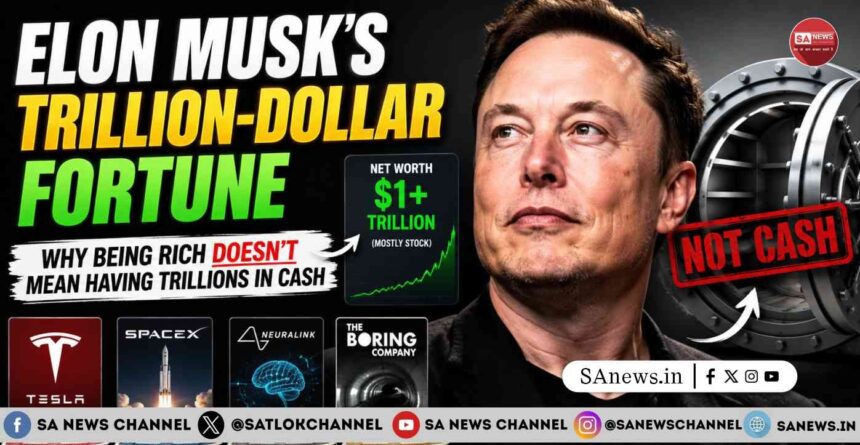
Elon Musk is often described as the richest person in the world. Some recent estimates have suggested that his wealth may have exceeded $1 trillion, driven mainly by the soaring value of companies such as SpaceX and Tesla. However, that does not mean Musk has a trillion dollars sitting in a bank account. Let’s understand the algorithm behind the soaring profit of the richest people across the globe through this article.
- Why Doesn’t He Just Sell Shares?
- How Taxes Work for Billionaires
- The Bigger Debate
- The Bottom Line
- Why Net Worth Can Disappear Faster Than People Think
- The Hidden Power of Ownership
- Could Governments Tax Billionaires Differently?
- What Musk’s Wealth Reveals About Modern Capitalism
- Looking Ahead
- The Mirage of Trillion-Dollar Fortunes and Paper Wealth
- The Eternal Wealth Discovered Through Sant Rampal Ji Maharaj
- FAQs on Musk Trillion Dollar Wealth
Most of his wealth exists on paper.
When financial publications calculate a person’s net worth, they multiply the number of shares they own by the current market value of those shares. Since Musk owns large stakes in Tesla, SpaceX and several other companies, changes in their valuations can add or remove hundreds of billions of dollars from his fortune without any money actually moving into his bank account.
This is why Musk has often said that he is “cash poor”. While he may have access to hundreds of millions of dollars in cash, the overwhelming majority of his wealth is tied up in company ownership.
This distinction between paper wealth and spendable money forces us to look deeper. Why do we relentlessly chase fortunes that market volatility can erase in minutes? Beyond financial systems, a more profound algorithm governs our existence, revealing that true, unshakeable abundance cannot be found in material capital, but in a completely different dimension of life.
Why Doesn’t He Just Sell Shares?
Selling large amounts of stock would create two problems.
First, it could reduce his control over the companies he built.
Second, selling shares would trigger capital gains taxes. Depending on the circumstances, the tax bill could reach billions of dollars.
Instead, many wealthy founders choose to borrow money using their shares as collateral. Banks are often willing to provide loans because the stock holdings are extremely valuable. The borrower gets access to cash without immediately selling assets.
How Taxes Work for Billionaires
One of the biggest debates surrounding billionaires involves taxes.
In the United States, people generally pay taxes when income is earned or when investments are sold at a profit. However, increases in the value of assets are usually not taxed until they are sold.
For example, if a person’s stock holdings rise by $100 billion in a year, they do not automatically owe tax on that gain unless they sell the shares.
Critics argue that this allows ultra-wealthy individuals to accumulate enormous fortunes while paying a lower effective tax rate than many wage earners. Supporters counter that taxing unrealized gains would be difficult because asset values constantly change and could force investors to sell shares simply to pay taxes.
Also Read: Elon Musk: The Visionary Behind Tesla and SpaceX
Musk has paid very large tax bills when he has sold stock or exercised stock options. In 2021, he said he paid roughly $11 billion in taxes, one of the largest individual tax payments ever reported. At the same time, analyses of earlier years showed that his wealth often grew much faster than the taxes he paid because most of those gains remained unrealized.
The Bigger Debate
Musk’s financial situation highlights a broader question about modern capitalism.
Supporters argue that entrepreneurs who build transformative companies deserve substantial rewards for taking enormous risks. They point to Tesla’s role in popularizing electric vehicles and SpaceX’s achievements in reusable rockets and satellite internet.
Critics argue that wealth concentrated at such extreme levels raises concerns about inequality, economic power and fairness in the tax system.
Both sides agree on one thing: a billionaire’s net worth and the amount of cash they actually possess are very different things.
The Bottom Line
Whether Elon Musk is worth hundreds of billions or more than a trillion dollars, most of that wealth exists in the form of ownership stakes rather than cash. His fortune rises and falls with the value of his companies. Like many wealthy founders, he can access money through borrowing instead of selling shares, which also affects how and when taxes are paid.
The debate over whether this system is fair continues, but understanding the difference between paper wealth, cash and taxable income is the key to understanding how modern billionaires manage their fortunes.
Why Net Worth Can Disappear Faster Than People Think
One reason many economists caution against focusing solely on net worth is that it can change dramatically in a short period of time.
Unlike cash sitting in a bank account, stock-based wealth depends on market confidence. Investors buy shares based on expectations about future growth, profits, and innovation. If those expectations change, valuations can rise or fall rapidly.
This has happened repeatedly throughout history. Technology entrepreneurs have gained and lost tens of billions of dollars within months due to market swings. During economic downturns, even the world’s richest individuals have seen their fortunes shrink substantially without spending a single dollar.
Elon Musk himself has experienced this volatility. During periods when Tesla’s share price declined sharply, hundreds of billions of dollars were temporarily wiped from his estimated net worth. Conversely, strong market performance added enormous amounts to his fortune.
Also Read: Tesla Stock Plummets $150 Billion Amid Elon Musk-Donald Trump Feud
This illustrates an important distinction: wealth on paper is not the same as spendable money. A billionaire may appear dramatically richer or poorer depending on stock market movements, even though their actual lifestyle remains unchanged.
The Hidden Power of Ownership
While discussions often focus on cash, the real power of extreme wealth comes from ownership.
Owning a large stake in a company provides influence over strategic decisions, voting rights, and future growth. In many cases, billionaires are less interested in converting shares into cash than in maintaining control over the organizations they have built.
For founders such as Musk, ownership allows them to pursue long-term visions that might not be possible under traditional corporate leadership. Tesla’s investments in electric vehicles, SpaceX’s efforts to develop reusable rockets, and Neuralink’s research into brain-computer interfaces all required years of spending before generating significant returns.
Supporters argue that concentrated ownership enables ambitious projects that public markets might otherwise consider too risky. Critics counter that such concentration gives extraordinary influence to a small number of individuals.
The debate ultimately centers on how much power should accompany extreme wealth.
Could Governments Tax Billionaires Differently?
As billionaire fortunes have expanded over the past two decades, policymakers around the world have proposed alternative tax systems.
One proposal is a wealth tax, which would impose an annual tax on total assets above a certain threshold. Advocates believe this would ensure that the ultra-rich contribute more regardless of whether they sell assets.
Another proposal is a tax on unrealized capital gains. Under this approach, individuals would pay taxes on increases in asset values even if they have not sold those assets.
Supporters argue these measures could generate significant government revenue and reduce wealth inequality. Opponents raise practical concerns. Determining the value of private businesses, artwork, real estate, and other assets each year could be difficult and contentious. Additionally, some owners might be forced to sell portions of their businesses simply to pay tax bills.
As a result, most countries continue to rely primarily on taxes triggered by sales, income, dividends, and inheritances.
What Musk’s Wealth Reveals About Modern Capitalism
Whether one views Elon Musk as an example of economic success or excessive wealth concentration often depends on broader beliefs about capitalism itself.
To supporters, Musk represents the rewards available to entrepreneurs who take extraordinary risks. His companies challenged established industries, created new technologies, and generated wealth for employees, investors, suppliers, and customers.
To critics, his fortune demonstrates how modern financial systems allow wealth to accumulate at unprecedented levels while many workers struggle with stagnant wages and rising living costs.
Both perspectives contain elements of truth.
The same economic system that enables groundbreaking innovation can also produce significant disparities in wealth and opportunity. Understanding Musk’s fortune therefore requires looking beyond the headline number and examining the economic structures that made it possible.
Looking Ahead
The future of billionaire wealth may look very different from the past.
Artificial intelligence, space technology, biotechnology, renewable energy, and advanced robotics are creating new industries capable of generating enormous value. Entrepreneurs operating in these sectors could build fortunes that exceed even today’s largest wealth estimates.
At the same time, public pressure for tax reform and greater economic equality is growing. Governments around the world are exploring ways to modernize tax systems without discouraging investment and innovation.
The challenge will be finding a balance between rewarding entrepreneurship and ensuring that economic growth benefits society as a whole.
As fortunes continue to grow and technology reshapes industries, the questions raised by Elon Musk’s wealth will remain central to debates about capitalism, taxation, and the future of the global economy.
The Mirage of Trillion-Dollar Fortunes and Paper Wealth
The staggering rise of modern billionaires like Elon Musk often leaves the world in awe. We hear of fortunes surpassing a trillion dollars and naturally imagine vaults overflowing with cash. Yet, as financial algorithms reveal, the overwhelming majority of this wealth is merely “paper wealth,” tied up in fluctuating stock market valuations and company ownership. It depends entirely on market confidence; if that confidence shifts, hundreds of billions can vanish into thin air without a single dollar being spent.
This reality makes us wonder: why is humanity so deeply obsessed with accumulating wealth that exists primarily on paper? We spend our entire lives chasing material security, building corporate empires, and counting numbers on a screen. But have we ever paused to think about what happens when our time on this planet comes to an end? Can any amount of stock options, corporate control, or worldly prestige buy us a single extra breath when death arrives? The truth is, we are investing our precious life span into an economic system built on decay, transience, and illusion.
The Eternal Wealth Discovered Through Sant Rampal Ji Maharaj
This continuous tussle for material abundance stems from a deeper, forgotten truth about our origin. Our soul instinctively craves a state of permanent security and endless abundance. However, Jagatguru Tatvdarshi Sant Rampal Ji Maharaj reveals that such stability can never be found in this mortal realm (the 21 universes), which is governed by Kaal Brahm (Satan) and defined by constant decay. True, self-replenishing abundance exists only in Satlok, our original, eternal home.
Kabir Saheb emphasizes this material delusion in His divine verses:
Chaaron yugon mein hum pukaaraen, Kook kahya hum hel re |
Heere maanik moti barsein, Ye jag chugta dhel re ||
While the world runs after the “pebbles” of paper wealth, Supreme God Kabir descends to offer the true “diamonds” of spiritual wealth and salvation. Sant Rampal Ji Maharaj is the singular Tatvdarshi Sant today who provides the authentic, scripture-based method of worship required to dissolve our accumulated karmic debts and clear our ultimate accounts. Worldly fortunes can disappear faster than we think, but the spiritual wealth gained through true devotion accompanies the soul eternally, leading us back to a life free from birth, death, and suffering.
To understand the volatile nature of this world and learn how to earn the true wealth of life, watch this eye-opening discourse by Sant Rampal Ji Maharaj:
Take Action Today!
Do not let your precious human life be consumed by the mirage of temporary wealth. Contact us to receive a free copy of the book ‘Gyan Ganga’ written by Sant Rampal Ji Maharaj or to take Naam Diksha (Initiation) from Jagatguru Tatvdarshi Sant Rampal Ji Maharaj.
Website: www.jagatgururampalji.org
YouTube: Sant Rampal Ji Maharaj
Facebook: Spiritual Leader Saint Rampal Ji
‘X’ handle: @SaintRampalJiM
FAQs on Musk Trillion Dollar Wealth
Q1. Does Elon Musk have $1 trillion in cash?
A. No, most of his wealth is tied to shares in companies like Tesla and SpaceX.
Q2. How can Elon Musk’s net worth change so quickly?
A. His net worth rises or falls with the market value of the companies he owns.
Q3. What is the difference between net worth and cash?
A. Net worth includes the value of assets, while cash is money readily available to spend.