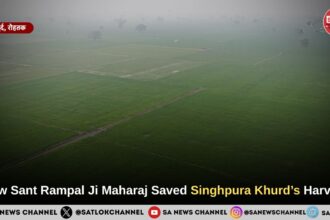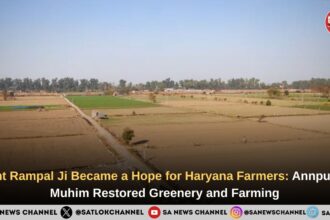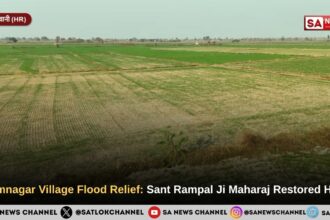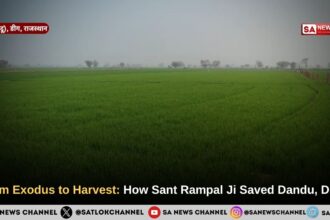


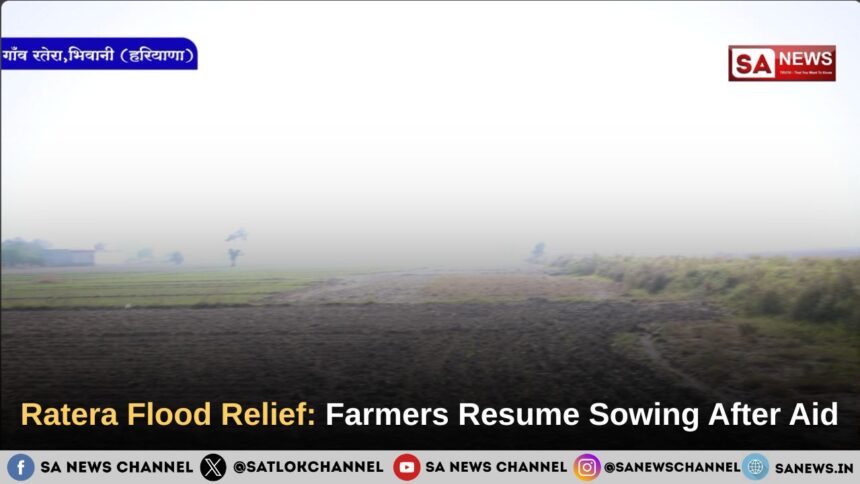
Flood-hit Ratera village in Bhiwani district of Haryana is witnessing signs of recovery after months of severe waterlogging that had submerged fields, homes, village roads, and agricultural land. Villagers said the flood situation had persisted since 2018, repeatedly damaging kharif crops and affecting farming activity across thousands of acres. According to villagers and local farmers, relief reached the village after an appeal was made to Tatvdarshi Sant Rampal Ji Maharaj. Following the assistance, large-scale water drainage work was carried out, allowing wheat and mustard sowing to begin again in many affected areas.
- Key Takeaways From the Ratera Flood Relief Effort
- Flooding in Ratera Left Farms and Houses Submerged
- Farmers Said Previous Appeals Brought Little Relief
- Relief Arranged Through Sant Rampal Ji Maharaj’s Support
- Villagers Describe Visible Change After Water Drainage
- Farmers Recall Rescue-Like Conditions During Peak Flooding
- Ratera’s Recovery Reflects Community-Led Relief Efforts
Villagers said they approached the team of Jagatguru Sant Rampal Ji Maharaj with a prayer for help after repeated appeals to authorities allegedly brought little relief. According to residents, the village had been struggling with severe flooding for years, and many farmers feared they would lose another cultivation season due to the standing water spread across agricultural land.
Key Takeaways From the Ratera Flood Relief Effort
- Ratera village in Bhiwani’s Bawani Khera tehsil faced recurring flood problems since 2018
- Farmers said kharif crops were repeatedly destroyed due to waterlogging
- Villagers claimed several feet of water submerged homes, roads, and thousands of acres of farmland
- Assistance was arranged by Sant Rampal Ji Maharaj Ji’s Team under the Annapurna Muhim initiative
- Relief included:
- 1,800 feet of 8-inch pipeline
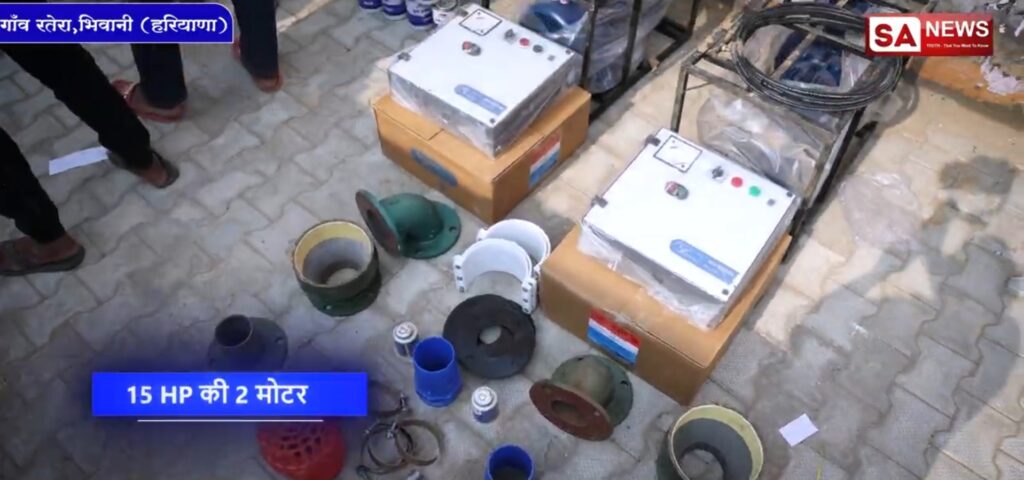
- Two 15 HP motors
- Operational accessories including starters, cables, suction pipes, adhesives, nuts and bolts
- Villagers stated that the support was provided free of cost
- Farmers reported that mustard and wheat sowing resumed after drainage operations
- Local residents said nearly 50% to 70% of cultivation activity restarted in several areas
| Relief Material Provided | Details |
| Pipeline | 1,800 feet, 8-inch pipeline |
| Motors | Two 15 HP motors |
| Additional Equipment | Starters, cables, elbows, suction pipes, rubber gaskets, adhesives, nuts and bolts |
| Purpose | Draining floodwater from agricultural land |
| Reported Cost to Villagers | No charge, according to villagers |
Flooding in Ratera Left Farms and Houses Submerged
Villagers described the flood situation in Ratera as one of the most difficult phases faced by the farming community in recent years. According to residents, water levels in agricultural fields reached nearly seven to eight feet in several areas, while many homes and internal village routes remained submerged under four to five feet of water.
Ground visuals shown during the field report displayed large stretches of agricultural land that had previously remained underwater. Farmers pointed toward mud embankments and water marks near village structures to explain how severely the area had been affected.
Also Read: From Flooded Fields to Flourishing Harvest: A Story of Transformation in Farmana Badshahpur
Local residents said roads connecting the village to the fields became inaccessible due to waterlogging. A temple located near the affected stretch also reportedly remained partially submerged during the peak flooding period.
Farmers Said Previous Appeals Brought Little Relief
Villagers stated that they had spent years approaching officials regarding the recurring flood problem. According to residents, repeated requests and visits to authorities did not result in any permanent solution to the crisis.
Some farmers alleged that government assistance remained limited and insufficient compared to the scale of agricultural losses suffered by the village. Residents said many cultivators feared that even the next sowing season would become impossible if the standing water was not removed in time.
According to villagers, the situation had reached a point where families feared further financial losses, damage to livestock, and long-term impact on cultivation.
Relief Arranged Through Sant Rampal Ji Maharaj’s Support
After villagers approached the committee of Tatvdarshi Sant Rampal Ji Maharaj seeking help, drainage assistance was arranged in the village under the Annapurna Muhim muhim. Residents stated that two powerful 15 HP motors and an 1,800-foot-long 8-inch pipeline were delivered to help remove water from the affected agricultural land.
Villagers repeatedly stated during the ground report that the support was provided free of cost.
The support extended far beyond just major equipment. At a single instruction from Sant Rampal Ji Maharaj, His disciples arranged everything required to make the system operational, including starters, cables, elbows, suction pipes, rubber gaskets, adhesives like Fevicol, and even the smallest steel nuts and bolts.
As villagers themselves expressed, “We didn’t have to purchase even a single nut from the market to get everything running.”
Residents also stated that the equipment was handed over as a permanent village resource so it could be used again in case of future waterlogging situations.
Villagers Describe Visible Change After Water Drainage
Nearly two months after the drainage work began, villagers said most of the accumulated water had been removed from the fields. Farmers pointed toward newly sown mustard crops and wheat fields as signs of recovery.
Several villagers claimed that nearly 50% of sowing activity had already resumed, while others estimated that cultivation had restarted across nearly 70% of the affected area.
A farmer owning 14 acres of land stated that four to five feet of water had submerged his fields earlier, making cultivation impossible. He said the fields later became suitable for sowing after the water was drained.
Another farmer said nearly 150 acres in the surrounding area had remained underwater, with roads and farmland fully submerged. According to him, the assistance helped channel the water into nearby drains and restore access to agricultural land.
Farmers Recall Rescue-Like Conditions During Peak Flooding
Several villagers described the flood situation as severe enough to require boats in some areas. One elderly resident stated that children were taken out using boats when water levels rose in the village.
Residents said houses, livestock, and standing crops remained at risk during the flooding period. Villagers repeatedly described the support as timely assistance that prevented further agricultural and financial damage.
During the field interaction, multiple residents referred to Sant Rampal Ji Maharaj as a “Messiah” for farmers, stating that help reached the village at a time when many had lost hope regarding cultivation and recovery.
Ratera’s Recovery Reflects Community-Led Relief Efforts
Ground conditions in Ratera now show visible agricultural activity in several affected fields where floodwater once remained stagnant for months. Farmers said mustard crops had started emerging while wheat sowing continued in multiple sections of the village.
Residents maintained that timely drainage support helped protect large portions of farmland from remaining barren for another season. Villagers also stated that the assistance restored confidence among farmers who had been uncertain about future cultivation prospects after prolonged flooding.Website: www.jagatgururampalji.org
YouTube: Sant Rampal Ji Maharaj
Facebook: Spiritual Leader Saint Rampal Ji
‘X’ handle: @SaintRampalJiM