

Imagine spending your entire life in a room where 95% of the furniture is invisible. You can feel it when you bump into it, see how it affects the things you can touch, but no matter how bright a light you shine, it never reveals itself directly. That is exactly the situation humanity finds itself in when it comes to the universe. According to the best scientific data available today, only about 5% of everything in existence is made of the atoms and particles we can see, touch, or measure directly. The remaining 95% is split between two deeply mysterious ingredients: dark matter, which makes up roughly 27%, and dark energy, which accounts for approximately 68%.
- What Is Dark Matter?
- How Scientists Discovered Evidence for Dark Matter
- Vera Rubin and the Spinning Galaxy Mystery
- Gravitational Lensing: Bending Light Around Invisible Mass
- What Is Dark Energy?
- How Dark Energy Was Discovered
- Dark Matter vs. Dark Energy: How They Differ
- What Scientists Are Currently Investigating
- Future Missions and the Road Ahead
- Conclusion: The Most Exciting Mystery in Science
These are not science fiction concepts. They are the conclusions of generations of careful observation, Nobel Prize-winning discoveries, and the most ambitious mapping projects in the history of science. Understanding dark matter and dark energy is, in many ways, the central challenge of modern physics. Let us walk through what each one is, how we found them, and why their existence changes everything we thought we knew about the cosmos.
What Is Dark Matter?
The Invisible Glue of the Universe
Dark matter is a form of matter that does not emit, absorb, or reflect any light. It is completely invisible to every kind of telescope ever built, whether optical, radio, X-ray, or infrared. The only reason scientists know it exists at all is because of its gravitational pull, its ability to tug on visible objects and bend the path of light.
Think of it this way: imagine a ghost that cannot be seen or photographed, but every time it walks through a room, it pushes the furniture around. You never see the ghost, but the moving furniture proves it is there. Dark matter is that ghost. Galaxies spin in patterns that make no sense unless enormous amounts of invisible mass are holding them together. Galaxy clusters bend light far more strongly than their visible stars and gas could possibly explain.
Dark matter does not interact with light at all, but it responds to gravity just as ordinary matter does. This single property makes it extraordinarily difficult to detect and, at the same time, leaves behind unmistakable signatures in the behavior of everything around it.
How Scientists Discovered Evidence for Dark Matter
Vera Rubin and the Spinning Galaxy Mystery
The most compelling early evidence came from an astronomer named Vera Rubin, working in the 1970s at the Carnegie Institution of Washington. Rubin and her colleague Kent Ford were measuring how fast stars orbit the centers of spiral galaxies. Based on the laws of gravity, stars far from a galaxy’s center should orbit more slowly than stars near the core, just as Neptune orbits the Sun far more slowly than Mercury does.
What Rubin found was entirely different. The stars on the outermost edges of galaxies were moving just as fast as those near the core. According to everything physicists knew about gravity, that should have been impossible. The implication was staggering: either Newton’s laws were wrong, or the visible matter in galaxies accounted for only a small fraction of the total mass.
Rubin and Ford kept observing galaxy after galaxy, and every single one showed the same pattern: flat rotation curves, meaning stars at the edges orbit just as fast as stars near the center. The conclusion was inescapable. Each galaxy was embedded in a vast sphere of invisible matter that extended well beyond the visible stars and gas, and this dark matter outweighed the visible matter by a wide margin.
Gravitational Lensing: Bending Light Around Invisible Mass
A second line of evidence comes from a phenomenon called gravitational lensing. When a massive object sits between Earth and a distant light source, its gravity bends and magnifies that light, acting like a cosmic magnifying glass. Scientists used DESI’s 3D galaxy maps combined with cosmic microwave background data to measure the “clumpiness” of dark matter in and around galaxies, using gravitational lensing to map all the different matter components in the universe, including dark matter.
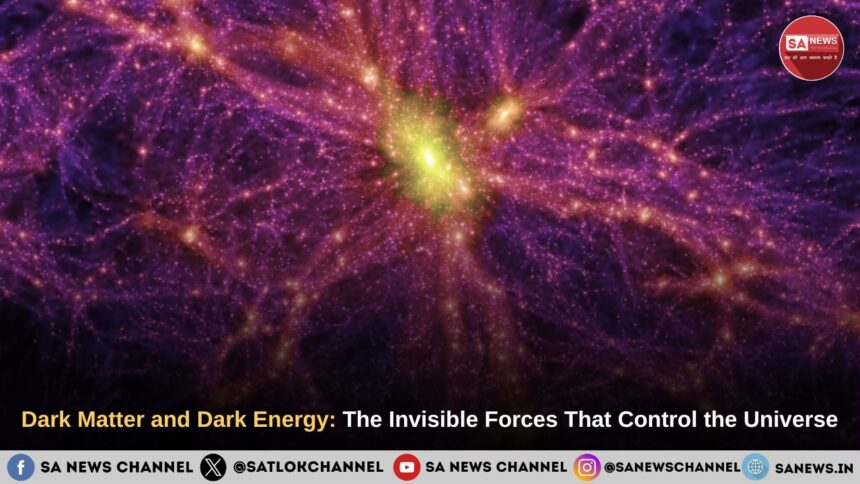
These maps consistently show that dark matter forms a vast cosmic web of invisible filaments and halos, with galaxies forming wherever this web is densest.
Also Read : The Craziest and Most Shocking Planets in the Universe That Feel Unreal
Why Dark Matter Matters: Its Role in the Universe
Dark matter is not merely a curiosity. It is the structural scaffolding of the entire universe. In the early universe, after the Big Bang, ordinary matter on its own would not have clumped together fast enough to form galaxies and stars within the time available. Dark matter provided the gravitational framework around which ordinary matter gathered, and without it, we might not have the elements in our galaxy that allowed life to appear.
Every galaxy sits inside a halo of dark matter. Those halos acted as gravitational seeds billions of years ago, pulling in hydrogen and helium gas until the density became high enough to ignite the first stars. Wherever scientists see a large cluster of thousands of galaxies, they also see an equally massive amount of dark matter in the same place, and when a thin string of regular matter connects two clusters, a corresponding string of dark matter runs alongside it.
Without dark matter, galaxies would fly apart, stars might never have formed, and the structured, layered universe we inhabit would simply not exist.
What Is Dark Energy?
A Force That Pushes the Universe Apart
If dark matter is the invisible glue, dark energy is the invisible stretching force. It is a property of space itself, a kind of energy embedded in the very fabric of the universe, and it is causing every galaxy to accelerate away from every other galaxy at an ever-increasing speed.
To understand this, picture blowing up a balloon covered in dots. As the balloon expands, every dot moves away from every other dot. The universe has been expanding like that balloon since the Big Bang. But dark energy is not just maintaining that expansion: it is pressing on the gas pedal, making the expansion speed up over time.
This is deeply counterintuitive. Gravity pulls things together, so the natural expectation was that the universe’s expansion should be slowing down over time. The discovery that it was actually accelerating stunned the entire scientific community.
The expansion of the universe started to speed up when dark energy began to dominate our universe, roughly ten billion years after the Big Bang. It is not just that the universe is expanding; the rate of expansion is increasing. Gravity tells us this should not be happening. It is as if you threw something into the air and it kept going up indefinitely, which contradicts everything we know about physics on Earth.
How Dark Energy Was Discovered
Two Teams, One Shocking Result
The discovery of dark energy in 1998 is one of the most dramatic moments in the history of science. No wonder, then, that cosmology was shaken at its foundations when two different research groups presented similar results in 1998: Saul Perlmutter’s Supernova Cosmology Project and Brian Schmidt’s High-z Supernova Search Team, in which Adam Riess played a crucial role.
Both teams were studying a specific type of exploding star called a Type Ia supernova. These explosions are useful because they always release the same amount of light, making them reliable “standard candles” for measuring cosmic distances. In 1998, the Nobel-winning astronomers used just 52 supernovae to determine that the universe is expanding at an accelerating rate. The discovery came as a complete surprise even to the scientists who made it.
The discovery that the universe was accelerating was named Science magazine’s Breakthrough of the Year for 1998, and it resurrected physicist Albert Einstein’s earlier idea of an energy that counteracts gravity and pushes space apart. Einstein had originally introduced this concept as a mathematical term in his equations before later abandoning it; now it was back, vindicated by observation.
The 2011 Nobel Prize in Physics was awarded to Saul Perlmutter, Brian Schmidt, and Adam Riess for this discovery, prior to which most models of the universe predicted that the gravitational pull of matter should cause the expansion of space to slow down over time.
Also Read : Deadliest Universe Objects: Black Holes & Space Threats
How Dark Energy Shapes the Fate of the Universe
Dark energy currently makes up approximately 68% of the total energy content of the universe, making it the single most dominant component of everything that exists. Its influence grows stronger as the universe expands, because more space means more of this embedded energy.
By comparing how galaxies clustered in the past with their distribution today, researchers have traced dark energy’s influence over 11 billion years of cosmic history. These observations suggest that dark energy was relatively weak in the universe’s early stages but gradually became more dominant as gravity’s hold loosened over expanding distances.
If dark energy remains constant or continues strengthening, galaxies will eventually drift so far apart that future civilizations, billions of years from now, would look out at a completely dark sky with no other galaxies visible. Some models even suggest a scenario called the “Big Rip,” where the accelerating expansion eventually tears apart galaxies, then stars, then planets, and ultimately even atoms themselves. Alternatively, new dark energy data suggesting the influence of dark energy may be weakening over time has raised the possibility that the universe could eventually reverse its expansion and collapse in a “Big Crunch.”
Dark Matter vs. Dark Energy: How They Differ
Despite sharing the word “dark,” these two phenomena are completely unrelated. Understanding their differences is key to understanding why each one is its own profound puzzle.
| Feature | Dark Matter | Dark Energy |
| What it is | A form of matter with mass | An energy embedded in space itself |
| How it behaves | Gravitationally attractive, pulls things together | Gravitationally repulsive, pushes things apart |
| Share of universe | ~27% | ~68% |
| Effect on galaxies | Holds them together, forms cosmic scaffolding | Drives galaxies apart at accelerating speed |
| When discovered | Evidence from 1970s (Vera Rubin) | Discovered in 1998 (supernova observations) |
| Current detection | Inferred from gravitational effects | Inferred from accelerating expansion |
Dark matter acts locally: it clusters around galaxies and galaxy clusters, holding structures together. Dark energy acts globally: it operates at the scale of the entire universe and determines its ultimate fate. They were each discovered through completely different methods, and current theories suggest they have no direct connection to each other.
What Scientists Are Currently Investigating
Evolving Dark Energy and the DESI Revolution
One of the most exciting developments in modern cosmology is the possibility that dark energy is not actually constant over time. Einstein’s original idea, called the “cosmological constant,” assumed dark energy was fixed and unchanging. But new data is challenging that assumption.
New results from the Dark Energy Spectroscopic Instrument (DESI) collaboration have used the largest 3D map of our universe ever made to track dark energy’s influence over the past 11 billion years. Researchers see hints that dark energy may be evolving over time in unexpected ways.
DESI completed its originally planned five-year survey ahead of schedule and with vastly more data than expected, producing the largest high-resolution 3D map of the universe ever made. Surprising results from the first three years of data hinted that dark energy, once thought to be a cosmological constant, might be evolving. With the full set of five years of data, researchers will have significantly more information to test whether that hint disappears or grows. If confirmed, it would mark a major shift in how we think about our universe and its potential fate.
What Is Dark Matter Made Of?
The leading candidate for dark matter particles for decades has been a class of hypothetical particles called WIMPs (Weakly Interacting Massive Particles). Despite increasingly sensitive underground detectors, no WIMP has ever been directly detected.
Some of the leading theories describe dark matter as being made of particles that, when two of them meet, annihilate and produce high-energy radiation such as gamma rays. Detecting this radiation is one of the main strategies scientists use to search for dark matter, and observations from the Fermi Gamma-ray Space Telescope have revealed an unusual glow near the center of the Milky Way that could be linked to dark matter.
In November 2025, astronomers detected a high-energy gamma ray signal that fits the expected footprint of dark matter particles, a discovery that could represent humanity’s first direct observational evidence of this long-hidden cosmic material. It remains under active investigation.
Future Missions and the Road Ahead
Telescopes That Could Change Everything
Several major scientific missions are actively working to unravel these mysteries.
NASA’s Nancy Grace Roman Space Telescope, set to launch in late 2026, will map dark matter over an area thousands of times larger than any previous survey. The Vera Rubin Observatory in Chile, named after the astronomer who pioneered dark matter research, will scan the entire southern sky repeatedly, tracking billions of galaxies to study both dark matter distribution and the behavior of dark energy over time.
Faint hydrogen signals from the cosmic Dark Ages may soon help determine the mass of dark matter particles, with simulations suggesting that future Moon-based observatories could distinguish between different types of dark matter.
DESI has already gathered measurements from six times more galaxies and quasars than any previous experiment and continues expanding its map. When the full five-year dataset is analyzed, scientists will have the most precise measurement ever taken of dark energy’s behavior across cosmic history.
Conclusion: The Most Exciting Mystery in Science
The universe is telling us something profound: nearly everything that exists remains invisible to us. The atoms, planets, stars, and galaxies that fill textbooks and inspire awe when we look up at the night sky account for barely five cents of every dollar of the universe’s total content. The remaining 95% operates silently, shaping everything around it.
This is not a failure of science. It is science at its most honest and alive, pushing into territory where certainty gives way to wonder. Ancient wisdom reminds us that the deepest truths about existence often lie beyond the reach of the ordinary senses. For those drawn to explore life’s ultimate questions, the books “Gyan Ganga“ and “Way of Living” by Saint Rampal Ji Maharaj offer a profound framework for understanding creation and the hidden dimensions of existence. The universe invites curiosity, and that curiosity, whether turned toward the stars or turned inward, is always worth following.