

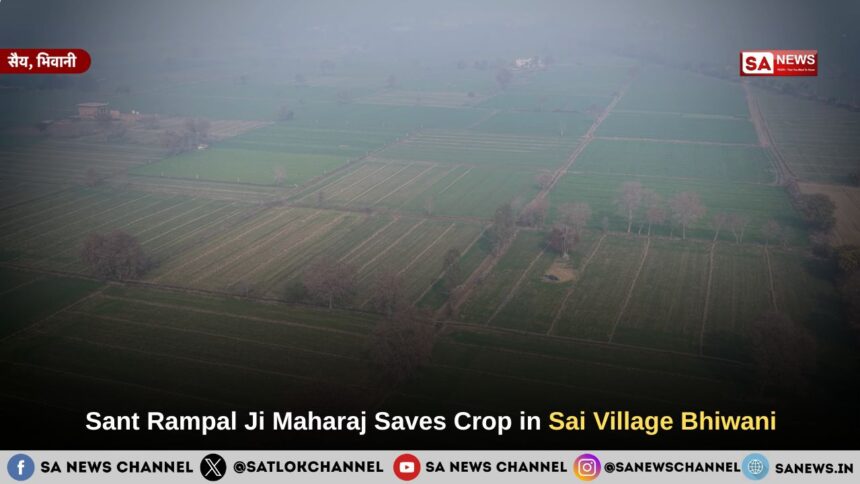
Sai village, located in the Bhiwani district of Haryana, maintains an economy where 95% of the population is entirely dependent on agriculture for their livelihood.
- Failure of Initial Drainage Efforts and Administrative Requests
- Material Assistance Provided by Sant Rampal Ji Maharaj
- Agricultural Restoration and Current Crop Status
- Summary of Aid and Financial Impact in Sai Village Bhiwani
- Individual Economic Impact and Farmer Testimonials
- Technical Implementation and Long-term Infrastructure
- Recovery of Rural Livelihoods and Social Stability
- Comprehensive Reclamation of Submerged Acreage in Sai
In August, specifically around the 10th and 11th, heavy rainfall caused severe flooding, submerging approximately 1,000 acres of land. This stagnant water reached depths of 4 to 5 feet, resulting in the total destruction of the Kharif crops, primarily paddy and cotton.
The persistence of this waterlogging until late November threatened the sowing of the Rabi wheat crop, which is essential for the annual financial stability of the resident farming families.
Failure of Initial Drainage Efforts and Administrative Requests
The village representatives, including the Sarpanch and local residents like Ranbir and Ashok Kumar, initially sought assistance from government departments.
While some administrative support was provided, the scale of the waterlogging exceeded the capacity of the available resources. The official procedures involved a sequential waiting list (number system), which the villagers found too slow to clear the fields in time for the wheat sowing window.
Consequently, a delegation from the village visited Barwala to submit a formal request for technical aid.
Material Assistance Provided by Sant Rampal Ji Maharaj
Upon receiving the petition from the villagers of Sai, Sant Rampal Ji Maharaj provided immediate logistical and technical support through the Annapurna Muhim. The following resources were delivered to the village within three days of the request:
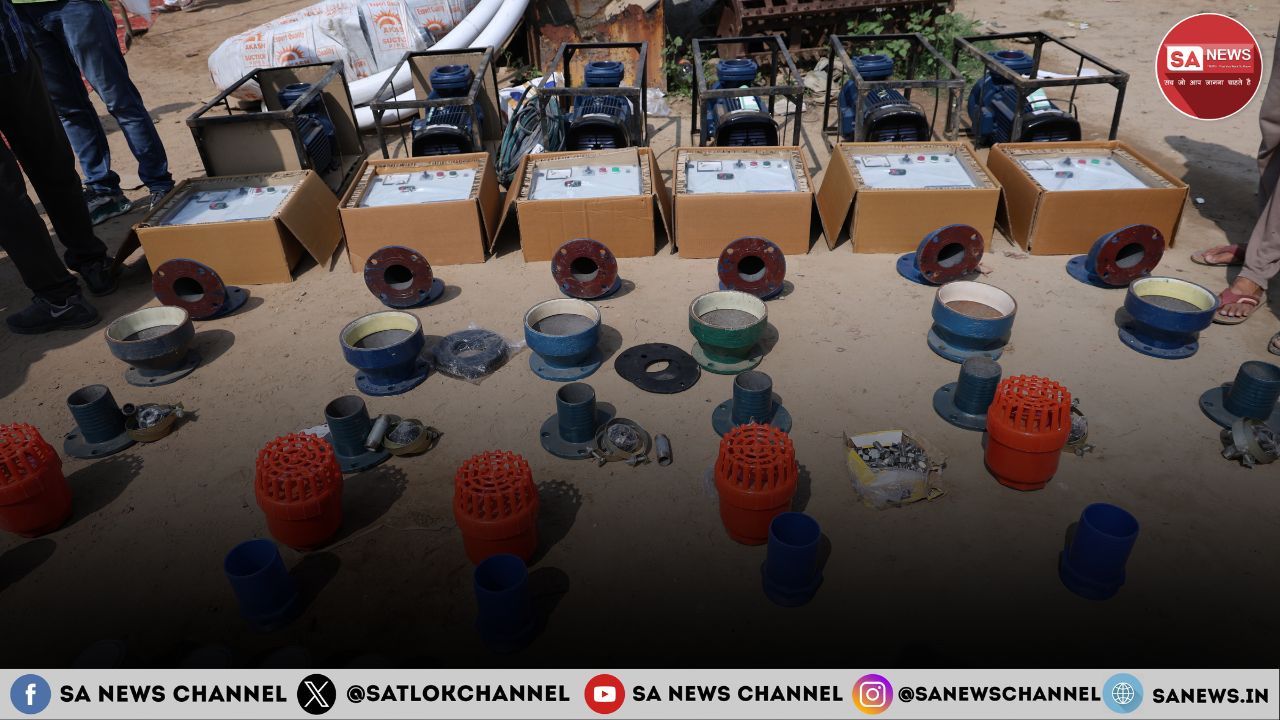
- Four high-capacity 15 Horsepower (HP) water-pumping motors.
- 12,000 feet of heavy-duty piping.
- All necessary electrical and mechanical accessories, including starters and 80 feet of specialized cables.
- Essential hardware such as nuts and bolts required for the complete assembly and operation of the drainage system.
These items were provided without any requirement for donations, fees, or administrative charges.
Agricultural Restoration and Current Crop Status
The machinery provided by Sant Rampal Ji Maharaj was operated continuously to expel the 5-foot deep stagnant water beyond the village boundaries and into designated canal systems. Two months following the intervention, the agricultural status of the 1,000-acre tract is as follows:
- 99% of the previously submerged land has been successfully reclaimed.
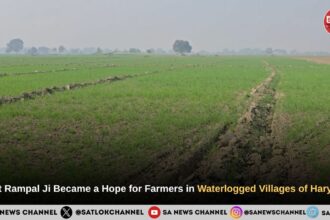
- Wheat crops have been sown across the reclaimed fields and are currently in the growth stage.
- The same pipes and motors provided for drainage are now being utilized for the first irrigation cycle of the newly sown wheat.
- Residents have permanently installed several of the pipe sections underground to serve as a long-term drainage infrastructure to prevent future waterlogging.
Summary of Aid and Financial Impact in Sai Village Bhiwani
| Category | Technical and Economic Data |
| Machinery Provided | 4 Motors (15 HP each) |
| Pipeline Infrastructure | 12,000 Feet |
| Total Reclaimed Land | 1,000 Acres |
Individual Economic Impact and Farmer Testimonials
The intervention by Sant Rampal Ji Maharaj prevented substantial financial losses for individual households and the collective village economy. Residents provided specific data regarding their losses and recovery:
- Vijay Singh (Brother of the Sarpanch): Personally manages 10 acres of land. He stated that the input cost for the lost Kharif crop was ₹15,000 to ₹20,000 per acre. With an expected wheat yield value of ₹50,000 per acre, the intervention saved him approximately ₹7 lakh in potential total loss.
- Ashok Kumar and Ranbir: Their family manages 50 acres of land. They reported that after receiving zero income from the Kharif season, the inability to sow wheat would have resulted in an unsustainable debt burden.
- Leasehold Farmers: One resident farmer who leases 8 acres at a rate of ₹20,000 per acre stated that without the drainage provided by Sant Rampal Ji Maharaj, he would have had no means to pay the lease or support his family, as he has no other source of employment.
- Collective Savings: The village leadership calculated that the successful sowing of the wheat crop across 1,000 acres, at a market value of approximately ₹70,000 per acre (including fodder), equates to a total economic restoration of ₹7 crore.
Technical Implementation and Long-term Infrastructure
Sant Rampal Ji Maharaj directed that the equipment be used exclusively for the benefit of the village until the crisis was fully resolved. The villagers provided the labor to operate the motors and lay the 12,000 feet of pipe.
Recognizing the recurring nature of such environmental challenges—noting a similar flood occurred in 1995—the village panchayat has strategically buried portions of the 12,000-foot pipeline.
This underground network is intended to provide an immediate response mechanism for future rainfall events, ensuring that the agricultural land remains productive.
Recovery of Rural Livelihoods and Social Stability
The successful drainage of 5-foot deep water has transitioned the village from a state of total crop failure to one of agricultural productivity. Where previously there were stagnant pools and destroyed crops, there is now green wheat cover across the fields.
The resident farmers emphasized that the timely provision of high-capacity pumps and pipes by Sant Rampal Ji Maharaj was the sole factor that allowed them to meet the sowing deadline, thereby securing their food supply and financial solvency for the coming year.
Comprehensive Reclamation of Submerged Acreage in Sai
The operation conducted under the guidance of Sant Rampal Ji Maharaj has resulted in the total recovery of the village’s primary economic asset. The 99% reclamation rate across 1,000 acres has neutralized the threat of long-term soil damage and financial insolvency.
The current status of the fields, featuring sprouted wheat and active irrigation, confirms the transition from an environmental disaster zone to a functional agricultural landscape, effectively preserving the livelihoods of the 95% of residents who depend on this land.