

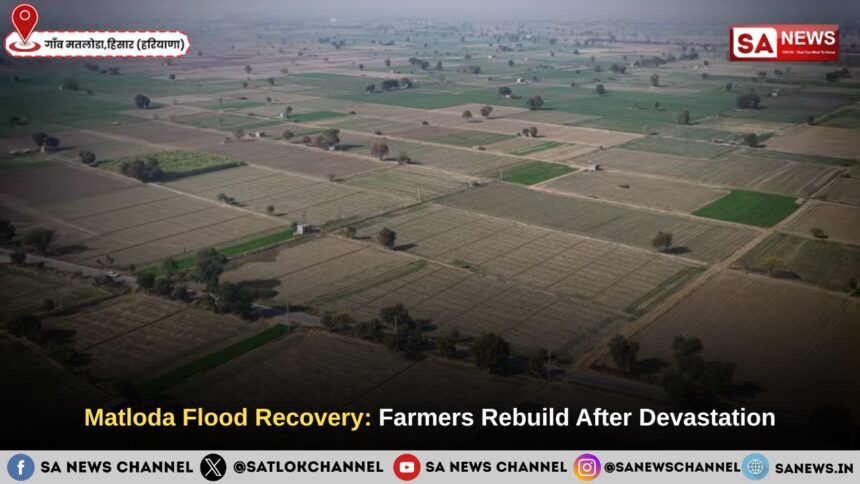
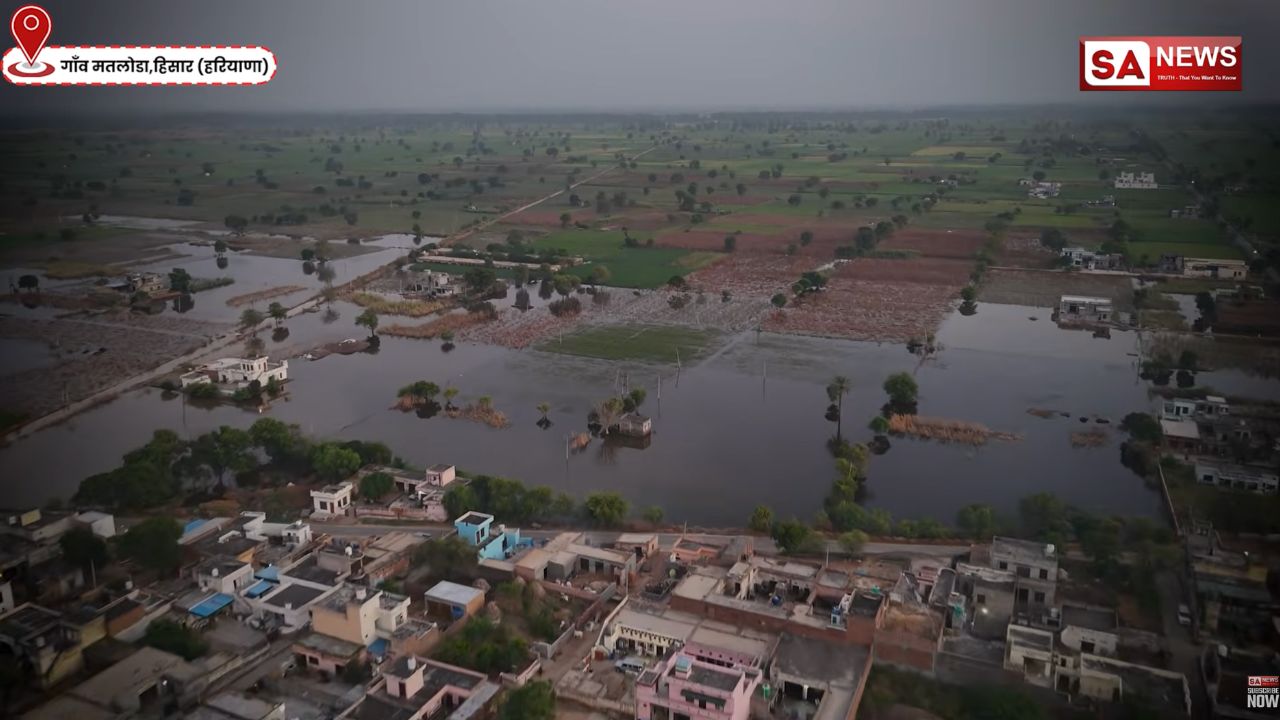
Matloda village in Hisar district of Haryana was, until a few months ago, a normal rural settlement where greenery in the fields and hope on people’s faces could be seen. But sudden heavy rainfall and floods completely changed the picture of this village. Around 2000 acres of land surrounding the village were submerged under 4 to 5 feet deep water. The situation became so severe that about 400 houses were affected, and even the government school was filled with water and turned into a pond.
- Farmers Broken: Crisis Over Crops, Debt, and Future
- Administrative Limitations and Ground Reality
- Hope for Help: When the Panchayat Took a Big Step
- Relief Work: Rapid Use of Technology and Resources
- From School to Fields: Visible Change on the Ground
- Social Impact: Brotherhood and New Hope
- From Disaster to Opportunity by the Grace of Sant Rampal Ji Maharaj
Village elders say they had never seen such a situation before. Standing crops in the fields were completely destroyed, and the lands meant for the next sowing remained waterlogged for months. Water began to stagnate in the village streets, increasing the risk of mosquitoes and diseases rapidly. People had only one question — what next?
Farmers Broken: Crisis Over Crops, Debt, and Future
The biggest impact of this disaster was on the farmers. The fields that provided income for the entire year were completely ruined. A farmer, Ramkesh, says, “There was water up to the chest level in our fields. Forget crops, it was difficult even to stand on the land. We started falling ill, and due to mosquitoes and filth, the condition worsened.”
Another farmer, Vikram, says, “Our entire crop was destroyed. In many places, there was up to 5 feet of water. Houses started collapsing, and it became difficult to save even the livestock. It felt like we would have to leave the village.”
The financial condition of farmers was deteriorating rapidly. The pressure of debt was increasing, and there was no hope for the next crop. Even the expectation of compensation was very low, and whatever was available was negligible compared to the losses.
Administrative Limitations and Ground Reality
Villagers say that although assurances were given by the administration, no concrete help reached at the ground level. Many farmers said that officials and leaders visited the site, assessed the situation, but could not provide solutions.
A villager, Anil, says, “Leaders came, got photos clicked, and left. We received no real help. The compensation was so little that it was useless.”
Sarpanch representative Jagbir Fauji says he used to receive hundreds of calls daily — some reporting collapsing houses, others talking about drinking water issues, and many distressed over crop losses. There was an atmosphere of chaos in the village.
Hope for Help: When the Panchayat Took a Big Step
When all paths seemed blocked, the village panchayat took a step in a different direction. The sarpanch representative and villagers appealed for help to Sant Rampal Ji Maharaj.
Jagbir Fauji says, “Initially, we only requested 16,000 feet of pipe and two motors. But we received far more than expected. We were immediately provided with 35,000 feet of pipe and four motors.”
The most important aspect was that this help arrived in a very short time. While under normal circumstances such arrangements could take days or weeks, here the materials reached the village within a single day.
Relief Work: Rapid Use of Technology and Resources
In total, about 42,000 feet long pipeline and seven powerful 15-horsepower motors were installed in the village. Additionally, 500 feet of pipe and two motors were separately provided for the school.

As soon as these resources arrived, work began at a war footing. Motors were installed at different locations, and water was drained out through pipelines. Villagers say the work continued day and night. Within a few days, the water level started decreasing rapidly, and gradually the water was completely drained from the fields and the village.
From School to Fields: Visible Change on the Ground
The government school, which earlier had 4 to 6 feet of water, is now functioning again with children returning to their studies. The school grounds have dried up, and classes have resumed.
A student said, “Our classes were बंद for a month. Now that the water has drained, we can come to school again.”
The condition of the fields also improved rapidly. Where water once stood, ploughing and sowing have now been completed. Wheat and mustard crops have started growing, and the fields have turned green again.
The important aspect was that this help was provided without any discrimination and in a completely organized manner. Resources were allocated according to the needs of different parts of the village, and even the government school was separately equipped with motors and pipes. Villagers say that while such arrangements usually take time, here immediate action was seen, which brought the situation under control before it worsened.
Social Impact: Brotherhood and New Hope
The impact of this entire process was not limited to the fields but also affected the village’s social structure. Earlier, disputes had begun among people over water, but after the availability of pipes and motors, the situation changed.
A farmer says, “Earlier there were fights over whose field the water would go to. But once everyone got the facility, the disputes ended.” Employment in the village also increased as farming activities resumed. This provided economic relief and helped restore normal life.
According to the sarpanch representative, this entire assistance directly benefited the village by crores of rupees. From wheat crops alone, an estimated benefit of around ₹8 crores is expected. Additionally, many houses on the verge of collapse were saved. Fodder became available for livestock, and the village economy gradually began to recover.
From Disaster to Opportunity by the Grace of Sant Rampal Ji Maharaj
The story of Matloda village is not just about a natural disaster but also about recovery from it. While the flood had pushed the entire village into crisis, timely technical and resource-based help from Sant Rampal Ji Maharaj changed the situation.
Today, the fields of the village are green again, children’s voices echo in schools, and hope has returned to the faces of farmers. In this entire story of Matloda village, the role of Sant Rampal Ji Maharaj appears decisive. When the village was surrounded by water from all sides and farmers were not receiving relief from anywhere, He responded immediately to the panchayat’s appeal and provided assistance. According to villagers, within a very short time, thousands of feet of pipeline and several high-capacity motors were delivered to the village, enabling rapid water drainage.
Farmers believe that this technical and financial support not only helped save their crops but also gave the entire village a chance to stand up again. Many farmers described it as “the biggest help received at the right time,” because if the water had remained for a few more days, the damage could have increased further. Sant Rampal Ji Maharaj is an extraordinary saint before whom everyone bows. Everyone is calling Saint Rampal Ji maharaj God.