


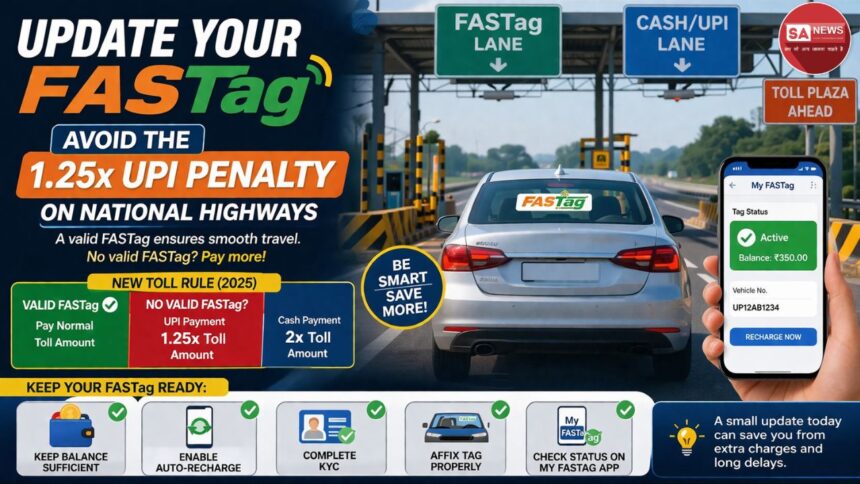
1.25x UPI Toll Penalty: India’s toll system has entered a stricter digital phase, and that means a FASTag sticker by itself is no longer enough. What matters at a National Highway fee plaza is whether your FASTag is valid, functional, correctly linked to your vehicle, properly affixed on the windshield, and backed by sufficient balance.
- Why this FASTag update matters more in 2026
- What an “updated” FASTag actually means
- A working FASTag is not just a sticker on the windshield
- KYC matters, and so does “One Vehicle, One FASTag”
- How to avoid the 1.25x UPI toll charge before your next trip
- Keep balance ready and stop relying on memory
- Check your status before leaving home
- Use the official grievance channels instead of arguing at the lane
- Know your rights if the toll equipment fails
- Why the government is tightening digital tolling
- What this means for daily commuters and private vehicle owners
- Road Discipline and Inner Discipline
- Update Your FASTag Before Your Next Highway Trip
- FAQs on FASTag Now
- 1. What is the 1.25x UPI toll charge on National Highways?
- 2. Will I still pay more if I have a FASTag but it is blacklisted?
- 3. Can I recharge my FASTag just before reaching the toll plaza?
- 4. How do I know if my FASTag is active or blacklisted?
- 5. What should I do if my FASTag shows balance but still causes trouble?
- 6. Where can I complain about a wrong deduction or toll dispute?
- 7. What happens if the toll equipment is not working but my FASTag is valid?
The government’s amended toll framework, introduced in October 2025 and still reflected in Parliament replies in February and March 2026, allows users without a valid FASTag to pay through UPI at 1.25 times the normal fee, while cash can still trigger a double charge. For regular commuters, this turns FASTag maintenance into a direct money-saving habit, not just a digital convenience. NHAI tweeted on it’s social media X account.
Why this FASTag update matters more in 2026
The most important point for motorists is that the 1.25x UPI rule is not a rumour or a social-media exaggeration. DD News, reporting on the Ministry of Road Transport and Highways amendment, stated that vehicles entering a toll plaza without a valid, functional FASTag face higher fees, with UPI charged at 1.25 times the applicable user fee and cash charged at double the standard fee. Recent parliamentary answers in 2026 also refer to G.S.R. 734(E) dated October 3, 2025, confirming that the applicable user fee for vehicles without FASTag or active FASTag was reduced from 2 times to 1.25 times if the user opts for UPI.
That means the penalty is real, measurable, and very easy to understand. If the standard toll for your vehicle is ₹100, a valid FASTag user pays ₹100 through the regular electronic toll system. A non-valid FASTag user who chooses UPI could pay ₹125, while a cash user could pay ₹200. In practical terms, UPI is cheaper than cash for non-compliant users, but it is still more expensive than simply keeping FASTag ready before the journey begins.
The government’s broader direction is also clear. In its January 2026 communication, PIB said that the change from 2x to 1.25x on UPI payments is meant to make digital payment a more practical alternative at toll plazas, with the goal of quicker movement and fewer disputes. The same official note said that between November 15 and December 10, 2025, more than 15 lakh UPI transactions were recorded at toll plazas, totaling ₹19.44 crore, while cash collection dropped by 25 percent. That is a strong signal that highway tolling is moving toward a more disciplined and more digital operating culture.
PIB also said that 98 percent of vehicles already use FASTag, which means the remaining users are now operating against the direction of the system rather than with it. For daily commuters, taxi owners, fleet operators, and even occasional family travelers, the practical takeaway is blunt: the cost of neglect has gone up, and the cost of staying compliant is still comparatively low. In a highway network that is already highly digitized, outdated FASTag habits now translate directly into extra spending and avoidable stress.
Also Read: Govt Launches PM E-Drive Scheme – Replaces FAME, Ignored Electric, Hybrid Vehicles
What an “updated” FASTag actually means
A working FASTag is not just a sticker on the windshield
Many motorists still think that buying FASTag once is enough forever. Official FASTag guidance shows otherwise. A blacklisted tag is one that has been blocked by the issuer bank and cannot be used to pay toll at a plaza. The same official FAQ says that tags can be blacklisted because of insufficient balance, vehicle-tag class mismatch, or non-affixation on the windshield and carrying the tag by hand. In other words, the problem is often not the absence of FASTag but the poor maintenance of FASTag.
This is why the phrase “update your FASTag” should be understood in a practical way. It means that the tag must have adequate balance, it must be attached properly to the correct vehicle, and it must remain readable and valid in the toll system. A loose tag on the dashboard, a tag issued for another vehicle class, or a tag with zero balance may all leave the driver exposed to the same result: the plaza does not accept the vehicle through the normal FASTag process, and the user ends up paying more.
KYC matters, and so does “One Vehicle, One FASTag”
Another part of FASTag compliance that many users ignore is KYC. NHAI’s “One Vehicle, One FASTag” initiative made it clear that users should complete the KYC process of their latest FASTag as per RBI guidelines, and that FASTags with valid balance but incomplete KYC would be deactivated or blacklisted by banks. NHAI also directed users to discard earlier issued FASTags and keep only the latest active one for a vehicle. This is important because many motorists think balance alone is enough, but the official position says that incomplete KYC can also create trouble.
That press release also explained why the reform was needed. NHAI referred to multiple FASTags being issued for a particular vehicle and to tags sometimes not being fixed on the windshield, both of which were creating unnecessary delays at toll plazas. So, an “updated” FASTag in 2026 does not only mean money in the wallet; it also means proper KYC, one active tag per vehicle, and correct physical placement. This is where many avoidable toll disputes begin.
Also read https://news.jagatgururampalji.org/fastag-annual-pass/
How to avoid the 1.25x UPI toll charge before your next trip
Keep balance ready and stop relying on memory
The easiest way to avoid an avoidable toll penalty is to remove memory from the process. In its February 2025 clarification, PIB stated that FASTag customers are encouraged to link their FASTag wallet to UPI, current account, or savings account under auto-recharge settings so they do not need manual recharges.
The same clarification said that all National Highway toll plazas operate on ICD 2.5 protocol with real-time tag status, and customers can recharge any time before crossing the toll plaza. This means a driver does not have to top up hours in advance, but should still avoid reaching the fee plaza with an empty balance and a hopeful mindset.
Auto-recharge is especially useful for people who travel on highways repeatedly: office commuters, sales teams, logistics vehicles, airport route drivers, and weekend intercity travelers. These users do not lose money because tolling is expensive by itself; they lose money because small lapses happen again and again. A funded FASTag wallet linked to auto-recharge turns tolling into a silent background process, which is exactly what the digital system is designed to achieve.
Also read: https://news.jagatgururampalji.org/toll-tax-on-two-wheelers-hindi/
Check your status before leaving home
NHAI’s My FASTag App offers one of the simplest tools available to users. According to the official app release, the app shows balance and tag status through color codes: green for active tag with sufficient balance, orange or amber for low balance, and red for blacklisted tags. This is a small but powerful feature because it removes guesswork. A driver no longer has to assume the tag is fine; the app gives a clear signal before the vehicle ever reaches the highway.
That makes one simple habit especially valuable: check FASTag status the same way you check fuel, tyres, or driving documents. A green status before departure is far better than a debate at the toll lane. If the app shows orange, top up immediately. If it shows red, do not assume the plaza will sort it out for you. A five-minute check at home is significantly cheaper than a 1.25x UPI charge repeated across multiple plazas in one day.
Use the official grievance channels instead of arguing at the lane
Toll disputes do happen, but the system now has official channels that motorists should know. A February 2026 Parliament reply said FASTag-related complaints can be lodged through the National Highways 24×7 Toll-Free Helpline 1033, the dedicated email for false deduction complaints, the respective FASTag issuer bank helplines, and the RajmargYatra App. The same answer said the government is working to make the tolling system “more efficient, transparent, and user-friendly.”
Rajmarg Yatra itself was launched as more than a simple highway information app. NHAI said it offers comprehensive highway information along with an efficient complaint redressal system. Later official NHAI reporting also noted that users can submit complaints with photos or videos, and the app also supports FASTag services such as buying or recharging through connected systems. For the modern highway user, this means the smartphone is not just a payment device; it is also the main dispute-resolution tool.
Know your rights if the toll equipment fails
Motorists often assume that every toll-side malfunction will still cost them money. Official FASTag FAQs provide an important protection here. If the ETC equipment is not working and the vehicle has a valid, functional FASTag with sufficient balance, the user is to be permitted to cross the toll plaza free of cost. The same FAQ also advises users to report the issue to customer care and the concessionaire. This is an important consumer-right detail because not every problem at the lane is the driver’s fault.
So, updating FASTag is not only about obeying the system; it is also about protecting yourself within the system. A well-prepared user knows both obligations and rights. Obligations include proper balance, KYC, correct affixation, and one active tag per vehicle. Rights include dispute channels, correction of wrong deductions, and free passage where ETC equipment has failed despite a valid FASTag. That is the difference between a confused commuter and an informed one.
Why the government is tightening digital tolling
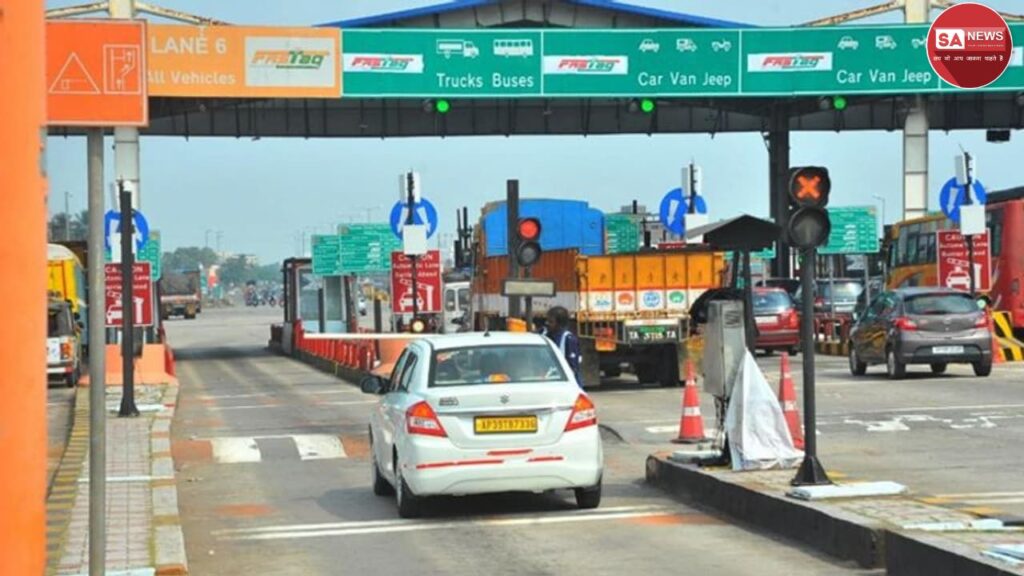
The government’s logic is not difficult to understand. DD News said the Third Amendment Rules, 2025 were meant to incentivize digital payments for non-FASTag users, streamline toll collection, and enhance transparency on National Highways. PIB’s January 2026 communication pushed the same message more conversationally, saying commuters can now “scan, pay, and move.” Together, these official messages point to the same policy direction: less cash, fewer lane arguments, quicker throughput, and a stronger digital audit trail.
This transition is also connected to the next phase of highway tolling. Parliamentary replies in 2026 state that the government has decided to implement Multi-Lane Free Flow electronic toll collection using integrated technologies such as AI-enabled Automatic Number Plate Recognition and RFID-based FASTag, allowing user fee to be charged without making vehicles stop, slow down, or remain in a lane. The future of tolling, in short, is not more manual correction. It is less stoppage, less negotiation, and more automatic verification.
That also means carelessness will become more visible, not less. In a barrier-less or increasingly automated system, the margin for last-minute adjustment shrinks. A driver who reaches the lane with an inactive tag today may still argue, scan, and pay. A driver in a more automated toll environment will be judged much more by system readiness than by personal explanation. So, the discipline of keeping FASTag updated is not only about today’s 1.25x UPI charge; it is preparation for tomorrow’s fully digital toll landscape.
What this means for daily commuters and private vehicle owners
For the average car owner, the lesson is practical rather than ideological. Highway travel costs are now shaped as much by digital compliance as by distance. If your FASTag is active, you move faster and pay the normal fee. If it is not, you may still pass using UPI, but you do so at a premium. If you insist on cash, you could pay far more. That is why FASTag maintenance now belongs in the same category as fuel refill, PUC check, and insurance renewal: a routine task that prevents bigger inconvenience later.
For regular non-commercial users, there is also a broader cost-management angle. PIB said the FASTag Annual Pass fee was revised from ₹3,000 to ₹3,075 for FY 2026-27 with effect from April 1, 2026. The pass is available for eligible non-commercial vehicles with a valid FASTag and covers one year or 200 toll plaza crossings, whichever is earlier. For users who repeatedly travel on National Highways, staying compliant is therefore not just about avoiding penalties; it can also open the door to more predictable and economical toll spending.
PIB also said the pass activates within two hours on the existing FASTag linked to the vehicle after payment through Rajmarg Yatra or the NHAI website. That detail again reinforces the central message of this story: the toll system is increasingly built around digital identity, verified payment readiness, and connected platforms. The private vehicle owner who learns this early will save both time and money. The one who ignores it will keep paying the price in small but repeated penalties.
Road Discipline and Inner Discipline
This FASTag update also carries a deeper life lesson. A small act of negligence on the road can lead to repeated financial loss, delay, and frustration. In a similar way, the official teachings associated with Sant Rampal Ji Maharaj present true spiritual knowledge as a path of discipline, right conduct, and scriptures-based worship rather than carelessness and confusion.
His official materials describe true worship and spiritual knowledge as the way to free the soul from suffering and move toward salvation. In that light, the FASTag story becomes more than a toll advisory: it is a reminder that order, truth, and discipline save us from avoidable penalties in both worldly life and spiritual life. To realise the deep spiritual experience read Sant Rampal Ji Maharaj’s sacred book Gyan Ganga by clicking on this link:Read Gyan Ganga.
Update Your FASTag Before Your Next Highway Trip
Five minutes of preparation can save money, time, and stress
Before your next National Highway trip, check only a few things: whether your FASTag shows green status, whether the balance is enough, whether KYC is complete, whether the tag is properly fixed on the windshield, and whether auto-recharge is turned on. Keep the My FASTag App or RajmargYatra ready, and remember 1033 in case of a dispute.
In 2026, that small routine is no longer optional housekeeping. It is the easiest way to avoid the 1.25x UPI toll charge, prevent plaza delays, and move through India’s highways with greater confidence and less friction.
FAQs on FASTag Now
1. What is the 1.25x UPI toll charge on National Highways?
It is the higher user fee applicable to vehicles without a valid, functional FASTag when the user opts to pay by UPI. Official reporting and parliamentary replies say the charge was reduced from 2 times to 1.25 times if the user chooses UPI.
2. Will I still pay more if I have a FASTag but it is blacklisted?
Yes, because a blacklisted FASTag cannot be used to pay toll. Official FASTag guidance says blacklisting can happen because of low balance, class mismatch, or not affixing the tag properly on the windshield.
3. Can I recharge my FASTag just before reaching the toll plaza?
Yes. PIB clarified that National Highway toll plazas operate on real-time tag status, and FASTag customers can recharge any time before crossing the toll plaza. Auto-recharge is also officially recommended.
4. How do I know if my FASTag is active or blacklisted?
Use the My FASTag App. NHAI says the app shows green for active tag with sufficient balance, orange or amber for low balance, and red for blacklisted tags.
5. What should I do if my FASTag shows balance but still causes trouble?
First, check whether your KYC is complete and whether you are using only the latest valid tag for that vehicle. NHAI’s “One Vehicle, One FASTag” initiative warned that incomplete KYC and multiple tags linked to one vehicle can lead to deactivation or blacklisting.
6. Where can I complain about a wrong deduction or toll dispute?
You can use the National Highways 24×7 helpline 1033, contact your FASTag issuer bank, use the dedicated false-deduction email channel mentioned in Parliament, or file a complaint through the RajmargYatra App.
7. What happens if the toll equipment is not working but my FASTag is valid?
Official FASTag FAQs say that if the ETC equipment is not working and your valid FASTag has sufficient balance, you should be allowed to cross the toll plaza free of cost.