


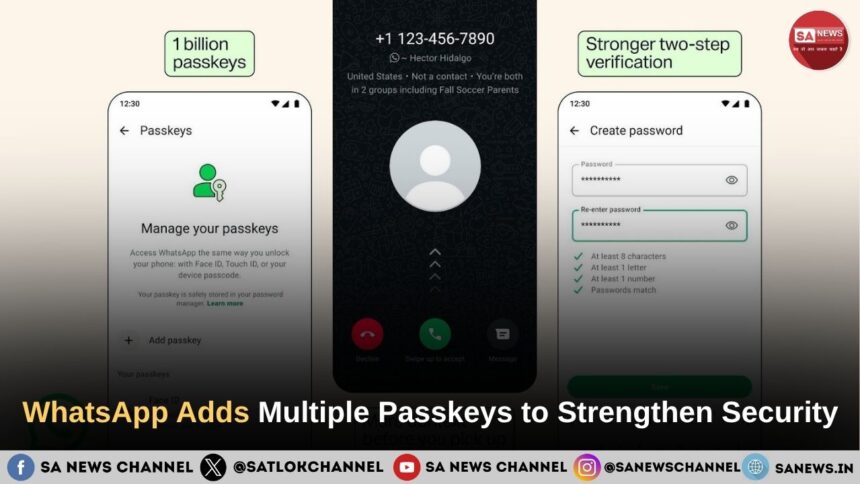
WhatsApp has announced a series of account-security updates, including support for multiple passkeys on a single account, stronger two-step verification and additional information about calls from people outside a user’s contacts. The update comes as messaging platforms face increasingly sophisticated phishing, hacking and scam attempts, with WhatsApp adding several layers of protection for account access and everyday interactions.
- WhatsApp Phishing and Security Update: Key Takeaways
- WhatsApp Adds Multiple Passkeys for Account Sign-Ins
- WhatsApp Upgrades Two-Step Verification With Stronger Passwords
- Android Users Get More Context on Unknown Calls
- WhatsApp’s Broader Response to Phishing and Scams
- WhatsApp Security Measures Add Multiple Layers of Protection
- What the Latest WhatsApp Phishing Protection Means for Users
- Spiritual Wisdom Beyond Digital Security
- FAQs on WhatsApp Phishing Latest News
WhatsApp Phishing and Security Update: Key Takeaways
- More than 1 billion people now use passkeys to log in to WhatsApp.
- Users can add more than one passkey to an account when using both Android and iOS devices.
- Passkeys can be managed through Settings > Account > Passkeys.
- WhatsApp has upgraded two-step verification from a six-digit PIN to a full password.
- The new password can be longer, alphanumeric and include special characters.
- Android users will receive more information about calls from people who are not saved in their contacts.
- WhatsApp has also recently introduced Scam Alert, an optional feature designed to identify suspicious messages from non-contacts.
WhatsApp Adds Multiple Passkeys for Account Sign-Ins
Meta announced the new WhatsApp security features on August 25, 2026. The company said more than 1 billion people now use a passkey to log into WhatsApp.
A passkey allows users to verify their identity through a fingerprint, Face ID or their device’s screen-lock code instead of relying on codes or PINs. WhatsApp says users can now add more than one passkey to the same account, a change that is particularly useful for people who use both Android and iOS devices. Users can manage their passkeys by going to Settings > Account > Passkeys.
Also Read: Meta और डिजिटल सुरक्षा: AI के दौर में सोशल मीडिया की बढ़ती जिम्मेदारी
The Hacker News reported that WhatsApp first introduced passkey support on Android in October 2023 before expanding it to iOS in early 2024. Meta subsequently integrated passkeys into Facebook logins in June 2025.
Passkeys are designed to provide phishing-resistant authentication. TechCrunch reported that they remove the need for traditional username-and-password combinations, which are ordinarily susceptible to phishing attacks.
WhatsApp Upgrades Two-Step Verification With Stronger Passwords
WhatsApp is also strengthening two-step verification, which provides an additional layer of protection against account takeover even when someone obtains a user’s one-time passcode.
Previously, WhatsApp used a six-digit PIN for this additional protection. The company has now upgraded the option to a full password that can be longer, contain letters and numbers, and include special characters.
WhatsApp specifically noted that a password containing a simple sequence such as “123456” should be upgraded. The company described the change as a way to make the additional security credential harder to guess.
SecurityWeek similarly reported that the new password can include alphanumeric characters and special characters, making it a stronger replacement for the previous six-digit PIN.
Android Users Get More Context on Unknown Calls
Another part of the update focuses on calls from people who are not saved in a user’s contacts. On Android, WhatsApp will now provide additional context before the user answers such calls.
Also Read: Is Privacy Already Dead? The Dark Truth Behind Meta and Google’s Data Empire
The information can include whether the caller’s number is from a different country and whether the caller and recipient belong to any common WhatsApp groups. The Hacker News also reported that WhatsApp’s additional context indicates whether the person calling is already on the user’s contact list.
WhatsApp said scammers rely on urgency, and that providing more information before a call is answered can give users an opportunity to pause and assess the situation. SecurityWeek reported the feature as an additional security measure currently available for Android users.
WhatsApp’s Broader Response to Phishing and Scams
The latest account-security measures follow another WhatsApp security development announced earlier in August. WhatsApp began a limited beta rollout of Scam Alert, an optional feature that uses an on-device machine-learning model to flag suspicious messages from people who are not in a user’s contacts.
SecurityWeek reported that the feature is designed to work alongside WhatsApp’s end-to-end encryption, with message classification taking place entirely on the device and without automatic reporting to WhatsApp or Meta.
The broader security push comes as phishing and hacking attempts have become more sophisticated. TechCrunch reported that the latest updates are part of efforts by WhatsApp and other messaging platforms to make account security more accessible for everyday users.
Also Read: WhatsApp Business Updates 2026: How Meta Is Turning WhatsApp Into an AI-Powered Business Platform
The developments also come amid recent phishing-related activity involving WhatsApp-linked accounts. The Hacker News reported on August 20 that suspected Russian cyber-espionage clusters had used sophisticated social-engineering and phishing campaigns targeting individuals across several sectors, with some activity involving WhatsApp account linking and account hijacking.
WhatsApp Security Measures Add Multiple Layers of Protection
The latest changes address different parts of the account-security process. Multiple passkeys provide an additional phishing-resistant sign-in method for users across Android and iOS. Stronger two-step verification adds another layer if a one-time passcode is obtained, while additional caller information is intended to give Android users more context before answering calls from unknown people.
WhatsApp’s Scam Alert feature adds another layer by examining suspicious message patterns on the device. Together, these updates show the platform’s continuing effort to strengthen protection around account access, unknown communications and scam activity while maintaining end-to-end encryption by default.
What the Latest WhatsApp Phishing Protection Means for Users
WhatsApp’s latest security update gives users more options to protect their accounts and more information to assess potentially unwanted interactions. More than 1 billion users already use passkeys, while multiple passkeys, stronger two-step verification and additional caller context expand the platform’s security measures. The recent Scam Alert rollout further addresses suspicious messages from unknown contacts.
Spiritual Wisdom Beyond Digital Security
Modern technology can provide stronger tools for protecting accounts, identities, and personal communication, but Jagatguru Tatvdarshi Sant Rampal Ji Maharaj’s teachings emphasize that human life also requires spiritual knowledge and righteous conduct. His official teachings describe knowledge as the basis for meaningful worship and stress honesty, integrity, and transparency in personal and public life.
In the context of phishing and online deception, this perspective naturally highlights the importance of remaining truthful and responsible while using technology. His teachings also describe material progress without spiritual wisdom as having limitations, emphasizing the need for higher spiritual understanding alongside worldly advancement.
Visit YouTube Channel: Sant Rampal Ji Maharaj
FAQs on WhatsApp Phishing Latest News
1. What is WhatsApp’s latest passkey update?
WhatsApp now allows users to add more than one passkey to an account, particularly helping those who use both Android and iOS devices.
2. How many WhatsApp users use passkeys?
WhatsApp says more than 1 billion people now use a passkey to log into their accounts.
3. What changed in WhatsApp two-step verification?
WhatsApp has upgraded the previous six-digit PIN to a longer password that can contain alphanumeric characters and special characters.
4. What information will Android users see about unknown calls?
Users can see information such as the caller’s country and whether they share any WhatsApp groups.
5. What is WhatsApp Scam Alert?
Scam Alert is an optional feature using an on-device machine-learning model to flag suspicious messages from non-contacts.