

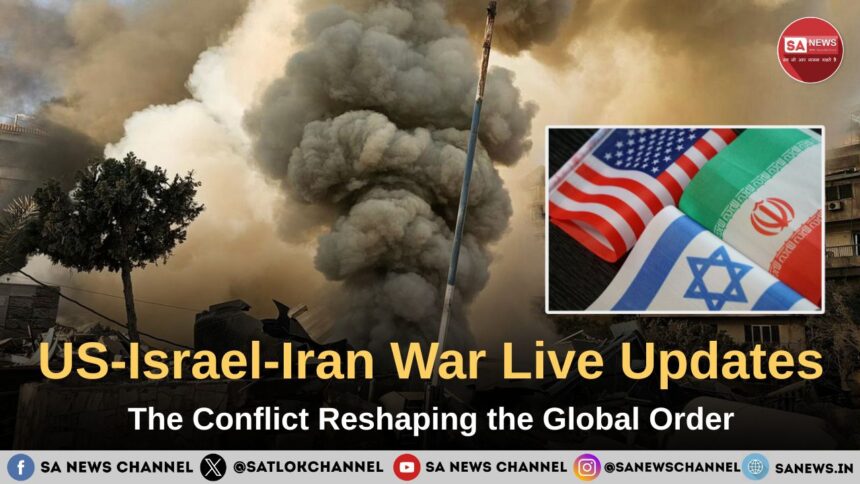

US-Israel-Iran War Live Updates: The Iran-Israel war marks a decisive escalation in a rivalry that has long simmered beneath the surface of Middle Eastern geopolitics. What distinguishes this phase is not merely the intensity of direct confrontation, but the systemic risk it introduces to the global order. Energy corridors, maritime chokepoints and fragile regional alliances now sit directly in the path of escalation. This conflict is unfolding in real time. We bring you live updates of events in the Iran-Israel war along with an analysis of the events transpired so far with a special focus on the energy crisis.
Live Update: Iran-Israel Tensions Continue As Rescue Operations Underway Near Sri Lanka After Maritime Incident
Following reports of a submarine strike on the Iranian frigate IRIS Dena near the search-and-rescue zone off the coast of Sri Lanka, local authorities have clarified that they remain neutral in the broader Iran-Israel conflict and are engaged only in humanitarian rescue efforts for survivors at sea. According to MP and Public Finance Committee Chair Harsha de Silva, Sri Lanka has no direct involvement in the incident and is responding solely to distress calls and recovery operations.
Live Update: India Confirms Adequate Fuel Stocks Amid Iran-Israel Hostilities
Amid the ongoing tensions in West Asia linked to the Iran-Israel conflict and its ripple effects on global energy markets, Indian authorities have reassured that the country holds adequate fuel reserves and currently sees no need for rationing petrol or diesel. Officials maintain that supply conditions remain stable despite geopolitical uncertainties
Indian Seafarers Killed in Strait of Hormuz Tanker Attacks Amid Escalating Middle East Conflict
Two Indian sailors who were believed to be missing after an Iranian missile struck the oil tanker MV Skylight near the waters of the Musandam Peninsula, are now confirmed as dead. This incident happened close to the strategic shipping lanes of the Strait of Hormuz. The vessel, which carried a 20-member crew including 15 Indians, was reportedly attacked while sailing in proximity to the port of Khasab. One of the deceased was a sailor from Bihar whose body was later recovered, while another crew member from Rajasthan went missing and is feared dead following the incident. The attack took place near the waters of Oman, a vital maritime zone for international shipping.
Live Update 5th March 2026: Naval Strike Marks Major Escalation
The conflict intensified in the past 24 hours following the sinking of Iran’s Moudge-class frigate IRIS Dena early on 4th March 2026, about 40 nautical miles off Galle, Sri Lanka. The vessel was returning from naval exercises in India and was struck by a U.S. Navy fast-attack submarine using a Mark 48 torpedo, according to U.S. Defense Secretary Pete Hegseth, marking the first reported U.S. submarine sinking of an enemy surface warship since World War II.
Rescue operations continue as Sri Lankan teams recover bodies and search for missing crew.
Simultaneously, U.S. and Israeli airstrikes have expanded across Iran, targeting security infrastructure and nuclear-linked facilities, including Natanz. U.S. Central Command states that multiple Iranian naval assets have been neutralized, though no specific count has been confirmed.
Iran asserts control over the Strait of Hormuz via missile and drone deployments, a claim disputed by U.S. officials. While the strait remains open, shipping traffic has fallen sharply fearing an attack from Iran, fuelling renewed oil market volatility. In response to strikes near Tehran, Iran launched fresh ballistic missiles toward Jerusalem and the U.S.-linked sites in Dubai and Qatar, widening the conflict and pushing reported fatalities past 1,000.
The situation remains rapidly evolving.
Highlights on US-Israel-Iran War Live Updates
- The premeditated attack in Iran was conducted on 28th February 2026 in a joint operation by Israel and the USA.
- The most consequential development of the Iran-Israel war 2026 has been the confirmed death of Ali Khamenei, alongside senior military officials including key figures within the Islamic Revolutionary Guard Corps.
- The attack by Israel backed by the USA has drawn severe reactions worldwide with a visibly divided world – one that supports this war, one that condemns it and the third fragment that is neutral as of now.
- In energy economics, dependency determines exposure to crisis. The majority of the world is dependent on the Middle Eastern region for oil. Only time will reveal how severe the impact will be for each of the dependent countries.
- The Iran-Israel war is now no longer confined to their geographical battle ground. It has further extended even into the Indian Ocean as the United States of America attacked Iranian ship IRIS Dena, killing several on board.
- Is this war solely a battle for oil supremacy? A deeper investigation will be undertaken in this article, revealing a startling truth.
The Iran-Israel War 2026
War has returned to the fault lines of the Middle East on 28th February 2026, again – but this is no contained regional confrontation. The escalating conflict between Iran and Israel is currently unfolding at the intersection of military deterrence, energy security and global power politics. What began as calibrated strikes and shadow engagements now threatens to redraw strategic boundaries far beyond the region, especially with the latest attack on the Israeli carrier IRIS Dena in the Indian Ocean on 4th March 2026.
- Live Update: Iran-Israel Tensions Continue As Rescue Operations Underway Near Sri Lanka After Maritime Incident
- Live Update: India Confirms Adequate Fuel Stocks Amid Iran-Israel Hostilities
- Indian Seafarers Killed in Strait of Hormuz Tanker Attacks Amid Escalating Middle East Conflict
- Live Update 5th March 2026: Naval Strike Marks Major Escalation
- Highlights on US-Israel-Iran War Live Updates
- The Iran-Israel War 2026
- Developments in the War So Far
- Initial Assault on 28th February 2026: Operation Epic Fury
- Iran’s Counteroffensive from 1st to 3rd March 2026
- Strait of Hormuz Disruption From 2nd March 2026 Onward
- Leadership Transition and Internal Dynamics from 3-4th March 2026
- Broader Situation as of 5th March 2026
- Global Condemnation and Support to Iran-Israel War 2026
- Countries Supporting the United States and Israel vs Countries Supporting Iran
- Countries Attempting Strategic Neutrality
- Economic Shockwaves and Energy System Risk
- Who Suffers Most in this Oil Crisis?
- Why War Continues Even When Humanity Believes in One God
- From Kalyug to Satyug: The Final Call Before Collapse
- FAQs on US-Israel-Iran War Live Updates
This war is bound to be a test of alliances, of energy resilience, of economic stability and of the fragile architecture that has underpinned global order since the end of the Cold War. Markets are reacting. Diplomatic channels are straining. Military postures are hardening. Day after day a newer country is getting pulled into this war, directly or indirectly. Are we really headed toward the highly-predicted World War III?
History may well record this moment as more than a regional war. However, deep beneath this scary confrontation lies a buried truth that the world is still unaware of. In this article, we will attempt to present this truth step-by-step to readers.
This is not simply a battlefield story. This story traces its roots to the origin of Christianity, Judaism and Islam. It is important to note that all three religions trace the same singular origin – they arose from the descendants of Prophet Abraham, also known as Prophet Ibrahim (Father of the three religions).
Why are the children from the same lineage bloodthirsty for each other with hatred beyond measure? Is killing each other God’s command or the devil’s? Before opening up this mystery, let us understand the proceedings of the Iran-Israel war thus far.
Developments in the War So Far
Before laying down the events thus transpiring, it is important to note that Iran had supported Palestine during the Israel-Palestine war, thereby rendering itself as an ally to Palestine and a foe to Israel. This is the actual visible foundation of the Iran-Israel conflict.
Military exchanges between Iran and Israel have intensified, moving beyond proxy confrontation into more direct and overt engagement. The United States of America is backing Israel in these coordinated attacks. Codenamed Operation Roaring Lion by the Israeli Defense Forces and Operation Epic Fury by the United States, a coordinated wave of strikes targeted Iranian leadership, security infrastructure and nuclear facilities since the morning of 28th February 2026.
Summary of key developments in the 2026 Iran Conflict (as of 5th March 2026):
Initial Assault on 28th February 2026: Operation Epic Fury
In the predawn hours, U.S. and Israeli forces carried out synchronised airstrikes aimed at key Iranian command centers, including a reported high-level gathering in Tehran.
- The attacks resulted in the confirmed deaths of Supreme Leader Ayatollah Ali Khamenei, along with senior military figures such as the Chief of Staff of the Armed Forces and the IRGC Commander (the Defense Minister’s status remains unconfirmed in some reports).
- Official statements from Washington and Jerusalem framed the mission as necessary to dismantle Iran’s nuclear capabilities and missile arsenal, while also creating pressure for internal regime change.
- In the opening day alone, allied aircraft delivered thousands of precision munitions, quickly gaining control of much of Iran’s airspace and severely damaging its integrated air defense systems.
Also Read: World War 3 In Making: Iran-Israel War Fueling Global Unrest
Iran’s Counteroffensive from 1st to 3rd March 2026
Despite the leadership losses, Iranian forces responded with waves of ballistic missiles and drones directed at Israeli territory and American military installations in the region, including bases in Qatar (Al Udeid), Kuwait and the UAE.
- Escalation extended to strikes on infrastructure in Gulf states hosting U.S. assets, such as Bahrain and parts of Oman, framing any nation supporting American operations as a valid target.
- Hezbollah, operating from southern Lebanon, activated a northern front by firing dozens of rockets and drones toward Israeli cities like Haifa and Tel Aviv, aiming to divide Israeli defensive resources.
In this tweet on X, the President of the Islamic Republic of Iran, Masoud Pezeshkian, justified Iran’s right to defend itself against the ‘American-Zionist military attack’.
Strait of Hormuz Disruption From 2nd March 2026 Onward
On 2nd March 2026, senior IRGC officials announced the ‘closure’ of the Strait of Hormuz, warning that vessels attempting passage, except those from supportive nations like China, would face destruction.
- Please note that the Strait of Hormuz has not been officially closed, but it has been blocked by the IRGC, maintaining their stance of striking any vehicle attempting to cross it. Therefore, the reality is that currently, the Strait of Hormuz does remain inaccessible for passage.
- While the U.S. has conducted strikes on Iranian naval assets (including sinking at least one major warship like the IRIS Makran and damaging others, with reports of 10 to 20 or even more vessels affected overall), Iran has relied on low-cost drones, shore-launched missiles and threats to render the channel unsafe for commercial traffic rather than a full mining operation.
- Global shipping companies, including Maersk, MSC and Hapag-Lloyd, halted movements through the area.
- Around 150 tankers remain anchored nearby and maritime insurers have largely withdrawn coverage, driving up war-risk premiums dramatically.
Leadership Transition and Internal Dynamics from 3-4th March 2026
Following Khamenei’s death, Iran’s constitution triggered the formation of a temporary three-member council (including President Masoud Pezeshkian, Chief Justice Gholam-Hossein Mohseni-Eje’i and cleric Alireza Arafi) to manage affairs pending a decision by the Assembly of Experts.
- Mojtaba Khamenei, the late leader’s son with close IRGC connections, has emerged as a leading candidate for succession amid speculation and reported hardline pressure, though no final appointment has been confirmed (some reports mention veteran figures like Ali Larijani in advisory or crisis-management roles).
- Israeli officials, including Defense Minister Israel Katz, have warned that any new leadership figures enabling continued aggression could become targets.
- Within Iran, public reactions range from official mourning and state funerals to isolated protests and unrest, amplified by ongoing economic hardships.
Broader Situation as of 5th March 2026
Energy markets have reacted sharply, with Brent crude exceeding USD 80 per barrel amid fears of prolonged disruptions; analysts project prices could reach USD100-120 if the Strait remains restricted through the month.
- Diplomatic strains are evident within NATO: France and the UK have voiced concerns over the legality of the initial strikes and pushed for restraint, however, both the countries have pledged support to USA and Israel in order to defend Gulf countries threatened by Iran.
- On the other hand, President Trump has threatened economic penalties against non-cooperative allies, including Spain (following Madrid’s refusal to permit U.S. tanker refueling or base access for operations).
- Evacuation efforts are underway, with the U.S. issuing urgent ‘depart now’ alerts for multiple Middle Eastern nations and India organising emergency repatriation flights for its citizens in the Gulf region.
- Israel has targeted strategic military infrastructure linked to Iran’s command capabilities and regional proxy networks.
- In response, Iran has launched coordinated missile and drone strikes aimed at Israeli assets and allied military positions in the wider Middle Eastern region. The risk of miscalculation has increased significantly as additional actors monitor developments closely.
- Regional airspace restrictions, heightened naval patrols and expanded missile defence deployments signal that the conflict is no longer confined to bilateral hostility. It now carries the characteristics of a broader strategic confrontation.
The tempo of escalation remains fluid, with each strike recalibrating deterrence thresholds.
Global Condemnation and Support to Iran-Israel War 2026
International reactions have been equally polarised. Some governments have condemned the killing of Khamenei as a dangerous escalation that undermines international norms and risks triggering wider instability. Others have refrained from direct criticism, instead emphasising Iran’s regional activities and the security concerns of Israel.
The divide reflects broader geopolitical alignments rather than purely moral judgement. Because a purely moral judgement would call for an end to all killings and an equal and safe world for all.
Countries Supporting the United States and Israel vs Countries Supporting Iran
The diplomatic landscape surrounding the Iran-Israel war reveals a widening geopolitical divide. While few governments frame their positions in absolute terms, patterns of alignment are becoming increasingly visible.
Countries Backing the United States and Israel
The United States remains Israel’s principal military and diplomatic backer. Washington has reaffirmed its commitment to Israel’s security and regional deterrence posture.
Among Western allies, several countries have expressed support for Israel’s right to defend itself, including:
- The United Kingdom
- Germany
- France
- Canada
- Australia
These governments have generally emphasised Israel’s security concerns while simultaneously calling for restraint to avoid regional escalation.
In the Middle East, some Gulf states, particularly those that normalised relations with Israel under the Abraham Accords, such as the United Arab Emirates and Bahrain, have adopted more cautious language. While not endorsing escalation, they have refrained from overtly siding with Iran and have prioritised regional stability.
Countries Supporting or Aligning with Iran
Iran’s strongest political backing has come from states already positioned in strategic opposition to the U.S. influence.
- Russia has criticised Western involvement and warned against further escalation, framing developments as destabilising to regional order.
- China has called for de-escalation but has consistently opposed unilateral military actions against sovereign states, a position that aligns diplomatically with Iran’s narrative.
- Regional players aligned with Tehran include Syria, Hezbollah in Lebanon (non-state actor but strategically significant) and various Iran-backed militia groups in Iraq.
- Spain is the latest country and a NATO ally to strongly condemn the attacks on Iran. President Pedro Sánchez not only addressed a press briefing, but also reiterated his stance on his X account with a firm ‘NO TO WAR’.
These countries have either expressed support for Iran or directly participated in related military activity.
Countries Attempting Strategic Neutrality
A large group of nations have adopted cautious neutrality. These include India, Brazil, South Africa and several Southeast Asian states. Their official statements emphasise:
- Immediate ceasefire
- Diplomatic engagement
- Protection of civilians
- Stability in energy markets
India’s position is particularly notable given its strong defence ties with Israel alongside its historical energy and infrastructure engagement with Iran.
This emerging split does not resemble Cold War binaries. It reflects a multipolar system in which states balance security interests, economic dependencies and domestic political considerations.
Economic Shockwaves and Energy System Risk
Beyond the battlefield, the most immediate transmission channel is energy as we seem to be at the verge of a massive oil crisis.
The Strait of Hormuz remains one of the world’s most critical maritime chokepoints, facilitating a substantial share of global oil shipments. Even the perception of disruption introduces a geopolitical risk premium into energy markets.
The Strait of Hormuz is only 21 miles wide at its narrowest point, yet it carries approximately 20-21 million barrels of oil per day – roughly one-fifth of global petroleum consumption.
In addition:
- Nearly 20% of global liquefied natural gas (LNG) trade transits this corridor.
- Qatar, one of the world’s largest LNG exporters, depends almost entirely on this route.
- Major Gulf producers like Saudi Arabia, Iraq, the UAE and Kuwait, rely heavily on its uninterrupted operation.
There are possible bypass mechanisms:
- Saudi Arabia’s East-West Petroline can redirect crude towards the Red Sea.
- The UAE operates the Abu Dhabi Crude Oil Pipeline to Fujairah.
However, combined rerouting capacity can only offset a fraction of total flows. A sustained disruption would still remove an estimated several million barrels per day from accessible seaborne markets – the largest sudden supply shock since the 1973 oil embargo.
Oil price spikes translate rapidly into transport costs, manufacturing inputs and consumer inflation. For economies already navigating tight monetary conditions, renewed energy volatility complicates central bank policy and fiscal planning.
Shipping insurance costs have risen, freight routes are being reassessed and global supply chains face renewed uncertainty. What does this hold for varying geographies?
Who Suffers Most in this Oil Crisis?
The Gulf region is the key supplier to most Asian countries and even Europe. Here is a glimpse of how the key importers of oil may be impacted
- India: India imports approximately 85-88% of its crude requirements. Every USD 10 rise in oil prices significantly increases the import bill and places downward pressure on the rupee. Inflationary spillover affects fertilisers, transport and food prices. Policymakers face a difficult trade-off between currency defence and growth support.
- Japan and South Korea: Japan sources roughly 70-80% of its oil from the Middle East. A sustained disruption would directly affect industrial output and energy costs, impacting manufacturing exports and domestic consumption.
- Europe: Europe’s exposure lies primarily in LNG markets. If Qatari cargoes are disrupted, Europe would compete more aggressively with Asia for American supplies, pushing wholesale gas prices upward.
- China: As the world’s largest crude importer, China would draw upon strategic reserves and leverage long-term contracts. Nevertheless, global price formation mechanisms limit Beijing’s insulation from market shock.
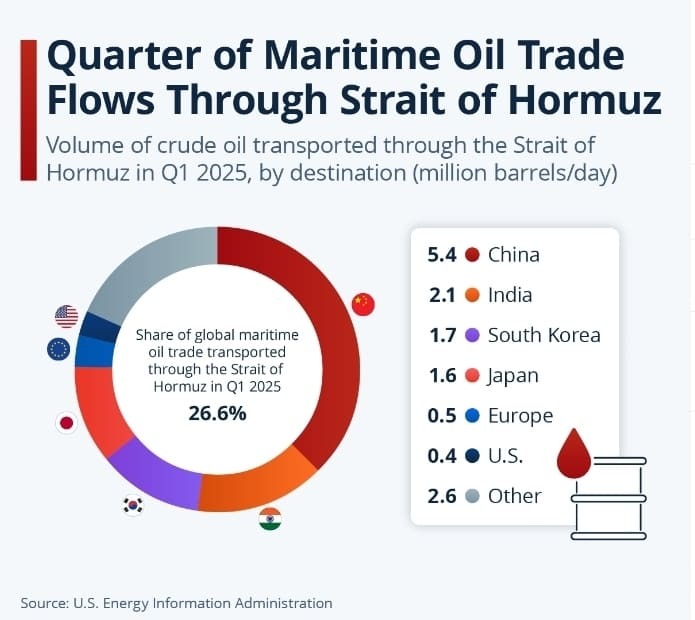
Source: Statista
The chart above depicts ‘volume of crude oil import’ for the first quarter of 2025, wherein China and India top the list.
The economic modelling is clear – even limited supply interruption scenarios produce measurable GDP drag across energy-importing nations. Emerging markets are particularly vulnerable due to currency exposure and fuel subsidy pressures.
The conflict therefore operates simultaneously as a military crisis, an economic stress test and massive humanitarian crisis too.
Why War Continues Even When Humanity Believes in One God
This analysis now brings us back to the question raised earlier in this article. The three principal players involved in this war are also staunch believers in their own religious teachings – Iran in Islam, Israel in Judaism and USA in Christianity. Ironically, all three religions speak of a single Creator, the Almighty God. Yet conflict persists.
The reason is not that God Himself endorses violence, but that human interpretation of some deliberately-inserted Satanic verses within the sacred scriptures of Islam, Judaism and Christianity. Further beyond these religions, Satanic interference can also be seen in religious scriptures like the Vedas, the Bhagavad Gita, etc.
The root of Israel-Palestine conflict, the foundation of all Middle-Eastern conflict, is the strong belief of both the Jews and Muslims that the land of Israel belongs to them, each believing the other has no right to it. While both sides cite the Holy Torah (specifically the Book of Genesis) as proof of their divine right to the land, Jagatguru Tatvdarshi Sant Rampal Ji Maharaj reveals that the physical territory is a distraction from a deeper spiritual trap.
Sant Rampal Ji Maharaj urges that it is essential to ask a fundamental question: What are the true attributes of God Almighty?
The real Supreme God would not sow hatred among His own creation. He would not inspire cruelty, vengeance or bloodshed. His guidance would unite, not divide; it would calm hearts, not inflame them.
And yet, look at the world today. Nations rage against nations. Communities crumble. Humans stand thirsting for each other’s blood, though created from the same origin. Division is defended as righteousness.
This cannot be the reflection of Divine Will.
This situation, though seemingly confusing, can be easily understood through the unparalleled spiritual knowledge of Sant Rampal Ji Maharaj.
From Kalyug to Satyug: The Final Call Before Collapse
Jagatguru Tatvdarshi Sant Rampal Ji Maharaj divulges the identity of the real perpetrator of unrest in this world – Kaal Brahm or Satan, as known to the western world.
Sant Rampal Ji Maharaj explains that every religion holds its scriptures sacred because the human soul carries an innate longing for God Almighty. Across cultures and centuries, mankind has searched for truth, for salvation, for reunion with the Supreme Power.
However, He further reveals that Satan Kaal Brahm has strategically distorted certain portions of sacred texts across religions. Through subtle manipulation, seeds of division were sown, though not openly, but gradually, embedding ideas that fuel rivalry, superiority, hatred and conflict. As a result, communities that were meant to coexist in devotion now stand opposed to one another.
Today, sects fight over territory, identity and ideology, and even over pieces of land that no human being can truly own beyond the span of a single lifetime. After death, that land remains. The body returns to dust. Yet the wars continue.
This must-watch video exposes how the foundations of the Israel-Palestine conflict were laid centuries ago through spiritual deception – a strategy by Satan that has now expanded into cycles of retaliation and escalating violence, costing countless innocent lives.
It challenges viewers to look beyond political narratives and examine the deeper spiritual roots of division, asking whether humanity has unknowingly been fighting battles designed by a force that thrive on chaos.
As the world drifts perilously closer to what feels like an inevitable global conflict. This slow-burning fire now threatens to engulf entire nations and humanity stands at a decisive crossroad. The signs of unrest are no longer distant warnings, they are unfolding before our eyes rapidly, each passing moment.
In such a grave hour, it is no longer enough to react politically or emotionally. It is time to pause and to seek higher understanding. Sant Rampal Ji Maharaj’s spiritual discourses call upon humanity to rise above hatred, fear and division. His teachings alone present a path that leads from spiritual darkness to lasting peace – a path that will usher Satyug within this turbulent Kalyug through true knowledge and righteous living.
If you are searching for answers beyond the noise of war and the rhetoric of power, this is an invitation to look deeper.
Uncover the real identity of Sant Rampal Ji Maharaj through the prophecies of famed astrologers like Nostradamus, in the following video:
Learn more by visiting:
Website: www.jagatgururampalji.org
YouTube: Sant Rampal Ji Maharaj
Facebook: Spiritual Leader Saint Rampal Ji
‘X’ handle: @SaintRampalJiM
FAQs on US-Israel-Iran War Live Updates
Q1) Could the Iran–Israel war turn into World War 3?
Answer: Analysts warn that wider regional alliances and global power involvement increase the risk of broader escalation.
Q2) Is the Strait of Hormuz at risk because of the war?
Military activity near this critical shipping route has raised fears of disruption to global energy transport.