


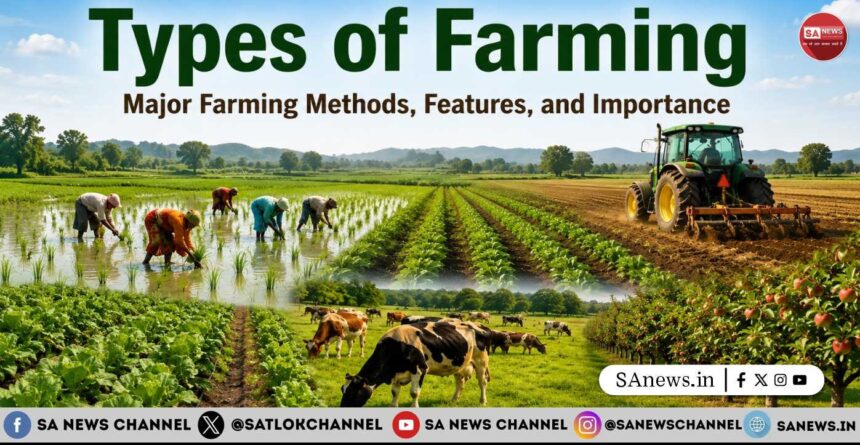
Types of Farming: The history of agriculture goes back to about 12,000 years. Agriculture happens to be one of the basic necessities for humankind. For today’s modern society, agriculture forms the foundation of livelihood and production of food.
Agriculture in developing countries such as India is not just confined to the production of food, but it is the foundation of the economy, jobs, and even rural development.
In this blog, you will discover various kinds of farming methods along with their features, advantages, disadvantages, and significance.
What is Farming?
Farming is the practice of cultivating land, growing crops and raising animals to produce food and other essential products for human use.
Modern farming is no longer limited to traditional methods. Today, advanced machinery, scientific techniques, fertilizers, irrigation systems, and digital technologies play a major role in agriculture.
Farming helps fulfill the food requirements of the growing population while also contributing to industrial growth and economic development.
Types of Farming
Farming practices can be categorized on the basis of the land used, weather conditions, irrigation, purposes of production, technologies employed, and type of tools and machinery used for the practice.
Farming practices are either traditional practices that make use of old and primitive techniques alongside the use of crude and handmade tools or the modern practices, which employ new machines as well as scientific technology for increased efficiency. The major types of farming include subsistence farming, commercial farming, intensive farming, extensive farming, plantation farming, shifting cultivation, mixed farming, dry and wet farming and organic farming. Let us know various types of farming in detail.
1. Subsistence Farming
This is one of the oldest types of farming in which farmers grow crops only for their own family’s consumption and not for commercial use. This farming method involves small production, and very little surplus to sell in the market.
Features of Subsistence Farming
- Small Land for Cultivation
- Primitive farming tools
- Use of Family labor
- Less productivity
Advantages
- Suitable for small farmers
- Less investment required
- Supports rural livelihoods
Disadvantages
- Limited production
- Generates low income
- Limited use of modern technology
This farming technique is still prevalent in many rural areas of developing countries.
2. Commercial Farming
The main objective of commercial farming is to earn profit. Large scale crops and livestocks are raised for sale in the market. This method involves heavy dependence on modern technology and machinery.
Features of Commercial Farming
- Large-scale production
- Use of modern machinery
- Improved seeds and fertilizers
- Huge investment
Advantages
- Higher productivity
- Increased farmer income
- Aids economic growth
Disadvantages
- Increased use of chemicals
- Adds to environmental pollution
- Higher operational cost
Crops such as wheat, sugarcane, cotton, and rice are widely produced in commercial farming.
3. Intensive Farming
Intensive farming involves maximum output from a limited area of land. To increase production, farmers use a high amount of labor, fertilizer, pesticides, irrigation, and technology.
Features of Intensive Farming
- High yield per hectare
- Greater dependence of fertilizers and pesticides
- Heavy labor and capital investment
Advantages
- Higher production from less land
- Helps cope up with increasing food demand
- Efficient use of land
Disadvantages
- Soil fertility may decrease with time
- Overuse of water and chemicals
- Environmental concerns
This method is more common in areas of dense population.
4. Extensive Farming
Extensive farming is practiced in areas where land is abundant and population is low. It is practiced with low-labour and investment. Per acre productivity of extensive farming is less when compared to intensive farming.
Features of Extensive Farming
- Abundant farm land
- Use of machinery
- Less labor required
Advantages
- Suitable for large land areas
- Lower labor costs
- Efficient for large-scale grain production
Disadvantages
- Requires huge land areas
- Lower productivity per acre
Extensive farming is commonly practiced in countries such as Australia, Canada and the United States.
5. Mixed Farming
As the name suggests, mixed farming involves both farming as well as livestock rearing. In this farming method, farmers grow crops and also raise animals such as cows, goats, poultry, or buffaloes.
Features of Mixed Farming
- Combination of agriculture and animal husbandry
- Multiple income sources
- Better utilization of resources
Advantages
- Additional income for farmers
- Reduced farming risk
- Natural manure availability
Disadvantages
- Increased labor requirement
- Animal care requires increased expenses
In countries such as India, mixed farming is highly popular. It is because mixed farming provides economic stability to farmers.
6. Organic Farming
In the times of ever increasing pollution and decreasing soil fertility, organic farming is the eco- friendly method of agriculture. This method holds its characteristics of limited or no use of synthetic fertilizers, pesticides, and chemicals for farming. This method instead uses natural manure, compost, and biological pest control.
Features of Organic Farming
- Chemical-free cultivation
- Environment-friendly methods
- Focus on soil health
Advantages
- Produces healthier food
- Protects soil fertility
- Reduces environmental pollution
Disadvantages
- Lower production in the initial stages
- Requires more time and effort
- Organic products can be expensive and difficult to sell
With increasing health concerns, the demand for organic farming is increasing worldwide.
7. Plantation Farming
In this method, a single crop is grown over a large area. The main aim of plantation farming is to earn profits by selling cash crops including tea, coffee, rubber, and cocoa.
Features of Plantation Farming
- Large-scale farming of a single crop
- Advanced technology used
- Skilled labor required
Advantages
- High commercial value
- Supports export industries
- Large-scale production
Disadvantages
- Dependence on one crop
- Vulnerable to climate changes
It is usually practiced in tropical and sub-tropical regions where the climate and rainfall are suitable for the growth of cash crops.
8. Shifting Cultivation
Known by the name of Jhum cultivation in north-east India, shifting cultivation is one of the primitive farming methods. In this method, farmers cultivate a piece of land for a few years and then move to another area, when the soil fertility reduces.
Features of Shifting Cultivation
- Common in forest regions
- Traditional agricultural practice
- Temporary cultivation areas
Advantages
- Reduced farming cost
- Use of natural resources
Disadvantages
- Causes deforestation
- Soil erosion and environmental damage
This method is practiced usually in forest and hill areas majorly in some northeastern regions of India.
9. Dry Farming and Wet Farming
Dry Farming
Dry Farming is the best suited method of agriculture in the area with low rainfall. The crops grown by this method usually require less water. Commonly grown crops in this method include millet, gram and sorghum.
Wet Farming
Like its name, wet farming is prevalent in regions with overall high rainfall and excessive water supply. Rice and sugarcane are the crops which are grown by this method.
Challenges Faced by Farming
Despite technological advancements, farmers worldwide still face several challenges.
- Water Scarcity: Dropping groundwater levels are creating irrigation problems for the farmers.
- Changing Climate: Many climatic factors such as irregular rainfall, droughts, and temperature changes affect crop production.
- Degrading Soil: The over- dependence on chemical fertilizers decrease the soil fertility.
- Financial Problems: Farmers face problems with loans, reduced crop prices, and limited access to resources.
Kisan Messiah: Saint Rampal Ji Mahara
Saint Rampal Ji Maharaj ji from Sonipat, Haryana is working for the welfare of the farmers and peasants of the nation. To protect farmers and their lands from floods, Saint Rampal Ji Maharaj ji is providing lakhs of feet of pipes, motors and all the essentials to the villages free of cost.
Almost 400 villages have benefitted from this Annapurna Muhim of Saint Rampal Ji Maharaj and the help is being continuously provided. Saint Rampal Ji Maharaj ji imparts the message of world unity through spiritual knowledge provided by Supreme God Kabir Saheb. To know more, visit Sant Rampal Ji Maharaj YouTube Channel.