


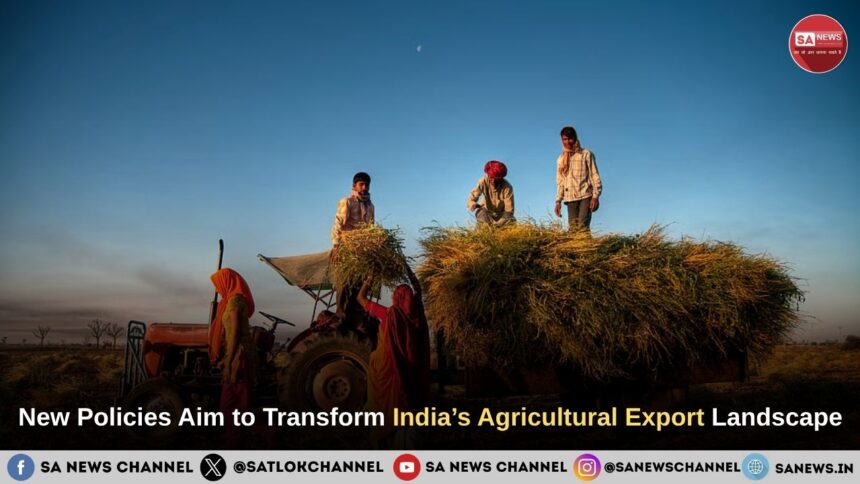
In the modern global economy, India’s agriculture is not only about feeding the nation but also about competing in international markets. For a country like India, where millions of people depend on agriculture and farm-related activities for their livelihood, agricultural exports can play a crucial role in economic growth and rural development. Recently, the government announced a series of new initiatives aimed at boosting agricultural exports, which appear more structured and pragmatic than previous efforts.
- Why Agricultural Exports Matter for Economic Growth
- Key Features of the New Export Policies
- How These Policies Benefit Farmers and Businesses
- Challenges in Agricultural Exports and How Policies Address Them
- Role of Technology and Infrastructure in Export Growth
- Global Market Opportunities for Agricultural Products
- Understanding Agricultural Export Policies
- Common Challenges and Areas of Improvement
- A Broader Perspective: Values and Sustainable Growth
The goal is to increase farmers’ earnings, strengthen supply chains, and establish India as a reliable global supplier of agricultural products. While the policy direction is promising, achieving these results will take time and sustained implementation.
Why Agricultural Exports Matter for Economic Growth
Agricultural exports are an important source of foreign exchange for India and directly affect rural livelihoods. Higher export demand can help farmers receive better prices for their crops. It can also encourage crop diversification, allowing farmers to shift toward high-value products such as spices, fruits, vegetables and organic produce.
At the national level, strong agricultural exports help reduce the trade deficit and strengthen India’s position in the global economy.
Key Features of the New Export Policies
The new policies aim to remove long-standing challenges such as weak logistics, inconsistent quality standards and policy uncertainty.
Major initiatives include:
- A stable export policy framework to avoid sudden bans or restrictions.
- Development of agricultural export clusters that integrate production, processing and logistics.
- Improvement of cold chain infrastructure, including storage and transportation facilities.
- Stronger quality standards to meet international market requirements.
- Digital agricultural platforms, such as https://enam.gov.in, to connect farmers directly with buyers.
- Financial incentives and support for exporters and agribusiness companies.
Together, these reforms aim to create a more organized and efficient agricultural export system.
How These Policies Benefit Farmers and Businesses
For farmers, the biggest advantage is better price realization, since international markets often offer higher prices for premium agricultural products.
Digital platforms and export channels can also reduce the role of middlemen, allowing farmers greater control over how their products are sold. For businesses, the policies provide greater stability and planning certainty, encouraging investment in processing, packaging and export infrastructure. However, small farmers may still need institutional support such as cooperatives or farmer-producer organizations to fully benefit from export opportunities.
Challenges in Agricultural Exports and How Policies Address Them
Despite strong potential, India’s agricultural export sector still faces challenges:
- High logistics and transportation costs
- Inconsistent product quality
- Limited market information
- Policy uncertainty in the past
The new policies attempt to address these issues through infrastructure development, standardized practices and better digital information systems.
Improving cold storage infrastructure can also reduce post-harvest losses, which remain a significant problem in India’s agricultural supply chain.
Role of Technology and Infrastructure in Export Growth
Technology is becoming an important driver of agricultural export growth. Digital platforms allow farmers to access real-time price information and connect directly with exporters. At the same time, roads, storage facilities and modern ports are essential for efficient exports. Even the best policies cannot succeed without strong infrastructure support.
The government’s strategy recognizes the need to combine policy reforms with infrastructure development.
Global Market Opportunities for Agricultural Products
India has a strong competitive advantage in producing many agricultural commodities, including spices, rice, tea, fruits, and organic products. Global demand for these products is increasing across regions such as the Middle East, Europe, and Southeast Asia.
Demand for sustainably produced and organic food products is also rising worldwide. If India successfully aligns its agricultural practices with these trends, export opportunities could expand significantly.
However, competition remains intense, with countries like Vietnam and Thailand dominating certain export segments. India will therefore need to focus on consistency, quality, and branding to strengthen its position in global markets.
Understanding Agricultural Export Policies
Agricultural export policies are government measures designed to encourage the export of agricultural products to international markets. These policies often involve subsidies, financial incentives, infrastructure investments, regulatory reforms, and international trade agreements.
In simple terms, the government aims to make exporting agricultural products easier, more profitable, and more accessible for farmers and businesses.
For India, such policies are particularly important because a large portion of the population depends on agriculture, and boosting exports can significantly improve rural incomes.
Common Challenges and Areas of Improvement
Despite these initiatives, several areas still require attention, including:
- Farmer awareness, as many farmers remain unaware of export opportunities and international market requirements.
- Access to finance, since small farmers may lack the capital needed to improve quality, packaging, or certification standards.
- Coordination challenges, particularly between different government agencies and state authorities.
- Global price volatility, as international market prices fluctuate and can influence export profitability.
Addressing these challenges requires continuous policy evaluation, improved coordination, and effective implementation strategies.
A Broader Perspective: Values and Sustainable Growth
Beyond economic benefits, agricultural development should also focus on sustainability and ethical practices.
Sant Rampal Ji Maharaj emphasizes honest work, balanced living and respect for nature. Agricultural policies should therefore balance income growth with environmental responsibility. Ultimately, the true success of these policies will be measured not only by export numbers but also by the well-being of farmers and the protection of natural resources.