


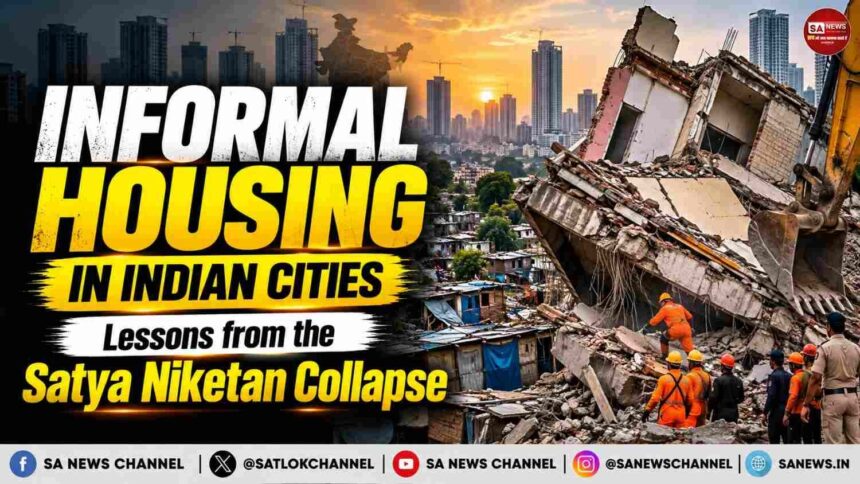
Satya Niketan Collapse: On 6 September 2026, a five-storey building in Satya Niketan, near Delhi University’s South Campus, collapsed in the afternoon. The building which housed paying guests (PG) under the name of Hostel Daze came crashing down. The disaster, which left authorities scrambling, claimed seven lives besides several injuries. Five of the dead were students from Uttar Pradesh, Chhattisgarh, and Madhya Pradesh, while the others were laborers.
- The Scale of Informal Housing Today
- Real-Life Examples That Reveal the Pattern
- Satya Niketan (Delhi, September 2026)
- Urban villages and recent tragedies
- Wazirpur’s Chandra Shekhar Azad Colony
- Kapashera (Delhi-NCR border)
- Core Flaws: Safety, Services and Exploitation
- Structural & Fire Hazards
- Overcrowding
- Service Irregularities
- Tenure Insecurity
- Exploitation
- Governance Gaps
- Why This Crisis Persists: Planning Gaps and Deeper Social Failures
- Practical Paths Forward
- The Fragile Foundations of Our Urban Dreams
- The Indestructible Refuge Beyond a Perishable World
The police alleged that the owner had constructed extra floors on the building to earn more revenue from tenants despite the building having structural weaknesses. Repairs were underway in the waterlogged basement when students signed a disclaimer releasing the hostels and the university administration from any liability. The building complex did not have sanction plans that showed the building’s final construction.
Delhi PG hostel collapse was an incident that highlighted the precarious state of India’s informal housing. There is a need to stop this laxity in housing as millions of Indians live in similar unsafe conditions.
The Scale of Informal Housing Today
Indian cities contain several overlapping forms of informal housing. In Delhi alone, estimates suggest over 60% of the population lives in unplanned settlements.
Jhuggi-Jhopri (JJ) clusters
Squatter settlements on public land. The Indian capital has around 675 recognized clusters of these, which house domestic workers, construction workers, traders and migrants.
Unauthorised colonies
These are built on agricultural or private land, with only partial approvals – Delhi has roughly 1,700-1,800 such colonies, many of which have been partially regularized on an “as-is, where-is” basis.
Urban villages
Former rural settlements which have been engulfed by the city (such as Hauz Rani, Munirka, Saidulajab, Katwaria Sarai), which have been converted to high-density rental housing for students, young professionals and migrants.
Paying Guest (PG) and shared rooms
Typically located in the vicinity of colleges and job clusters, these are exemplified by Satya Niketan, where the original residents have vacated their homes and the houses have been split up vertically to make narrow hostel-like beds with a meal plan costing between Rs 12,000-16,000 per bed.
College hostels are inadequate, with several South Campus colleges having only a few dozen seats for thousands of students, while formal private housing is either too far, too expensive or unavailable, forcing people to turn to the informal sector.
The same trend can be seen in Mumbai, Bengaluru, Hyderabad and other cities – migration continues, planning does not keep pace and people end up living wherever they can, close to their work or college.
Real-Life Examples That Reveal the Pattern
Satya Niketan (Delhi, September 2026)
Demand is always high, illegal additions, construction on a weak infrastructure, loose civic oversight led to fatalities. Students spoke of rooms with beds barely an inch apart and landlords raising prices because the beds were never kept occupied.
Urban villages and recent tragedies
The areas of Hauz Rani and Saidulajab have had fires and collapses due to overcrowding, illegal additions and tangled wiring. Fire engines were thwarted by the narrow lanes.
Wazirpur’s Chandra Shekhar Azad Colony
The residents of this colony survived on political patronage in the form of ration cards, electricity connections and survey slips. When the winds of change blew, these were quickly replaced by demolition drives. Similar situations are reported in Mumbai’s slums after anti-encroachment operations, with families ending up on the pavements or in secondary informal housing.
Kapashera (Delhi-NCR border)
This is home to hundreds of thousands of migrant workers who survive in thick concentrations of rental accommodation with shared toilets, cash rents and few services. Proximity to work is more important than the lack of formal amenities.
These cases are similar in that they reflect a need for affordable locations, a lack of alternatives, and proliferation of informal arrangements until a crisis intervenes.
Core Flaws: Safety, Services and Exploitation
Informal housing is not just substandard, it systematically fails to meet the most basic criteria.
Structural & Fire Hazards
Structural and fire hazards are a possibility due to addition of extra floors not sanctioned by authorities, faulty foundations and absence of fire NOCs for hostel-type occupation.
Overcrowding
Overcrowding in small rooms with poor ventilation. This is exploitation of the space because more people are being put in increasing the live load on the building.
Service Irregularities
Inadequate or irregular supply of water, electricity, drainage and garbage disposal. Many unauthorised colonies face periodic sewage flooding.
Tenure Insecurity
Tenancy insecurity, particularly in JJ clusters on government land because demolition is a constant threat.
Exploitation
Exploitation in the form of high rents and ‘no liability’ clauses and take-it-or-leave-it attitude. New migrants to the city are most vulnerable.
Governance Gaps
Governance failures such as master plans, public land, slow provision of affordable housing, and restrictive enforcement of rules which create a policy vacuum that gets filled up by private players.
This has resulted in a parallel city which sustains the main city but is at risk of being torn down.
Why This Crisis Persists: Planning Gaps and Deeper Social Failures
The formal affordable housing shortage is the starting point. The master plans prioritized homeownership or low-density development, leaving out most people. The public agencies control significant parcels of land, but they dole out the sales at an excruciating pace. Past rent-control experiences discouraged formal rental markets. Migration and urbanization rates are rising faster than the projected growth.
Corruption and patronage culture aggravate the situation. To get building sanctions, extra Floor Space Index (FSI), or regularization takes place; people must pay bribes to the authorities. Plots have incentives for illegal construction, and builders and small-scale landlords understand that they can add value by constructing additional floors or converting residential houses into commercial structures. Moreover, civic authorities turn a blind eye to these activities. Politicians tolerate slum development for the security of the votes; selective lifting of restrictions and services provision creates an aura of exclusiveness, but it all comes crashing down when the politician loses power.
Real estate speculation has fuelled the informal housing market by utilizing black money and political funds, creating unaffordable land prices for the poor. The enforcement of the law is also inconsistent, with authorities cracking down on illegal occupation only in response to a high-profile tragedy. The desire to maximize profits by increasing rent is also a contributing factor, as the FIR at Satya Niketan points out.
In summary, most of India’s informal squatting results from the confluence of formal housing shortages and the shortcomings of the real-estate market. The lack of affordable formal housing options is the root cause, while the control of land by large patrons and the opacity of the system creates an environment conducive to patronage and corruption.
Practical Paths Forward
Temporary crackdowns (structural audits of PGs, sealing of unsafe buildings, suspension of officials) are necessary after tragedies. They are not enough.
- Develop Formal Affordable Housing: Boost affordable rented and owned housing stock near education and employment clusters, including purpose-built student housing/worker hostels through public-private partnerships.
- In-situ upgrading with improved safety: Formalize tenure for existing informal settlements through provision of basic services and enforce stricter building and fire-safety requirements applicable and achievable by low-income residents with tenure security as an incentive where possible.
- Land and planning reforms: Prioritize release of publicly-owned land for affordable housing, allow higher density (with infrastructure) and designate specific housing zones for affordable housing.
- Transparent enforcement: Digitize the approval process; independently verify structural soundness for multi-story rentals; remove discretion in the enforcement process to reduce opportunities for bribery; and impose uniform penalties.
- Rental market and finance reforms: Balanced tenure regulations and incentives for formal supply and credit products for informal sector workers.
- Improved data and participation: Comprehensive mapping and effective citizen engagement with upgrading initiatives.
- Increased demand-side measures: Expansion of college hostels, improvement of public transport to encourage more dispersed residence and investment in secondary cities as well as metropolitan areas.
By decreasing opacity and improving accountability in land use and building regulations and by promoting accessible formal alternatives to unofficial housing, the rate at which illegal construction and corruption-prone patronage take hold in a city will decrease.
The Fragile Foundations of Our Urban Dreams
The fatal building incident in Delhi’s Satya Niketan highlighted the fragile nature of life. Every day, millions of people enter developing cities in pursuit of a livelihood, in the hope of securing a piece of land with four walls and a roof, and in the process, they expose the precariousness of physical existence and the protection it provides.
Urban planners and policymakers often talk in terms of stricter building regulations, crackdowns on unauthorized constructions, and improved architectural and engineering practices. What, however, does stronger concrete provide when it comes to the unpredictability and volatility of life? It makes us wonder why we strive so hard to live in these fragile buildings made of sand that can be swallowed by the earth with a blink of an eye. Can even modern civil engineering create an impervious structure around us to protect the inhabitant from death, grief, and fate?
We work towards securing a solid footing on this earth, but it appears that each breath we take reminds us of the fact that it is on the shifting sands. The crumbling of the buildings is only a figurative representation of something more profound and deeply entrenched in the human psyche – a longing for some solid foundation that will never fail.
The Indestructible Refuge Beyond a Perishable World
Jagatguru Tatvdarshi Sant Rampal Ji Maharaj elucidates this inherent human paradox about seeking the permanence of a world that does nothing but exist temporarily. The physical world we live in is a part of the realm of Satan (Kaal Brahm) – where everything, including bricks and planets, is doomed to decay and eventual destruction. Saint Garibdas Ji Maharaj talks about this reality in the following couplet from His holy book:
“Drishti pade so dhokha re. Khand pind brahmand chalenge thir nahi rahsi loka re. thir nahi rahsi loka re.”
Sant Rampal Ji Maharaj narrates that our subconscious desire for a safe and secure existence is derived from the realization deep down in our souls of the fact that Satlok – the world ruled by the Supreme God Kabir – is the only real permanent abode that is immune to decay and destruction.
The concrete buildings and constructions of this world can never shield us from death, grief, and fate. True security lies in the divine shelter of a real and permanent world free from the prospect of decay and destruction. The only way we can attain this divinity-assured safety is by realizing the authentic spiritual guidance dispensed exclusively by a Tatvdarshi Sant. Jagatguru Tatvdarshi Sant Rampal Ji Maharaj is the one Who guides humanity towards permanent safety by taking it out of this cyclic and crumbling world into Satlok.
Pause and ponder over the importance of this divine message Sant Rampal Ji Maharaj brings forth and seeks to make us understand. Connect with the divine by finding true spiritual guidance from the one and only Sant Rampal Ji Maharaj and build a permanent refuge free from the prospect of decay and destruction.
- Website: www.jagatgururampalji.org
- YouTube: Sant Rampal Ji Maharaj
- Facebook: Spiritual Leader Saint Rampal Ji
- ‘X’ handle: @SaintRampalJiM