

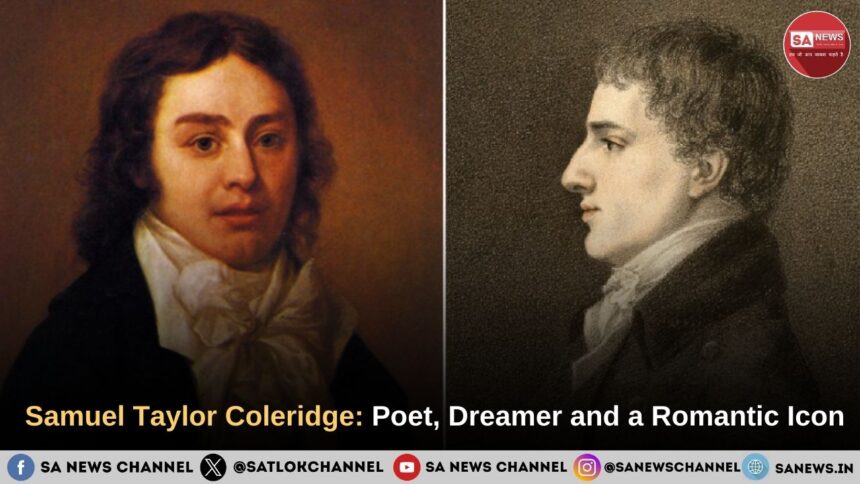
Samuel Taylor Coleridge (1772-1834), a legend in English Romanticism, had a life of poetic brilliance, philosophical insight, and personal struggle. Born in Devon, England, as the son of a vicar with scholarly inclinations, he went on to collaborate on such groundbreaking works as the 1798 Lyrical Ballads with William Wordsworth, initiating the Romantic movement with the likes of “The Rime of the Ancient Mariner” and the opium-fueled “Kubla Khan.”
Samuel Taylor Coleridge’s writing career was a combination of supernatural ballads, meditative nature poetry in the style of “Frost at Midnight,” and influential literary criticism in Biographia Literaria, where he evaluated the creative function of imagination in poetry and philosophy, even as he struggled with addiction and unfulfilled dreams.
Childhood Roots Uncovered
Born on October 21, 1772, in Ottery St. Mary, Devon, Samuel Taylor Coleridge was the youngest of ten children to Reverend John Coleridge, a scholarly vicar and schoolmaster, and his wife Ann.
His father’s vast library at home and family environment played an essential role in igniting in Samuel the spirit of reading from a tender age, reciting sermons and also earning him the nickname “little parson”. Samuel’s father, John, was a moral figure who fuelled his imagination with tales of stars and history.
Everything in Samuel’s life was going fine until 1781, when John died suddenly—at age nine, leaving Samuel isolated and bookish amid family strife—he ran away once, slept rough, and clashed with his siblings.
School Days and Cambridge Chaos
Enduring harsh conditions at the school, Samuel Taylor Coleridge entered Christ’s Hospital in 1782, where he excelled in classics, rhetoric, and poetry. It was during this time that he made friends with Charles Lamb.
He entered Jesus College, Cambridge, in 1791 but dropped out midsession amid debts, unrequited love, and radical dreams like Pantisocracy. These childhood roots of loss, voracious reading, and rebellion profoundly shaped his Romantic genius.
Utopian Dreams with Southey
Samuel Taylor Coleridge met fellow poet Robert Southey in 1794 during a walking tour. His friendship with Robert Southey ignited a profound bond rooted in shared ideals of equality and liberty.
Both the writers dreamed up “Pantisocracy,” which would be a simple community where everyone ruled equally and shared everything—there would be no difference between the rich or poor.
They planned to live in America, farm the land and spend time writing poems and thinking deep thoughts. In this farm, twelve couples would work hard, grow food, and live in nature with peace. Southey dreamt of creating a place where there is no place for crime or fights, pure tramwork.
Coleridge quit college to talk up Southey’s idea in his town. But ended the dream by 1795 due to money problems, doubts, and real-life challenges. Still, it showed their young hope for a better world.
Lyrical Ballads Revolution
Samuel Taylor Coleridge and William Wordsworth together released Lyrical Ballads, which was considered both a great work of literature and the birth of the Romantic Period, from 1797-1798.
Coleridge and Wordsworth were both men of their time who chose to break away from the traditional poetic style of the 18th-century and instead write about common people using “plain” or common language.
On one side, Coleridge was known for exploring the supernatural and the power of the individual imagination in his poem “Rime of the Ancient Mariner.” While Wordsworth, on the other side, wrote poems such as “Tintern Abbey,” which expressed both the beauty of nature and the human emotion resulting from that beauty.
The publication of Lyrical Ballads in 1798 as an anonymous work by Wordsworth was shocking to critics, who labeled the book as “blasphemy against poetry.” The preface to Lyrical Ballads, often thought to be Wordsworth’s manifesto, provided a revolutionary change in how those in the literary community viewed poetry; it urged poets to use their sense of feeling to create poetry, that feeling was best remembered in a state of calmness, and that nature should be viewed as a way to obtain moral guidance.
Although Coleridge contributed significant ideas to the poems in Lyrical Ballads, his later criticism of some of those same ideas is perhaps an indication of the extent to which he challenged accepted views on poetry. Lyrical Ballads experienced a slow initial sale; however, the second printing sold very quickly; as a result of Lyrical Ballads, a revolution occurred: poets began to search for “their” poetic view instead of relying on tradition and polished poetry for inspiration and opportunities for the sublime.
The works of both Coleridge and Wordsworth moved English poetry from works that appealed to the head to works appealing to the heart and to a belief in the sublime.
Opium Addiction Shadows
For pain from rheumatism, gout, and stress, Samuel Taylor Coleridge first turned to opium laudanum around 1796 for remedy that soon turned into an addiction. What started as a pain relief for physical problems and dental agony turned into daily dependence. By early 1800s Coleridge consumed up to two quarts weekly by the—fueling vivid dreams for poems like Kubla Khan but clouding his life.
Coleridge’s condition worsened after his travels to Malta and Italy in 1804-1806, which were meant to cure him. His condition deteriorated resulting in severe constipation needing enemas, family rifts, and fights with close friends like Wordsworth in 1810. He split from wife Sara in 1808, lost annuity support from the Wedgwoods, and went in isolation, fighting guilt and withdrawal.
By 1814, his condition led him under the care of Dr. James Gillman’s in London. He lived in his supervision for 18 years until his death in 1834, curbing but never giving up. Opium dimmed his genius, halting uncompleted works, yet inspired haunting visions—mirroring the cursed mariner’s torment.
Also read: From Medical Apprentice to Immortal Poet: Biography of John Keats
Highgate Haven and Eternal Legacy
In the care of Gillman, Coleridge attained some stability in his new life from him. He found himself in a small attic room with a view of woods and meadows that allowed him to care for his beloved birds and flowers while receiving visitors who praised his great lectures on philosophy, on Shakespeare and on the subject of faith. Visitors named him the Sage of Highgate.
While in Highgate, Coleridge made daily revisions of the famous poems Kubla Khan and Biographia Literaria, creating poetry together with significant critical works that had a positive influence on the growth of the Romantic Movement.
While Coleridge’s addiction was certainly indicative of the turmoil in his life, he did find a measure of peace at Highgate which enabled his reconciliation with his family and the creation of what remained of his last great period of wisdom.
Coleridge died on July 25, 1834 at the age of 61 years and was buried in the vicinity of St. Michael’s Church, which had been erected in memory of himself, with his latter published epitaph: “Stop, Christian passer-by! Stop, Child of God!” The visions of the Ancient Mariner, the imaginative concepts of many poetic, creative works, and the influence of Coleridge on Keats and Shelley and numerous others continue to assert Coleridge’s rightful position as the Sage of Romanticism, as he battled with his genius and with his humanity.
Saint Rampal Ji Maharaj Serving Humanity
As Coleridge left a long-lasting impact on Romantic poets, in the same way Saint Rampal Ji Maharaj ji is leaving an influence in this world with all His social service programmes. The list of Saint Rampal Ji Maharaj ji’s social service is non- ending. Some of the social service programmes by Saint Rampal Ji Maharaj are:
● Annapurna Initiative: Free food, clothes, LPG, school fees, homes for poor families.
● De-addiction Drives: Help quit alcohol, drugs, tobacco.
● Dowry-Free Marriages (Ramaini): Simple weddings without dowry
● Free Medical Camps: Dental, eye care, surgeries
● Blood Donation Drives: Regular camps.
● Free Body Donations: Bodies donated for medical research and studies.
● Disaster Relief: Aid for floods, COVID, pilgrims.
● Free Langar (Sadaavrat): Daily free meals at Satlok Ashrams.
● Tree Plantation: Lakhs of trees planted.
● Elderly and Orphan Care: Residence and support.
● Free Ambulance Services: For patients undergoing critical conditions.
For more information, visit us atwww.jagatgururampalji.org or Saint Rampal Ji Youtube Channel.