

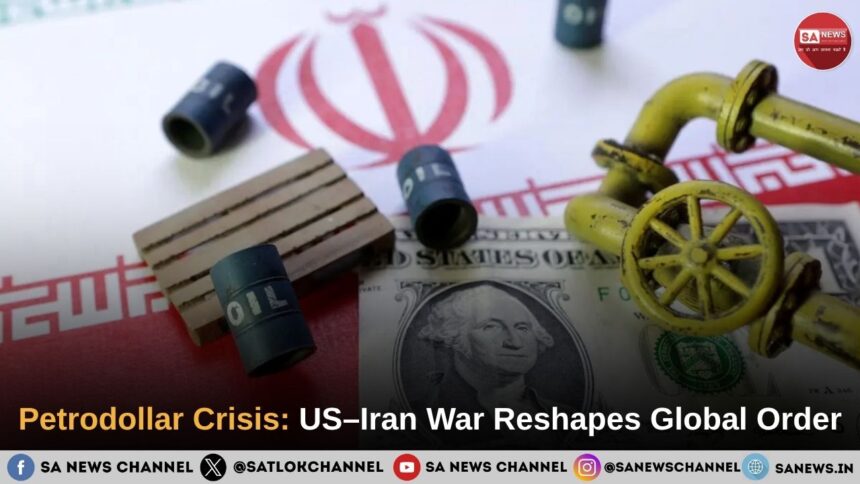
Petrodollar Crisis: The global economy isn’t just facing another geopolitical crisis—it is being pushed to its limits. Escalating tensions between the United States and Iran, along with disruptions in the Strait of Hormuz, are exposing cracks in the very system that has long sustained global financial stability.
- The Petrodollar System: A Quiet Pillar of Global Power
- The War That Shook the Assumptions
- The Strait of Hormuz: Where Economics Meets Geopolitics
- Three Fault Lines Cracking the Petrodollar System
- America’s Reduced Dependence on Middle Eastern Oil
- Erosion of Dollar-Based Oil Trade
- Declining Confidence in the US Security Umbrella
- A Gradual Shift: From Petrodollar to Multi-Currency Energy Trade
- Global Economic Impact: What We Are Seeing Right Now
- Inflationary Pressures
- Capital Flow Adjustments
- Strategic Realignment Toward Asia
- Acceleration of Energy Transition
- India’s Perspective: A Frontline Impact
- The Long Game: What Lies Ahead
- The Fragility of Our Man-Made Fortresses
- Beyond the Petrodollar: Finding the Eternal Home
Is the decades-old economic order quietly beginning to weaken?
But beyond oil, currency, and power, there’s a deeper layer few are paying attention to. When systems we trust start to shake, it raises a compelling question—are we only witnessing surface-level disruptions, or are these signals pointing toward a more fundamental truth about the fragile nature of everything we rely on?
This is not just another crisis update—it’s a perspective that may change how you see the world.
The Petrodollar System: A Quiet Pillar of Global Power
To understand the present, we must revisit a strategic arrangement forged in the 1970s.
After the collapse of the Bretton Woods system, the United States entered into an implicit bargain with Gulf oil producers, particularly Saudi Arabia:
- Oil would be priced in US dollars
- Gulf nations would reinvest surplus oil revenues into US assets
- In return, the United States would provide military protection and strategic security
This arrangement became known as the petrodollar system.
Over time, it achieved three critical outcomes:
- Global Dollar Dominance – Every oil-importing country needed dollars
- Recycling of Capital – Oil revenues flowed back into US financial markets
- Strategic Alignment – Gulf economies became deeply tied to the US security umbrella
Today, Gulf Cooperation Council (GCC) nations collectively manage over $6 trillion in sovereign wealth, much of it invested in dollar-denominated assets. Their currencies are largely pegged to the dollar, supported by approximately $800 billion in reserves.
In simple terms:
The petrodollar system turned oil into a global financial engine—and the US dollar into its fuel.
The War That Shook the Assumptions
The recent escalation involving US and Israeli strikes on Iran has altered long-standing assumptions.
While the conflict is geographically concentrated, its consequences are not. Gulf nations—despite decades of alignment with Washington—have faced direct fallout:
- Missile and drone strikes targeting energy infrastructure
- Economic disruptions across oil-producing economies
- Heightened vulnerability in a region assumed to be under US protection
This has triggered a fundamental reassessment:
Is the US security umbrella still reliable—and worth the economic cost?
This question strikes at the third pillar of the petrodollar system: security in exchange for economic alignment.
The Strait of Hormuz: Where Economics Meets Geopolitics
The Strait of Hormuz remains one of the most critical chokepoints in the world, carrying nearly one-fifth of global oil supply.
Any disruption here is not merely logistical—it is systemic.
Recent tensions have led to:
- Restricted maritime movement
- Heightened insurance and shipping costs
- Market speculation about selective access
Yuan or Bitcoin for Passage: Reality Check
There have been market reports and speculation suggesting that oil shipments might be allowed passage through the Strait of Hormuz if transactions are conducted in Chinese yuan rather than US dollars.
- These reports are not officially confirmed policy, but they are being closely watched by financial markets
- They reflect a broader and real trend: growing experimentation with non-dollar energy trade
As for Bitcoin, there is no credible or verified evidence that Iran is systematically accepting Bitcoin for oil transit through the Strait. While Iran has previously explored cryptocurrency in limited contexts to bypass sanctions, its role in global oil trade remains marginal and impractical at scale.
What This Signals
Even the possibility of conditional currency-based access is significant.
It suggests:
- Oil trade may no longer be strictly dollar-dependent
- Strategic chokepoints could be used to influence currency systems
- Financial and geopolitical power are becoming increasingly intertwined
Three Fault Lines Cracking the Petrodollar System
The current crisis has exposed structural weaknesses that were already forming.
America’s Reduced Dependence on Middle Eastern Oil
The United States is now a net energy exporter, reducing its reliance on Gulf oil.
This weakens the original logic of the petrodollar bargain:
Protection in exchange for energy access is no longer equally necessary.
Erosion of Dollar-Based Oil Trade
Even before the conflict:
- China, Russia, and Iran were promoting non-dollar energy trade
- Sanctioned oil was increasingly traded in alternative currencies
- Gulf nations had begun experimenting with non-dollar transactions
For example:
- Saudi Arabia exports significantly more oil to China than to the US
- Asia has become the primary destination for Middle Eastern energy
This shift in trade flows is gradually redefining currency dynamics.
Declining Confidence in the US Security Umbrella
This is perhaps the most immediate and impactful fault line. Despite decades of alignment:
- Gulf nations have directly experienced attacks
- The expectation of guaranteed protection has weakened
As former UK Treasury minister Jim O’Neill observed: Aligning with the US no longer guarantees security in the way it once did. This perception shift could have profound implications for global alliances.
A Gradual Shift: From Petrodollar to Multi-Currency Energy Trade
The global economy is not witnessing an overnight collapse of the petrodollar—but it is undergoing a gradual transition.
Emerging Patterns
- Petroyuan: China expanding influence through energy trade
- Petrorupee: India exploring bilateral settlement mechanisms
- Petroeuro: Potential diversification within Europe
These are not replacements yet—but they are alternatives in development.
Why This Matters
The strength of the dollar has always relied on:
- Trust
- Stability
- Universality in trade
If oil—the most traded commodity—begins to diversify away from the dollar, the long-term implications are profound.
Also Read: US-Israel-Iran War Live Updates: The Conflict Reshaping the Global Order
Global Economic Impact: What We Are Seeing Right Now
The current scenario is already reshaping global economics in real time.
Inflationary Pressures
Oil price volatility is feeding directly into:
- Transportation costs
- Manufacturing expenses
- Food prices
This creates a ripple effect across economies, particularly in import-dependent nations.
Capital Flow Adjustments
If Gulf nations begin:
- Liquidating dollar assets
- Redirecting investments toward Asia
It could impact:
- US bond markets
- Global liquidity patterns
- Exchange rate stability
Strategic Realignment Toward Asia
Asia is emerging as the central hub of energy demand:
- China and India are key buyers of Gulf oil
- Economic opportunities in Asia are expanding rapidly
This is encouraging Gulf nations to:
- Diversify partnerships
- Reduce exclusive dependence on the US
Acceleration of Energy Transition
Ironically, instability in oil markets may accelerate:
- Investment in renewable energy
- Diversification away from fossil fuels
In the long term, this could reduce the importance of oil itself—further weakening the petrodollar’s foundation.
India’s Perspective: A Frontline Impact
For India, the implications are immediate and significant:
- Over 80% of oil is imported
- A large portion passes through the Strait of Hormuz
Direct Consequences
- Rising fuel prices
- Pressure on the Indian rupee
- Increased inflation
Strategic Opportunity
At the same time, India is:
- Exploring alternative trade mechanisms
- Strengthening ties with multiple energy suppliers
This dual approach—managing risk while diversifying partnerships—will define India’s economic resilience.
The Long Game: What Lies Ahead
The current crisis is not just a short-term disruption—it is a stress test of the global economic architecture. Three possible trajectories are emerging:
Restoration of the Petrodollar System
- Conflict stabilizes
- Gulf-US ties remain intact
- Dollar dominance continues
Hybrid System Emerges
- Dollar remains dominant
- Alternative currencies gain partial role
- Regional trade systems strengthen
Structural Transformation
- Multi-currency energy trade becomes standard
- US financial dominance declines
- A new global order takes shape
The global economy currently feels like a giant machine running on a single, vital fuel: the petrodollar. However, as the 2026 conflict in the Middle East intensifies and the Strait of Hormuz remains blockaded, we are witnessing how quickly this “invincible” system can crumble. With Brent Crude surging past $120 per barrel and nations frantically shifting to alternative currencies, the anxiety of a total economic reset is palpable. We have spent generations believing that financial hegemony and military dominance could purchase security, yet a single disruption in a narrow waterway has brought the world to the brink of stagflation and chaos.
The Fragility of Our Man-Made Fortresses
This current crisis raises uncomfortable questions that go beyond market trends. Have we ever paused to consider if a system built on depleting resources and political intimidation can ever provide lasting peace? Why is it that every “solution” humanity invents eventually births an even more complex and dangerous problem? We chase economic stability to feel safe, yet the more we build, the more we fear losing it all. If our global prosperity can be shattered so easily, are we truly as advanced as we claim to be?
This makes us wonder if we are looking for security in the wrong places. We treat the symptoms of economic collapse—inflation, currency wars, and supply chain breaks—while completely ignoring the root cause of the instability itself.
Beyond the Petrodollar: Finding the Eternal Home
Jagatguru Tatvdarshi Sant Rampal Ji Maharaj provides a lens that looks past the volatility of oil prices and geopolitical shifts. He reveals that this world, part of the 21 universes ruled by Kaal Brahm (Satan), is inherently designed for decay and destruction. Whether it is the petrodollar, gold, or digital currency, nothing in this mortal realm is eternal. The conflicts we see today are reflections of a deeper karmic struggle where souls are caught in a cycle of “tit for tat.”
As Sant Garibdas Ji Maharaj from Haryana has stated:
Drishti pade so dhokha re |
Khand pind brahmand chalenge thir nahi rahsi loka re ||
This divine verse reminds us that everything we see is a temporary illusion; even the vast universes are in a state of motion toward eventual dissolution. No economic policy can reverse this cosmic law. True sustainability is not found in “saving the planet” or fixing a currency, but in returning to Satlok—our original, eternal home where abundance is natural and death does not exist.
Sant Rampal Ji Maharaj is the only Tatvdarshi Sant today who reveals the scripture-based method to burn away the karmic debts that bind us to this cycle of war and scarcity. It is time to wake up and seek the protection that no bank or government can offer.
Don’t let the shifting tides of the world leave you in despair. Discover the path to ultimate salvation and eternal peace.
Website: www.jagatgururampalji.org
YouTube: Sant Rampal Ji Maharaj
Facebook: Spiritual Leader Saint Rampal Ji
‘X’ handle: @SaintRampalJiM
.