

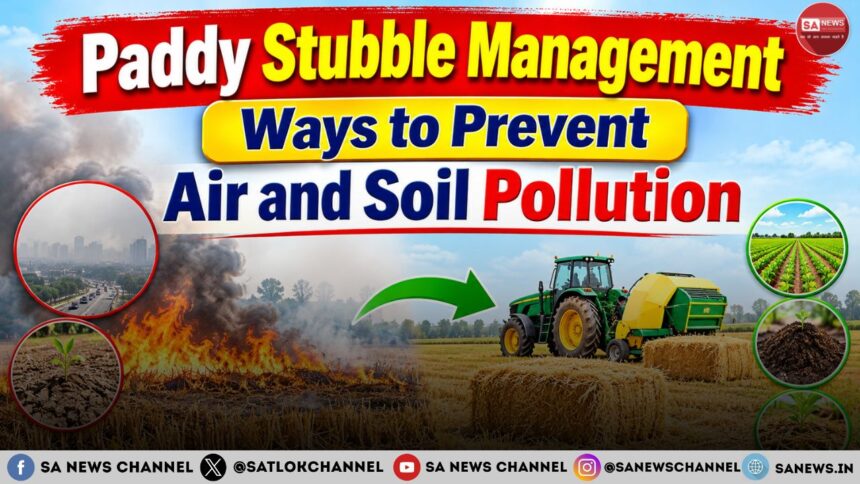
Paddy stubble management has become an important environmental priority in India, particularly across Punjab, Haryana, Uttar Pradesh and other rice-producing regions. Every year, after the paddy harvesting season, farmers face the challenge of disposing of large quantities of leftover crop residue before preparing their fields for the next wheat crop. Due to limited time, machinery costs and inadequate residue collection facilities, many farmers resort to stubble burning as a quick method of clearing their fields.
- What Is Paddy Stubble and Why Does Its Management Matter?
- How Does Paddy Stubble Burning Cause Air and Soil Pollution?
- 1. Deterioration of Air Quality
- 2. Increased Greenhouse Gas Emissions
- 3. Loss of Soil Fertility
- 4. Destruction of Beneficial Soil Microorganisms
- 5. Threats to Human and Animal Health
- Effective Methods of Paddy Stubble Management
- Role of Modern Agricultural Machinery in Preventing Stubble Burning
- Government Initiatives to Promote Paddy Stubble Management in India
- 1. Crop Residue Management Scheme
- 2. Financial Assistance for Agricultural Machinery
- 3. Promotion of Paddy Straw-Based Industries
- 4. Satellite-Based Monitoring of Stubble Burning
- Challenges in Implementing Sustainable Paddy Stubble Management
- How Can Farmers Help Prevent Air and Soil Pollution?
- Conclusion: Turning Paddy Stubble into a Valuable Agricultural Resource
- Frequently Asked Questions (FAQs)
However, burning paddy stubble releases harmful pollutants into the atmosphere, contributes to seasonal air pollution and damages soil health. The practice also wastes valuable agricultural resources that could otherwise be converted into organic manure, bioenergy, animal bedding and other useful products.
With growing concerns about air quality, climate change and declining soil fertility, sustainable paddy stubble management has become essential. Modern agricultural technologies, government initiatives and alternative uses of crop residues can help farmers reduce pollution while improving agricultural productivity and creating additional income opportunities.
What Is Paddy Stubble and Why Does Its Management Matter?
Paddy stubble refers to the leftover stalks, leaves, roots and straw remaining in agricultural fields after rice harvesting. Commonly known as parali in India, this crop residue is produced in substantial quantities, particularly when combine harvesters are used.
Farmers cultivating wheat immediately after paddy often have a short window to prepare their fields. Removing or managing the remaining straw can require additional labour, machinery and transportation. Consequently, some farmers choose to burn the residue to clear their fields quickly.
However, paddy straw is not useless agricultural waste. It contains organic carbon and essential plant nutrients, including nitrogen, phosphorus, potassium and sulphur. Properly managed crop residues can contribute to soil organic matter, improve soil structure and support nutrient cycling.
Therefore, instead of burning paddy stubble, farmers can adopt sustainable methods to recycle agricultural residues and protect the environment.
How Does Paddy Stubble Burning Cause Air and Soil Pollution?
Paddy stubble burning creates environmental problems that extend beyond agricultural fields. Its impact can be observed in air quality, soil health, biodiversity and human well-being.
1. Deterioration of Air Quality
One of the major consequences of stubble burning is the release of smoke and harmful pollutants into the atmosphere. Burning paddy straw releases particulate matter, carbon monoxide, carbon dioxide, nitrogen oxides and other air pollutants.
Fine particulate matter, particularly PM2.5, can penetrate deep into the respiratory system and aggravate asthma, respiratory infections and cardiovascular conditions.
During the post-harvest season, smoke from agricultural fires can contribute to severe air pollution across the Indo-Gangetic Plain, including Delhi-NCR. However, stubble burning is one of several pollution sources, alongside vehicular emissions, industrial activities, construction dust and waste burning.
2. Increased Greenhouse Gas Emissions
Open burning of crop residues releases greenhouse gases such as carbon dioxide, methane and nitrous oxide. These gases contribute to global warming and climate change.
Avoiding uncontrolled crop residue burning and adopting sustainable agricultural practices can help reduce avoidable emissions and support climate-friendly farming.
3. Loss of Soil Fertility
Paddy straw contains valuable organic carbon and nutrients that can benefit agricultural land. Burning crop residue destroys a significant portion of this organic material and results in the loss of nutrients.
Repeated burning can adversely affect soil organic matter, nutrient availability and soil structure. It also prevents farmers from fully utilising the potential benefits of returning crop residues to agricultural land.
4. Destruction of Beneficial Soil Microorganisms
Healthy soil contains beneficial bacteria, fungi, earthworms and other microorganisms that support nutrient cycling and organic matter decomposition.
The intense heat generated during stubble burning can damage or destroy soil organisms near the surface. Repeated burning may disturb the biological balance of agricultural soil and affect its long-term productivity.
5. Threats to Human and Animal Health
Smoke from agricultural fires can cause coughing, eye irritation, breathing difficulties and aggravation of existing respiratory conditions.
It can also reduce road visibility and increase the risk of traffic accidents. Livestock and wildlife may be affected by smoke, while agricultural fires can damage nearby vegetation and habitats.
Effective Methods of Paddy Stubble Management
Sustainable paddy stubble management involves adopting alternatives that allow farmers to utilise crop residues rather than burn them. These methods are broadly classified into in-situ and ex-situ management.
1. In-Situ Crop Residue Management
In-situ management refers to handling paddy straw directly within agricultural fields. It helps farmers retain crop residues and prepare their land for the next crop.
Happy Seeder Technology
Happy Seeder is an agricultural machine that allows farmers to sow wheat directly into fields containing paddy stubble and loose straw.
It manages standing crop residue while placing wheat seeds into the soil. This eliminates the need to burn or completely remove paddy straw before sowing.
Super Seeder Technology
A Super Seeder combines residue management and sowing operations. It cuts and manages paddy straw while incorporating it into the soil and sowing the next crop.
This technology helps farmers prepare their fields without resorting to open-field burning.
Mulching
Mulching involves spreading chopped paddy straw over the soil surface. The residue forms a protective layer that offers several benefits:
- Helps conserve soil moisture.
- Reduces soil erosion.
- Suppresses weed growth.
- Moderates soil temperature.
- Adds organic matter as the residue decomposes.
Paddy Straw Incorporation
Farmers can incorporate chopped paddy straw into the soil using suitable agricultural equipment. As the residue decomposes, it contributes organic matter and nutrients.
However, appropriate moisture conditions and sufficient decomposition time are important. Farmers should follow agricultural experts’ recommendations to avoid temporary nitrogen immobilisation and difficulties in crop establishment.
2. Ex-Situ Crop Residue Management
Ex-situ management involves collecting paddy straw from agricultural fields and transporting it for productive applications.
Biomass Energy Production
Paddy straw can be converted into biomass pellets and briquettes for use in suitable industrial boilers and energy-generation facilities.
This provides an alternative use for agricultural residues and creates opportunities for farmers to earn additional income.
Biogas and Bio-CNG Production
Paddy straw can serve as a feedstock for biogas and compressed biogas production through appropriate processing technologies.
These processes convert agricultural residues into useful energy and can support the development of rural bioenergy industries.
Composting and Organic Manure
Paddy straw can be converted into organic compost through controlled decomposition. The resulting manure can improve soil organic matter, support soil structure and contribute to nutrient cycling.
Mushroom Cultivation
Paddy straw is an important growing medium for cultivating certain edible mushrooms, particularly oyster mushrooms.
This offers farmers and rural entrepreneurs an opportunity to use agricultural waste productively and develop additional income sources.
Animal Bedding and Industrial Applications
Properly processed and stored paddy straw can be used as animal bedding. It also has potential applications in paper manufacturing, packaging materials and other industries.
Its suitability for animal feed depends on quality, processing and nutritional requirements.
Role of Modern Agricultural Machinery in Preventing Stubble Burning
Technology plays an important role in making crop residue management easier and more affordable for farmers. Modern agricultural equipment can reduce the time and labour required to manage large quantities of paddy straw.
Some commonly used machines include:
- Happy Seeder: Enables direct wheat sowing in fields containing paddy residue.
- Super Seeder: Manages crop residue while sowing the next crop.
- Straw Mulcher: Chops and spreads crop residue across the field.
- Baler: Collects and compresses loose paddy straw into manageable bales.
- Rotavator: Helps incorporate crop residues into agricultural soil.
- Zero-Till Drill: Allows sowing with minimal soil disturbance.
Custom Hiring Centres (CHCs) are particularly important for small and marginal farmers who may not be able to purchase expensive machinery.
Through these centres, farmers can rent agricultural equipment at comparatively affordable rates. Timely availability, trained operators and proper machine maintenance are essential for the success of these initiatives.
Government Initiatives to Promote Paddy Stubble Management in India
The Government of India has introduced several initiatives to discourage crop residue burning and promote sustainable agricultural practices.
1. Crop Residue Management Scheme
The Ministry of Agriculture and Farmers Welfare has been implementing the Crop Residue Management Scheme since 2018–19.
The scheme supports Punjab, Haryana, Uttar Pradesh and the National Capital Territory of Delhi in adopting sustainable crop residue management practices.
It promotes the use of agricultural machinery and infrastructure for both in-situ and ex-situ management of paddy straw.
2. Financial Assistance for Agricultural Machinery
Under the scheme, eligible farmers and institutions receive financial assistance for approved crop residue management machinery.
Support for equipment such as Happy Seeders, Super Seeders, balers and other residue management machines helps farmers adopt alternatives to burning.
Custom Hiring Centres also improve machinery accessibility by allowing farmers to rent equipment rather than purchase it.
3. Promotion of Paddy Straw-Based Industries
The government has encouraged the development of supply chains that connect farmers with industries using agricultural residues.
These supply chains involve collecting, baling, transporting and storing paddy straw for biomass energy, biofuel and other industrial applications.
Such initiatives can create additional income opportunities for farmers while reducing the quantity of crop residue burned in agricultural fields.
4. Satellite-Based Monitoring of Stubble Burning
Satellite technology helps authorities identify agricultural fire incidents and monitor crop residue burning across different regions.
The Indian Space Research Organisation (ISRO), along with relevant government agencies and research institutions, contributes to the monitoring framework used to detect farm fires.
The Commission for Air Quality Management (CAQM) also coordinates measures to prevent stubble burning in Delhi-NCR and adjoining areas.
Challenges in Implementing Sustainable Paddy Stubble Management
Despite technological advancements and government support, several challenges continue to affect the adoption of sustainable crop residue management.
Limited Time Between Crops: Farmers often have a short period between paddy harvesting and wheat sowing, making residue management difficult.
High Machinery Costs: Modern agricultural equipment can be expensive, particularly for small and marginal farmers.
Lack of Awareness: Some farmers are unaware of the long-term environmental and economic benefits of managing crop residues sustainably.
Transportation and Storage Difficulties: Collecting, transporting and storing large quantities of paddy straw requires adequate infrastructure.
Limited Market Opportunities: Farmers may struggle to find reliable buyers and profitable markets for collected crop residues.
Addressing these challenges requires coordination among farmers, agricultural institutions, government agencies, machinery manufacturers and industries that utilise agricultural waste.
How Can Farmers Help Prevent Air and Soil Pollution?
Farmers play a central role in reducing stubble burning and promoting environmentally responsible agriculture. Some practical measures include:
- Avoid burning paddy stubble and explore suitable in-situ or ex-situ management methods.
- Use Happy Seeders, Super Seeders and other residue management machinery wherever appropriate.
- Convert suitable crop residues into compost and organic manure.
- Explore opportunities to sell collected straw to biomass and bioenergy industries.
- Participate in Custom Hiring Centres to access affordable agricultural equipment.
- Consult Krishi Vigyan Kendras (KVKs) and agricultural experts for region-specific guidance.
- Promote awareness about the environmental and economic benefits of sustainable crop residue management.
- Consider suitable crop varieties, harvesting schedules and crop diversification options to reduce residue management pressures.
Conclusion: Turning Paddy Stubble into a Valuable Agricultural Resource
Paddy stubble management is not just about preventing seasonal air pollution; it is also about protecting soil fertility, conserving natural resources and making Indian agriculture more sustainable.
Although burning crop residues may appear to be a convenient solution for clearing agricultural fields, its environmental consequences can be significant. In contrast, mulching, composting, residue incorporation, biomass production and modern agricultural machinery offer practical alternatives.
The success of these initiatives depends on affordable technology, effective government support, reliable market linkages and greater awareness among farming communities.
Instead of treating paddy stubble as agricultural waste, India needs to recognise it as a valuable resource that can support soil health, renewable energy and rural livelihoods.
Sustainable paddy stubble management can therefore contribute to cleaner air, healthier soil and a more resilient agricultural future.
Frequently Asked Questions (FAQs)
1. What is paddy stubble management?
Paddy stubble management refers to the scientific and sustainable handling of leftover rice crop residues after harvesting. It includes mulching, composting, incorporation into soil, baling and conversion into biomass or bioenergy.
2. How does stubble burning cause air pollution?
Stubble burning releases particulate matter, carbon monoxide, carbon dioxide, nitrogen oxides and other pollutants. These emissions deteriorate air quality and can aggravate respiratory and cardiovascular health problems.
3. How does paddy stubble burning affect soil fertility?
Burning crop residue destroys organic matter and valuable plant nutrients. Repeated burning can also adversely affect soil microorganisms, nutrient availability and soil physical properties.
4. What are the best alternatives to paddy stubble burning?
Effective alternatives include Happy Seeder technology, Super Seeders, mulching, composting, straw incorporation, biomass production and biogas generation.
5. Can farmers earn money from paddy stubble?
Yes. Farmers can sell collected paddy straw to biomass power plants, biofuel producers and other industries. It can also be used for mushroom cultivation, compost production and other commercial applications.