

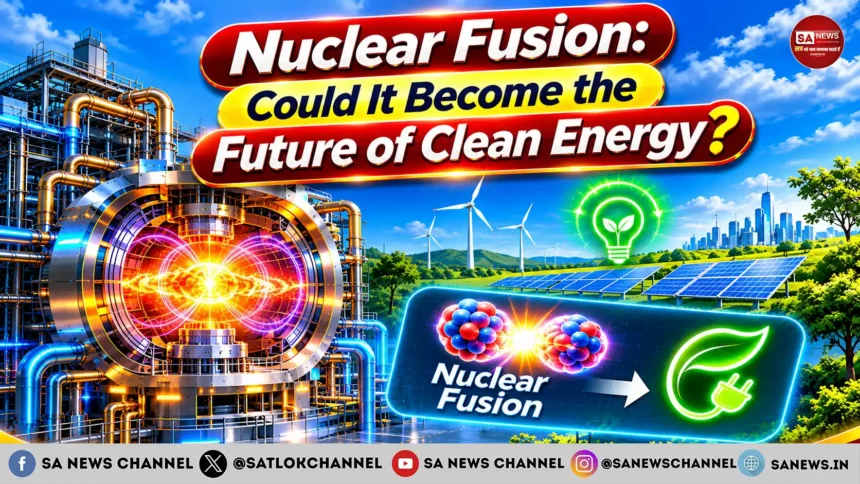
For decades, nuclear fusion has carried a frustrating reputation: it’s the energy source of the future, and as the old joke goes, it always will be. Often described as the “holy grail” of clean energy, fusion is the very process that powers our Sun and stars. By mimicking the conditions of deep space right here on Earth, humanity could theoretically unlock an era of limitless, zero-carbon electricity.
But as global energy demands skyrocket, spurred heavily by the meteoric rise of AI data centers and digital infrastructure, the race to commercialize fusion has shifted from a distant scientific pipedream into a high-stakes global engineering sprint.
Where do we stand today? Could fusion genuinely power our grid, or is it destined to remain confined to laboratory walls?
The Physics: Recreating a Star in a Bottle
To understand why fusion is so enticing, it helps to contrast it with nuclear fission, the technology used in traditional nuclear power plants today. Fission works by splitting heavy atoms like uranium apart. While fission is low-carbon and highly efficient, it produces long-lived radioactive waste and carries the risk of thermal meltdowns if things go wrong.
Fusion does the exact opposite: it merges light atomic nuclei (typically isotopes of hydrogen like deuterium and tritium) under immense heat and pressure to form helium. When these atoms fuse, a tiny fraction of their mass is converted into a staggering amount of energy, following Einstein’s famous equation:
E=mc2
The fuel supply is virtually inexhaustible. Deuterium can be extracted easily from ordinary seawater, and tritium can be bred from lithium, which is widely available. A single gallon of seawater can yield as much energy through fusion as 300 gallons of petrol.
Even better, fusion is inherently safe. It does not produce high-level, long-lived nuclear waste, and it cannot experience a runaway chain reaction; if the system is disrupted, the plasma instantly cools and the reaction stops. There is no risk of a meltdown.
Recent Breakthroughs: Moving Past the Milestones
For a long time, the roadblock wasn’t understanding the physics, it was maintaining a net energy gain. To make fusion viable, you have to pump more energy into confining and heating hydrogen plasma than the reaction spits back out.
That narrative began to shift dramatically. Landmark achievements, such as the milestone at the U.S. National Ignition Facility (NIF), proved that controlled fusion could officially generate more energy than was required to trigger the reaction.
Meanwhile, experimental magnetic confinement reactors around the world are shattering endurance records:
- Tokamaks and Stellarators: Facilities like China’s EAST (Experimental Advanced Superconducting Tokamak) and European laboratories have successfully sustained ultra-dense, million-degree plasma states for extended periods, utilizing advanced artificial intelligence to stabilize turbulent magnetic fields in real time.
- Private Sector Surge: The fusion landscape is no longer driven solely by government-funded monoliths like the international ITER project. Billions in private venture capital have flooded into private startups leveraging high-temperature superconducting magnets and novel geometries, drastically shrinking the projected footprints of future power plants.
The Hurdles: Why Isn’t It on the Grid Yet?
Despite incredible scientific strides, turning a physics experiment into a commercial power plant is one of the most difficult engineering challenges in human history.
- Materials Science: The environment inside a fusion reactor is brutal. The reactor walls are constantly bombarded by high-energy neutrons, degrading materials rapidly. Finding or engineering alloys that can withstand this continuous neutron battering for decades without becoming structurally compromised is a massive bottleneck.
- The Tritium Supply Chain: While deuterium is abundant, tritium is rare and radioactive. Future commercial reactors will need to successfully breed their own tritium on-site at scale, a technology that is still in its infancy.
- Economic and Capital Scaling: According to global energy outlooks from organizations like the IAEA, bringing commercial fusion to reality will require tens of billions in additional capital, alongside streamlined regulatory frameworks. Building a prototype that works in a lab is vastly different from building a cost-competitive plant that can reliably feed baseload power into a national grid.
Looking Ahead: When Will Fusion Arrive?
Historically, skeptics joked that fusion was always “30 years away.” Today, leading scientists and industry directors argue that timeline has tightened, with pilot power plants targeting operations in the 2030s and 2040s.
Projections vary wildly: optimistic economic models suggest fusion could capture a meaningful slice of the global electricity mix by the latter half of the century, providing clean, weather-independent baseload power that complements wind and solar.
Nuclear fusion may not solve our immediate energy crises tomorrow, but it is no longer a matter of if we can achieve it, but when we can engineer it. As private investment accelerates and AI simulations unlock new pathways for plasma control, humanity is closer than ever to capturing the power of the stars and bringing it down to Earth.
Beyond the Advancements: Purpose of Human Life
These advancements in energy are mind blowing but one may contemplate about how the entropy of this universe is so high yet everything aligned perfectly for life to evolve.
How was the universe created and what’s the purpose of this life? Many religious leaders and philosophers have tried making up theories around this but none of them actually fit the bigger picture.
This is where Sant Rampal Ji Maharaj comes in. He unfolds the hidden secrets within our holy scriptures and enlightens us to the right way of worship and the creation of this universe.
Make sure to checkout: https://www.jagatgururampalji.org/en/creation-of-nature-universe/all-religions/
FAQs (Frequently Asked Questions)
1. What is nuclear fusion in simple terms? Nuclear fusion is the process of smashing light atoms (usually hydrogen) together at extreme heat and pressure until they merge into helium, releasing massive amounts of clean energy, the exact same reaction that powers the Sun.
2. How is nuclear fusion different from nuclear fission? Nuclear fission splits heavy atoms like uranium apart, creating energy along with long-lived radioactive waste. Nuclear fusion merges light atoms together, producing vastly more energy with no high-level radioactive waste and zero risk of a meltdown.
3. Is nuclear fusion completely clean and safe? Yes. Fusion produces zero greenhouse gas emissions, emits only harmless helium as a byproduct, and cannot suffer a runaway chain reaction; if anything goes wrong inside the reactor, the plasma simply cools and stops.
4. What fuel is used in a nuclear fusion reactor? Most fusion reactors use two isotopes of hydrogen: deuterium, which is easily extracted from ordinary seawater, and tritium, which can be bred from lithium inside the reactor.
5. Why haven’t we built commercial nuclear fusion power plants yet? While scientists have achieved net energy gain in labs, commercializing fusion requires solving major engineering hurdles, such as building reactor walls that can survive extreme neutron bombardment and scaling up tritium fuel production.
6. How hot does a nuclear fusion reactor get? To force atoms to fuse without the immense gravitational pressure of a star, reactors on Earth must heat hydrogen gas into a plasma reaching over 100 million degrees Celsius, more than six times hotter than the core of the Sun.
7. What is “net energy gain” in nuclear fusion? Net energy gain (or ignition) occurs when a fusion reaction produces more thermal energy than the energy required to heat and confine the plasma, proving the process can act as a viable power source rather than an energy drain.
8. How is AI helping develop nuclear fusion? Artificial intelligence and machine learning algorithms predict and adjust magnetic fields in milliseconds, keeping turbulent, superheated plasma stable inside doughnut-shaped reactors called tokamaks.
9. When will nuclear fusion power be available on the grid? Many fusion startups and national research programs aim to connect pilot power plants to the electrical grid in the 2030s and 2040s, with widespread commercial adoption projected for the second half of the century.
10. Will nuclear fusion replace solar and wind energy? Rather than replacing renewables, fusion is expected to complement solar and wind by providing reliable, weather-independent “baseload” power that runs 24/7 regardless of sunlight or wind speeds.