

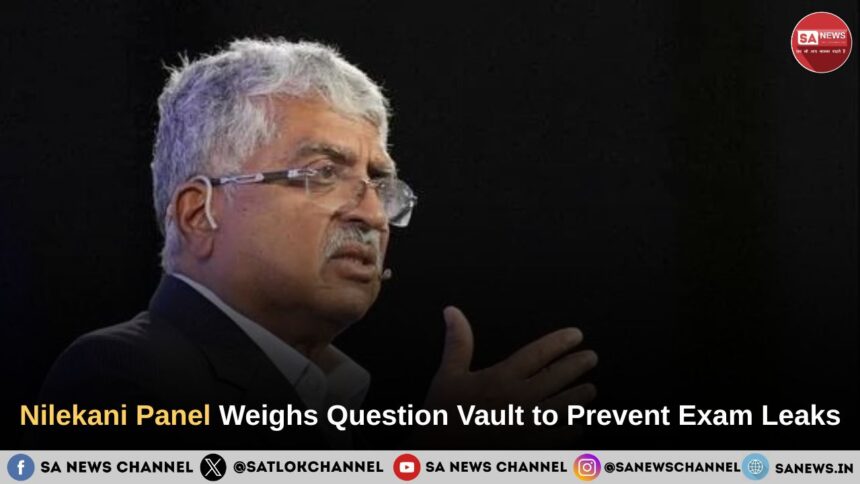
India’s examination reform task force, led by Nandan Nilekani, is considering a secure question vault containing more than one lakh questions to reduce examination paper leaks. The proposal includes generating question papers shortly before examinations and delivering them digitally to test centres. The panel is also examining computer-based testing (CBT), while experts have raised concerns about academic standards, cybersecurity and accessibility for rural students.
Question Vault Proposed to Strengthen Exam Security
The High-Powered Task Force (HPTF) on examination reforms, headed by Infosys co-founder Nandan Nilekani, is considering a technology-backed question vault following the NEET-UG 2026 paper leak controversy. According to reports published by The Indian Express on October 17, the proposed system would maintain a pool of more than one lakh questions prepared, verified and translated throughout the year. Examination papers would be assembled shortly before tests and delivered digitally.
Speaking at the Bloomberg New Economy Forum 2026, Nilekani said generating papers at the last minute from a large question bank could reduce the financial incentive for leaks. The task force is also considering separating question-paper preparation, examination-centre management and examination conduct among different service providers.
The Staff Selection Commission (SSC) already uses an internal digital question vault. SSC Chairman S. Gopalakrishnan said the Commission conducts around a dozen recruitment examinations annually across more than 200 centres in approximately 140 cities, covering over 300 shifts. For an examination scheduled at 5 pm, questions are selected according to a predetermined blueprint, and the paper is compiled and encrypted at 4.45 pm before being transmitted to examination centres. Candidates access it at the scheduled time using their passwords. Gopalakrishnan said the SSC had recorded no paper leak in the preceding five years, attributing the security of its process to encryption and controlled digital handling.
Experts Flag Academic Quality and Accessibility Concerns
Educators and technology experts have cautioned that a question vault alone cannot guarantee examination fairness. Questions require rigorous academic validation to ensure balanced syllabus coverage, appropriate difficulty levels and the ability to assess understanding rather than only factual recall. Experts have also warned that randomly selecting questions could create differences in difficulty across examination sessions. Doreswamy P, CEO of Excelsoft Technologies, emphasised the need to secure every stage, from question creation and validation to storage and delivery.
Nilekani has also proposed expanding computer-based testing, but experts have highlighted risks involving cybersecurity, impersonation, network reliability and inadequate facilities. Anand Kumar, founder of Super 30 warned that fully computer-based examinations could disadvantage rural and economically weaker students without adequate computer access. Ashish Mittal, founder and director of Innovatiview India Ltd, stressed that expansion requires secure networks, backup power, reliable technology, candidate authentication and real-time monitoring.
NEET-UG Controversy and Latest Developments
The CBI registered a case on May 12, 2026, following allegations concerning the unauthorised circulation of NEET-UG examination material. The examination was held on May 3. The reform process also draws on recommendations made by the committee headed by former ISRO chairman K. Radhakrishnan in October 2024, which proposed a nationwide network of standardised testing centres.
More than 2.2 million candidates registered for NEET-UG 2026, making a transition from pen-and-paper testing to computer-based testing a substantial logistical challenge. Multiple sessions would require a transparent, independently audited normalisation system to account for differences in question-paper difficulty. CBT is already used for JEE-Main, CUET and UGC-NET. However, the Centre told the Supreme Court on August 4 that it had not finalised a decision to shift NEET-UG to CBT from 2027.
The six-member Nilekani task force, which has held more than 58 meetings and consultations over two months, is expected to submit its final report by the end of October. Until the recommendations are finalised and adopted, the Question Vault and wider CBT expansion remain proposals under consideration.
Spiritual Knowledge Emphasises Truthful Conduct
The teachings of Tatvdarshi Sant Rampal Ji Maharaj emphasise understanding spiritual knowledge through the evidence of sacred scriptures, including the Vedas and the Bhagavad Gita.
His spiritual discourses encourage people to examine scriptural teachings and understand the importance of truth in human life. In this context, viewers can watch the first to fifth episodes of “Shastrarth Ka Shankhnaad” starting from October 3 and 2026, every Saturday and Sunday at 7:30 PM to 9:30 PM on Sadhna TV and the Sant Rampal Ji Maharaj YouTube Channel.
Official Platforms:
- Website: www.jagatgururampalji.org
- YouTube: Sant Rampal Ji Maharaj
- Facebook: Spiritual Leader Saint Rampal
FAQs on Nilekani Panel’s Exam Reform Proposals
1. What is the Question Vault proposal?
It involves securely storing verified questions and assembling examination papers shortly before tests begin.
2. Who heads the examination reform task force?
Nandan Nilekani, Infosys co-founder, heads the six-member High-Powered Task Force on examination reforms.
3. How could a Question Vault reduce paper leaks?
It could limit advance access to complete papers and reduce risks associated with printing, transportation and distribution.
4. Will NEET-UG become computer-based in 2027?
The Centre told the Supreme Court on August 4 that it had not finalised a decision to shift NEET-UG to CBT from 2027.
5. What concerns have experts raised?
They include academic quality, question difficulty, cybersecurity, infrastructure requirements and accessibility for rural students.