


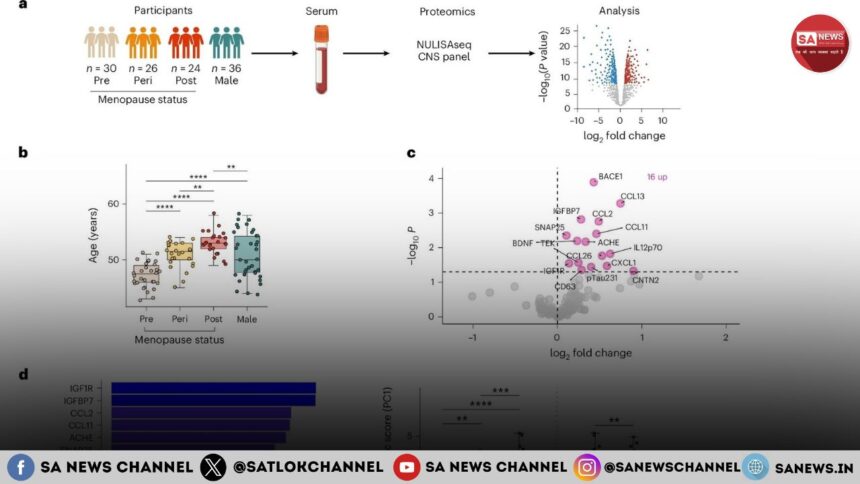
A Nature Medicine study found that menopause-related changes in blood proteins were associated with biological aging, less favourable cognitive outcomes and a higher relative risk of Alzheimer’s dementia in older women. Researchers analysed several cohorts, while stressing that the findings show associations and do not establish that menopause causes dementia.
- Why researchers examined menopause and brain ageing
- How the study was conducted
- Validation in the UK Biobank
- Links with cognitive ageing and Alzheimer’s dementia
- What the findings do — and do not — establish
- A Research Lead, Not a Diagnostic Test
- Spiritual Knowledge and Human Well-being
- FAQs on Menopause-Related Blood Protein Changes and Brain Ageing
Why researchers examined menopause and brain ageing
Menopause involves a steep decline in ovarian hormones, including 17β-estradiol and progesterone, and a sustained rise in follicle-stimulating hormone (FSH). These endocrine changes affect multiple body systems and may be relevant to later brain ageing and dementia risk.
The study, “Blood proteomics of menopause map to brain aging and dementia risk”, was published in Nature Medicine on 22 September 2026. Researchers from the University of Toronto, the University of California San Francisco and collaborating institutions examined blood-based biological changes associated with spontaneous menopause.
Alzheimer’s disease-related biological processes may begin decades before dementia symptoms, which typically emerge in the mid-70s. Menopause occurs at an average age of 51, placing the transition within a period relevant to the study of early brain ageing. Earlier and surgical menopause, as well as vasomotor symptoms such as hot flashes and night sweats, have also been associated in previous research with indicators of later cognitive health.
Also Read: Top Neuroscientist Warns: 3 Daily Habits That Are Quietly Damaging Your Brain Cells
How the study was conducted
The initial analysis included 80 women aged 43–58: 30 premenopausal, 26 perimenopausal and 24 postmenopausal participants. Thirty-six age-matched men were included for comparison. Menopause stages were classified using STRAW+10, and serum was analysed using NULISAseq proteomics. After adjusting for age, researchers identified 16 proteins elevated in postmenopausal compared with premenopausal women. They reflected inflammatory (CCL13, IL-12p70, CXCL1, CCL26, CCL2, CCL11, TEK and CD63), synaptic or neuronal-network (CNTN2, ACHE, SNAP25 and BDNF), metabolic (IGFBP7 and IGF1R) and Alzheimer’s-related (BACE1 and p-tau231) biology.
A principal component analysis produced a menopause proteomic score; its first component explained 28.7% of the variation in the 16 proteins. The score rose stepwise across menopause stages and tracked more strongly with reproductive hormones than chronological age. It was inversely associated with estradiol and positively associated with FSH. When FSH, estradiol and progesterone were modelled together, only FSH remained significantly associated with the score. Proinflammatory proteins were especially elevated in women with vasomotor symptoms.
Among the canonical Alzheimer’s biomarkers examined, p-tau231 was the only one that differed significantly between postmenopausal and premenopausal women after accounting for age.
Validation in the UK Biobank
The researchers analysed plasma Olink data from 2,814 age-matched women in the UK Biobank. Of 2,923 proteins measured, 1,300 differed by menopause stage: 1,146 were higher and 154 lower in postmenopausal women than in pre- and perimenopausal women. The analysis replicated key shifts and showed broader upregulation of inflammatory and catabolic processes.
In a further analysis of 2,340 women, postmenopausal participants had less favourable age gaps in 11 of 13 organ-age measures and 36 of 38 cell-age measures. Findings included measures of brain and artery ageing and oligodendrocyte precursor-cell ageing.
Links with cognitive ageing and Alzheimer’s dementia
The researchers next examined four independent cohorts of older women, with average ages of 60.7–72.1 years and 11,925 participants in total. Higher menopause proteomic scores were associated with less favourable cognitive outcomes.
In longitudinal analyses, higher baseline scores were associated with faster cognitive change in the Alzheimer’s Disease Neuroimaging Initiative (ADNI; 673 women) and the UCSF Brain Aging Network for Cognitive Health (BrANCH; 100 women). In the Wisconsin Registry for Alzheimer’s Prevention (WRAP; 93 women), higher scores were associated with lower global cognitive performance.
Also Read: Unnoticed Miracle of God: The Human Physiology and Anatomy
The UK Biobank analysis included 11,059 women without known dementia at baseline, followed for an average of 15.7 years. Each one-unit increase in the menopause proteomic score was associated with a 15% higher relative hazard of Alzheimer’s dementia (hazard ratio 1.15; 95% confidence interval 1.01–1.31; 219 events). The association was not statistically significant for frontotemporal dementia, vascular dementia or all-cause dementia. Individual protein associations varied across cohorts.
What the findings do — and do not — establish
The researchers emphasised that the findings do not establish that menopause causes dementia. The study also did not demonstrate that protein changes measured during midlife directly predict whether an individual woman will develop Alzheimer’s disease.
The molecular signatures may help researchers select biomarkers or therapeutic targets for brain health in midlife women. The University of California San Francisco’s report described an eventual goal of investigating whether the molecules could contribute to an early-warning blood test; this remains a research aim, not an established clinical screening tool. Further longitudinal studies are needed to determine whether the changes can reliably predict cognitive decline or guide preventive interventions.
A Research Lead, Not a Diagnostic Test
The findings identify associations between menopause-related blood proteins and later cognitive outcomes across several cohorts. They offer a basis for further research into hormonal changes and brain ageing, but do not prove causation or establish a clinical prediction test. Additional longitudinal evidence is needed before these molecular signatures can guide individual risk assessment or prevention.
Spiritual Knowledge and Human Well-being
The findings highlight how closely the human body, brain and overall well-being are interconnected. While modern medical research examines biological changes associated with ageing, spiritual knowledge also emphasises the importance of understanding the human body and the purpose of life.
In this context, the scriptural discussions and teachings of Tatvdarshi Sant Rampal Ji Maharaj encourage people to explore spiritual knowledge through evidence-based scriptural debate (Shastrarth). Such discussions offer a perspective on human existence, health and the deeper questions of life, alongside the scientific understanding of the human body.
FAQs on Menopause-Related Blood Protein Changes and Brain Ageing
1.What did the Nature Medicine menopause study find?
It found that menopause-related blood protein changes were associated with biological ageing, cognitive decline and Alzheimer’s dementia risk.
2.How many proteins changed during menopause in the initial study?
Researchers identified 16 proteins elevated in postmenopausal women compared with premenopausal women, after adjusting for age.
3.Which hormone was most strongly associated with the menopause protein score?
FSH was the only hormone significantly associated with the score when FSH, estradiol and progesterone were modelled together.
4.Did the study prove that menopause causes Alzheimer’s disease?
No. The researchers reported associations and said the findings do not establish that menopause causes dementia.
5.What did the study report about Alzheimer’s dementia risk?
Each one-unit increase in the menopause proteomic score was associated with a 15% higher relative hazard of Alzheimer’s dementia.