


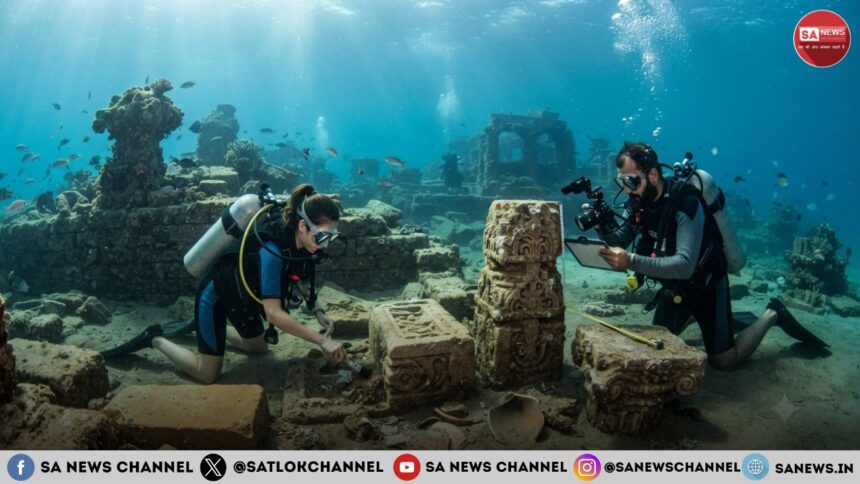
India’s coastline holds more than beautiful beaches, fishing villages and busy ports. Beneath its surrounding waters lie traces of ancient settlements, forgotten trading centres, stone structures and possible remnants of once-thriving communities. From Dwarka in Gujarat to Mahabalipuram and Poompuhar in Tamil Nadu, marine archaeology is helping researchers investigate India’s fascinating underwater heritage. These discoveries raise intriguing questions about how ancient people lived, traded and adapted to changing
- The Hidden History Beneath India’s Oceans
- Dwarka: Exploring the Mystery of an Ancient City
- Mahabalipuram: The Mystery of the Seven Pagodas
- Poompuhar: The Lost Port City of Tamil Nadu
- Bet Dwarka: Evidence of Ancient Maritime Activities
- India’s Ancient Maritime Trade Routes
- How Marine Archaeologists Discover Underwater Civilizations
- Why Did Ancient Coastal Settlements Disappear?
- Why Are India’s Underwater Archaeological Discoveries Important?
- Government Initiatives for Protecting Underwater Heritage
- Challenges in Protecting India’s Underwater Heritage
- The Future of Marine Archaeology in India
- Learning from History
- FAQs on Marine Archaeology
coastlines. Although some submerged sites are connected with legendary stories, scientific investigations help separate historical evidence from popular beliefs. Exploring these underwater remains offers a remarkable glimpse into India’s maritime past.
The Hidden History Beneath India’s Oceans
When people think about ancient Indian civilizations, they generally imagine magnificent temples, historical monuments, forts and archaeological sites. However, some of India’s most interesting historical stories may be hidden beneath the Arabian Sea, the Bay of Bengal and the Indian Ocean.
Over thousands of years, India’s coastal geography has changed significantly. Natural processes such as coastal erosion, changing sea levels, storms, earthquakes and sediment movement have transformed shorelines. Settlements that once stood close to the sea may now be partially or completely submerged.This is where marine archaeology becomes important. Marine archaeology is the scientific study of human history through underwater remains. It involves examining submerged settlements, ancient ports, shipwrecks, stone anchors, pottery, sculptures and other objects that provide information about past civilizations.India has an especially interesting underwater archaeological landscape because of its long maritime history. Ancient communities maintained connections with different regions through sea trade, fishing, navigation and cultural exchange.Today, researchers are exploring these underwater sites to understand what happened to coastal settlements and how ancient communities interacted with the sea.
Dwarka: Exploring the Mystery of an Ancient City
One of India’s most fascinating underwater archaeological locations is Dwarka, situated in Gujarat along the Arabian Sea.
Dwarka holds immense cultural and religious importance because Hindu traditions associate it with Lord Krishna’s ancient kingdom. According to popular accounts, the city was submerged after Krishna’s departure from the earthly world.
For centuries, stories about the submerged city have attracted historians, researchers and curious visitors.
However, what does archaeology actually tell us?
Underwater investigations around Dwarka and nearby Bet Dwarka have identified several interesting archaeological remains. These include stone anchors, structural remains, pottery and other objects that indicate historical human activity along the coast.
Marine archaeologist S. R. Rao’s research, published in 1987, described submerged features near Dwarka and Bet Dwarka, including a stone jetty, structural remains, fortification walls and rock-cut slipways.
Stone anchors are particularly important because they provide clues about ancient maritime activities. Their shapes, materials and designs help researchers understand how vessels were secured and how coastal communities used the sea.
Recent Underwater Exploration in Dwarka
Dwarka has once again attracted attention through renewed archaeological investigations.
On February 18, 2025, the Archaeological Survey of India (ASI) began a new underwater exploration near the Gomati Creek in Dwarka. The investigation aimed to locate, document and study submerged archaeological remains.
The project also focused on understanding the age of recovered objects through scientific examination of sediments and marine deposits.
The exploration continued to highlight the importance of modern technology in underwater research.
It is important to understand that the archaeological remains discovered around Dwarka do not automatically establish that the entire legendary city described in religious traditions has been identified. Researchers must carefully examine the evidence before reaching historical conclusions.
Nevertheless, Dwarka remains one of India’s most important locations for studying underwater cultural heritage.
Mahabalipuram: The Mystery of the Seven Pagodas
Another fascinating destination for marine archaeology is Mahabalipuram, located along Tamil Nadu’s Coromandel Coast.The town is famous for its magnificent rock-cut temples, sculptures and architectural monuments built during the Pallava period.One of its most interesting historical stories concerns the legendary Seven Pagodas.
According to local traditions and historical accounts, several temples once stood near the shoreline. Over time, the sea supposedly swallowed some of these structures, leaving only the famous Shore Temple visible today.For many years, this story remained an intriguing part of Mahabalipuram’s history.However, underwater archaeological investigations have provided interesting evidence.Researchers from the National Institute of Oceanography (NIO) and the Archaeological Survey of India have explored the coastal waters around Mahabalipuram.
Investigations have identified submerged stone structures and numerous dressed stones in the intertidal zone.A scientific study published in 2021 examined submerged temple structures near Mahabalipuram. Researchers used radiocarbon dating of marine deposits and materials growing over the submerged structures to investigate when they went underwater.The study suggested that different structures may have been submerged during separate periods, including around the first century CE and the late fourteenth century CE.
What Could Have Caused the Submergence?
Researchers have considered several possible natural explanations:
- Coastal erosion gradually changes the shoreline.
- Cyclonic activity affecting coastal settlements.
- Tsunamis and powerful ocean waves.
- Changes in local sea levels.
- Movement of sediments around ancient structures.
These possibilities demonstrate how natural environmental changes can reshape coastlines over centuries.
Mahabalipuram is therefore an important example of how local traditions, historical records and scientific research can come together to investigate the past.
Poompuhar: The Lost Port City of Tamil Nadu
Poompuhar, also known as Kaveripattinam, is another important location in India’s underwater archaeological history.Situated near the mouth of the River Kaveri in Tamil Nadu, Poompuhar was an important ancient port town associated with early Chola history.It is also mentioned in classical Tamil literature, particularly the famous literary work Silappadikaram.
Historical descriptions portray Poompuhar as a prosperous coastal settlement where merchants, sailors, fishermen and traders participated in maritime activities.The town was connected with overseas commercial networks and played an important role in regional trade.However, the coastline around Poompuhar experienced considerable changes over time.Researchers have investigated the possibility that coastal erosion and other natural processes contributed to the disappearance of parts of the ancient settlement.
What Have Archaeologists Discovered?
Marine archaeological investigations around Poompuhar have focused on identifying submerged structures and understanding the changing coastal landscape.
Researchers have used techniques such as:
- Bathymetric surveys to study underwater depth.
- Side-scan sonar to identify features on the seabed.
- Sub-bottom profiling to investigate buried geological layers.
- Sediment analysis to understand environmental changes.
- Underwater photography and documentation.
These methods help researchers identify possible archaeological remains without immediately disturbing the underwater environment.A major development in this field is the Digital Poompuhar initiative.India’s Department of Science and Technology, in its 2025–26 annual report, described a collaborative research project involving 12 national institutions. The project developed an integrated model of Poompuhar’s history and investigated different phases of coastal development and submergence.The report also described a proposed early phase, called Poompuhar-1, located approximately 35–45 kilometres offshore, with an estimated age of 12,000–15,000 years before present.Such an extraordinary age estimate requires careful scientific interpretation and further investigation. It should not be treated as definitive proof of a 12,000-year-old urban port city.Nevertheless, the research highlights how advanced marine technology is opening new possibilities for studying India’s ancient coastal settlements.
Bet Dwarka: Evidence of Ancient Maritime Activities
Located near the coast of Gujarat, Bet Dwarka is another significant archaeological location.The island has strong religious associations and is traditionally connected with the ancient city of Dwarka.However, its importance extends beyond religious traditions.Underwater archaeological research in the surrounding waters has identified objects that provide valuable information about historical maritime activities.
Some important findings include:
- Stone anchors of different shapes and sizes.
- Pottery fragments.
- Structural remains.
- Objects associated with ancient settlements.
- Evidence suggesting maritime connections.
Stone anchors are especially useful for understanding the development of ancient navigation.Different types of anchors may indicate changes in boat-building methods, maritime technology and trading activities.Researchers from the National Institute of Oceanography have conducted investigations around Bet Dwarka to understand these archaeological remains and their relationship with ancient coastal settlements.The Archaeological Survey of India has also renewed its underwater exploration activities in the region.
In February 2025, the government announced underwater investigations around Dwarka and Bet Dwarka. These studies aimed to document submerged remains and scientifically establish their antiquity.Bet Dwarka demonstrates that underwater archaeology is not simply about discovering lost buildings. It also helps researchers reconstruct everyday activities, including fishing, transportation, navigation and trade.
India’s Ancient Maritime Trade Routes
India has enjoyed a long relationship with maritime trade.Its geographical position connected the Indian subcontinent with the Middle East, Southeast Asia, Africa and other parts of the world.Ancient merchants travelled across the Arabian Sea and Bay of Bengal, carrying valuable products and exchanging ideas, technologies and cultural traditions.
Important historical coastal trading centres included:
- Lothal in Gujarat.
- Arikamedu in Tamil Nadu.
- Poompuhar in Tamil Nadu.
- Bharuch in Gujarat.
- Muziris in the Malabar region.
These places help historians understand how ancient Indian communities participated in international trade.
Lothal and the Ancient Dockyard
Lothal, located in present-day Gujarat, is one of the most important archaeological sites associated with the Indus Valley Civilization.The site is famous for a large brick-built basin traditionally identified as a dockyard.Its location and archaeological remains have attracted considerable attention because they provide clues about ancient water management and possible maritime activities.Although Lothal is not an underwater kingdom, it helps explain the development of ancient maritime connections in western India.
Arikamedu and Overseas Connections
Arikamedu, near Puducherry, is another important archaeological location.Excavations at this site have revealed evidence of trade connections between ancient South India and the Mediterranean world.Archaeologists have discovered pottery, including Roman amphora fragments, along with other objects that indicate overseas commercial interactions.The Archaeological Survey of India’s underwater archaeology programme has also conducted explorations around the Arikamedu region.These investigations help researchers understand the relationship between ancient ports, river systems and coastal trade.
How Marine Archaeologists Discover Underwater Civilizations
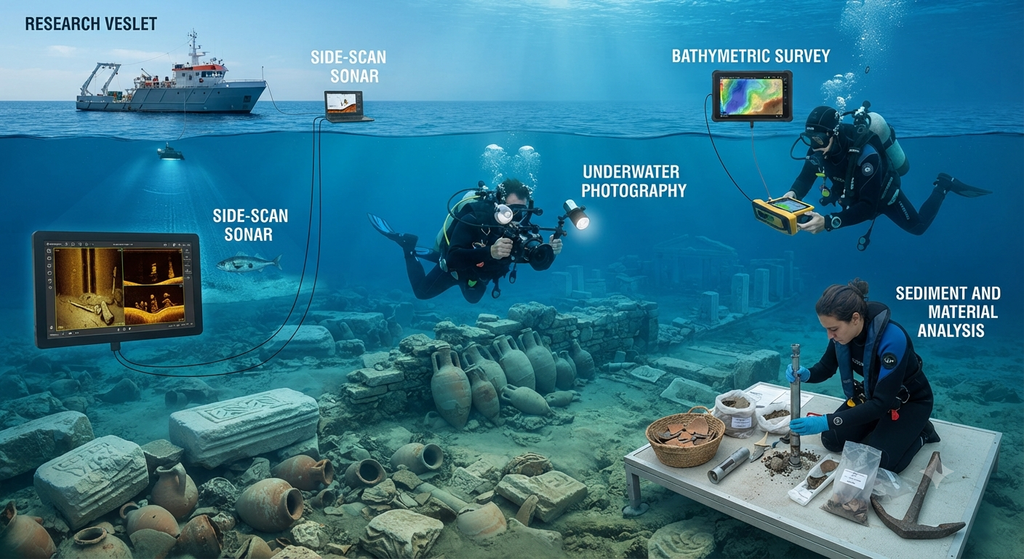
Finding historical remains beneath the sea is not an easy task.Unlike land-based archaeological excavations, underwater investigations involve difficult environmental conditions, limited visibility, water pressure and changing currents.Marine archaeologists use specialised equipment and scientific techniques to investigate these locations.
Side-Scan Sonar
Side-scan sonar is used to create images of the seabed.It helps researchers identify unusual shapes, objects and possible archaeological structures beneath the water.
Bathymetric Surveys
Bathymetry involves measuring underwater depths and mapping the shape of the seabed.These surveys help scientists understand underwater landscapes and identify areas that may contain submerged settlements.
Underwater Photography
Special underwater cameras allow archaeologists to document structures, pottery, anchors and other objects.Photographic records are important because underwater discoveries must be studied carefully without unnecessary disturbance.
Sediment and Material Analysis
Scientists examine sediments, pottery, stone objects and other materials to understand their age and historical context.Radiocarbon dating may also be used when suitable organic material is available.Combining different scientific techniques helps researchers build a more reliable picture of ancient coastal life.
Why Did Ancient Coastal Settlements Disappear?
One of the biggest questions in marine archaeology is why settlements that once existed on land are now found beneath the sea.There is no single explanation because every coastal location has its own geographical and environmental history.Several natural processes may have contributed to the disappearance of ancient settlements.
Rising Sea Levels
Global and regional sea-level changes can gradually flood low-lying coastal areas.Settlements located close to the shoreline may become submerged over long periods.
Coastal Erosion
Waves and currents continuously reshape beaches and shorelines.Over centuries, erosion can remove large sections of coastal land and damage historical structures.
Tsunamis and Cyclones
Powerful ocean events can destroy coastal settlements, transport sediments and alter the surrounding landscape.However, a specific disaster should only be linked to a particular archaeological site when supported by scientific evidence.
Geological Changes
Earthquakes, land subsidence and tectonic movements can also influence coastal geography.In some areas, land may gradually sink relative to sea level, allowing seawater to cover previously inhabited locations.Understanding these processes is important because underwater archaeology is closely connected with climate science, geology and environmental research.
Why Are India’s Underwater Archaeological Discoveries Important?
India’s submerged archaeological heritage is valuable for several reasons.First, it helps historians understand ancient settlements and their relationship with coastal environments.Second, underwater discoveries provide evidence of maritime trade, navigation and cultural exchanges.Third, they help researchers investigate how environmental changes affect human communities.These discoveries also have educational and cultural importance.They encourage younger generations to take an interest in history, science, archaeology and marine conservation.
Government Initiatives for Protecting Underwater Heritage
The Archaeological Survey of India established its Underwater Archaeology Wing in 2001 to strengthen underwater archaeological research.The organisation conducts surveys, documents submerged sites, studies ancient shipwrecks and works towards protecting underwater cultural heritage.A significant recent development came in July 2026.According to information shared by the Ministry of Culture in Parliament, underwater research and exploration activities were underway at Dwarka and Bet Dwarka in Gujarat, Mahabalipuram in Tamil Nadu and Karaikal in Puducherry.
The government also identified several locations for further exploration up to 2030, including:
- Dwarka and Bet Dwarka.
- Vijay Durg in Maharashtra.
- Janjira in Maharashtra.
- Karaikal in Puducherry.
- Mahabalipuram in Tamil Nadu.
Poompuhar was also included in the government’s underwater exploration initiatives through the Tamil Nadu State Department of Archaeology.These developments show that India is giving increasing attention to its underwater cultural heritage.
Challenges in Protecting India’s Underwater Heritage
Despite growing scientific interest, protecting underwater archaeological sites remains challenging.Many submerged structures are exposed to strong currents, changing temperatures, marine organisms and natural erosion.
Human activities also create risks.
Illegal removal of artefacts, unregulated diving, pollution, fishing activities and coastal development can damage historically important sites.Another challenge is the high cost of underwater research.Specialised diving equipment, trained archaeologists, research vessels and advanced scanning technologies require considerable investment.India therefore needs continued cooperation between government institutions, marine scientists, historians, archaeologists and local coastal communities.
Public awareness is equally important.
People should understand that underwater archaeological objects are not ordinary souvenirs. They are valuable historical evidence that must remain protected for future generations.
The Future of Marine Archaeology in India
The future of marine archaeology in India looks promising.Technological advancements are making it possible to investigate underwater locations with greater accuracy.
Researchers are increasingly using digital mapping, sonar technology, remote sensing, underwater photography and three-dimensional reconstruction.These developments can help create detailed digital records of submerged structures.Artificial intelligence and advanced data analysis may also support the identification of unusual seabed patterns and the interpretation of large archaeological datasets.
India’s long coastline offers enormous opportunities for further research.From Gujarat to Tamil Nadu, Maharashtra to Odisha, many coastal regions may contain important evidence of ancient human activities.However, future discoveries must be supported by careful documentation, scientific dating and independent research.
The real achievement of marine archaeology will not simply be finding a lost city. It will be understanding the people who lived there, their relationship with nature and the historical changes that shaped their communities.
Learning from History
The discovery of lost underwater settlements proves that even the most prosperous civilizations are temporary, transformed over time by nature. This historical reality aligns with the teachings of Sant Rampal Ji Maharaj, who emphasizes looking beyond fleeting material wealth toward spiritual truth, moral values, and righteous living. Exploring India’s underwater heritage teaches us to respect past generations, protect nature, and preserve ancient knowledge. Ultimately, these submerged kingdoms inspire self-reflection: while physical structures fade, true wisdom, good deeds, and understanding the deeper purpose of human life endure forever.
FAQs on Marine Archaeology
Q1. What is marine archaeology?
Marine archaeology is the scientific study of human history through underwater remains such as submerged settlements, ancient shipwrecks, ports, pottery, stone anchors and other historical objects.
Q2. Is the ancient city of Dwarka really underwater?
Underwater investigations around Dwarka and Bet Dwarka have identified submerged structures, stone anchors and other archaeological remains. However, these discoveries do not conclusively establish that the entire legendary city described in religious traditions has been found.
Q3. What are the most important underwater archaeological sites in India?
Some important locations include Dwarka and Bet Dwarka in Gujarat, Mahabalipuram in Tamil Nadu, Poompuhar in Tamil Nadu and coastal areas around other ancient trading centres.
Q4. What caused ancient Indian coastal cities to disappear underwater?
Possible causes include rising sea levels, coastal erosion, cyclones, tsunamis, geological movements and changing river systems. The reasons may differ from one location to another.
Q5. What is the role of the Archaeological Survey of India in underwater archaeology?
The Archaeological Survey of India’s Underwater Archaeology Wing investigates submerged archaeological sites, documents underwater remains, studies ancient shipwrecks, trains researchers and works to protect India’s underwater cultural heritage.