The National Council–Joint Consultative Machinery (NC-JCM) Staff Side has submitted a comprehensive 51-page memorandum for the 8th Pay Commission, proposing significant changes to salaries, pensions, and allowances for central government employees. Key recommendations include a minimum basic pay of ₹69,000, a fitment factor of 3.833, and doubling the annual increment to 6%. The proposal, aimed at benefiting over 50 lakh employees and pensioners, also focuses on pay restructuring, improved allowances, and inflation-linked adjustments.
- Key Takeaways: 8th Pay Commission Proposals by NC-JCM
- What is the 8th Pay Commission and Its Role?
- Minimum Pay Proposal and Fitment Factor Explained
- Annual Increment and Inflation Concerns
- Restructuring of Pay Levels and Career Progression
- Proposed Pay Matrix Under 8th CPC
- HRA Revision and Allowance Enhancements
- Pension, Welfare, and Social Security Measures
- Leave, Benefits and Employee Welfare Proposals
- Family Unit Redefinition and Social Considerations
- Implementation Timeline and Next Steps
- A Comprehensive Shift in Pay and Welfare Framework
- Ethics, Balance and True Well-being
- FAQs on 8th Pay Commission
Key Takeaways: 8th Pay Commission Proposals by NC-JCM
- Minimum basic pay proposed at ₹69,000
- Fitment factor suggested at 3.833
- Annual increment recommended at 6% (up from 3%)
- Coverage: Over 50 lakh employees and pensioners
- HRA revision: 40% (X), 35% (Y), 30% (Z) linked to DA
- Proposal to merge 18 pay levels into 7 pay scales
- Demand for restoration of Old Pension Scheme (OPS)
- Minimum five promotions in 30 years of service
- Pension proposed at 67% of last pay drawn
- Implementation date suggested: January 1, 2026
What is the 8th Pay Commission and Its Role?
The 8th Pay Commission is a government-appointed panel tasked with revising the pay, allowances, and pensions of central government employees and retired former servicemen. It also evaluates the broader financial implications of these revisions, including government expenditure, retirement benefits, and contribution structures.
The latest memorandum submitted by the NC-JCM Staff Side forms a consolidated list of demands from key employee unions and associations.
Minimum Pay Proposal and Fitment Factor Explained
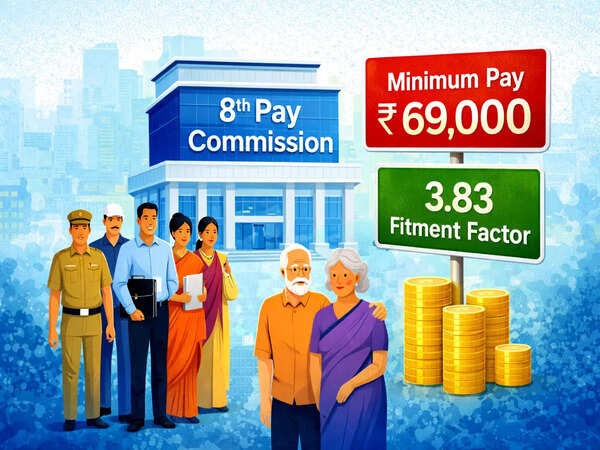
A central demand in the memorandum is the increase in minimum basic pay from ₹18,000 under the 7th Pay Commission to ₹69,000. This represents an approximate 283% increase.
To support this revision, a fitment factor of 3.833 has been proposed. This factor is used to determine revised salaries across pay levels. If implemented, it will significantly raise both salaries and pensions.
The maximum pay has been suggested at ₹2,15,000, aligning with the revised structure.
Also Read: Cabinet Approves Formation of 8th Pay Commission for Central Government Employees
According to a CNBC-TV18 report, the 7th Pay Commission had recommended a minimum pay of ₹18,000, which forms the base for current comparisons.
Annual Increment and Inflation Concerns
The NC-JCM has recommended doubling the annual increment rate from 3% to 6%.
This demand is based on rising inflation, increasing living costs, and evolving economic conditions. Senior employee leader Shiv Gopal Mishra stated that the current 3% increment is insufficient to meet present-day financial realities.
The proposal argues that a 6% increment would better align salary growth with inflation trends.
Restructuring of Pay Levels and Career Progression
The memorandum proposes a major restructuring of the existing pay matrix:
- Reduction of 18 pay levels to 7 broader pay scales
- Merging of levels:
- Levels 2 and 3 → Pay Scale 2
- Levels 4 and 5 → Pay Scale 3
- Levels 7 and 8 → Pay Scale 5
- Levels 9 and 10 → Pay Scale 6
This restructuring aims to simplify the pay system and address career stagnation by enabling smoother promotions.
Additionally, the proposal includes:
- Minimum five promotions or financial upgradations in 30 years of service
- Rationalisation of pay levels while maintaining higher levels with fitment adjustments
- A minimum-to-maximum pay ratio capped at 1:12
Proposed Pay Matrix Under 8th CPC
| Pay Scale | Existing Pay Range | Proposed Minimum |
| Pay Scale 1 (Level 1) | ₹18,000 – ₹56,900 | ₹69,000 |
| Pay Scale 2 (Levels 2 & 3) | ₹21,700 – ₹69,100 | ₹83,200 |
| Pay Scale 3 (Levels 4 & 5) | ₹29,200 – ₹92,300 | ₹1,12,000 |
| Pay Scale 4 (Level 6) | ₹35,400 – ₹1,12,400 | ₹1,35,700 |
| Pay Scale 5 (Levels 7 & 8) | ₹47,600 – ₹1,51,100 | ₹1,82,500 |
| Pay Scale 6 (Levels 9 & 10) | ₹56,100 – ₹1,77,500 | ₹2,15,100 |
| Levels 11–17 | Retained with 3.833 factor | — |
HRA Revision and Allowance Enhancements
The NC-JCM has proposed an upward revision in House Rent Allowance (HRA):
- 40% for X cities
- 35% for Y cities
- 30% for Z cities
The memorandum recommends linking HRA to Dearness Allowance (DA) for automatic inflation adjustments and reviewing city classifications every five years.
Additional allowance-related proposals include:
- 10% extra pay for higher qualifications
- Overtime at double rates under labour laws
- Improved compensation for high-risk roles in healthcare, defence, and laboratories
Pension, Welfare, and Social Security Measures
The draft committee has outlined several welfare measures:
- For employees recruited after January 1, 2004, Old Pension Scheme (OPS) should be reincorporated.
- Pension fixed at 67% of last pay drawn
- Family pension set at 50%
- Pension revision every five years
- Commutation restoration after 11 years
Other provisions include:
- ₹2 crore compensation for death during duty
- Group insurance: ₹1 crore (Group C), ₹1.5 crore (Group B)
- Gratuity: One month’s wages with no service ceiling
- Unlimited earned leave accumulation and encashment up to 600 days
Leave, Benefits and Employee Welfare Proposals
The memorandum also proposes expanded leave and benefits:
- 45 days paternity leave
- 240 days maternity leave without two-child restriction
- 60 days Parent Care Leave
- 20 days earned leave encashment on LTC
- 30 days minimum guaranteed bonus
- 100% compassionate appointment
It also suggests extending General Provident Fund (GPF) benefits to NPS and UPS employees until OPS is restored.
Family Unit Redefinition and Social Considerations
A significant proposal involves redefining the family unit from three to five members, including parents.
C. Srikumar, a drafting committee member, stated that this aligns with the Maintenance and Welfare of Parents and Senior Citizens Act, which mandates support for dependent parents.
The memorandum also proposes equal unit value for men and women, eliminating existing disparities.
Implementation Timeline and Next Steps
The NC-JCM has recommended implementing all proposed changes from January 1, 2026.
These recommendations will now undergo consultations and discussions before any formal adoption by the 8th Pay Commission.
As an umbrella body representing employee unions, NC-JCM has presented a unified demand framework reflecting financial, structural, and welfare-related concerns of central government employees.
A Comprehensive Shift in Pay and Welfare Framework
The memorandum submitted by the NC-JCM goes beyond salary revision, proposing a structural transformation of the pay system. By addressing inflation, career progression, social security, and employee welfare, the recommendations aim to create a more balanced and sustainable compensation framework. The inclusion of pension reforms, family considerations, and enhanced allowances reflects a broader approach to employee well-being. The final outcome will depend on consultations and policy decisions under the 8th Pay Commission.
Ethics, Balance and True Well-being
Discussions around salary revisions, pensions, and welfare measures ultimately reflect a broader concern for dignity, stability, and balanced living. While economic reforms aim to address material needs such as inflation and security, they also highlight the importance of fairness and responsibility within society.
In this context, the teachings of Tatvdarshi Sant Rampal Ji Maharaj emphasise that true well-being is not limited to financial progress alone but is achieved through true spiritual knowledge and ethical living. It empowers people to think in the right direction and incorporates wisdom in their approach. Such a perspective encourages individuals to align material growth with inner stability and social harmony.
Today, Sant Rampal Ji Maharaj has been tirelessly giving those teachings and fulfilling His duties as a Complete Saint. In order to explore more, visit following platforms:
For more information visit our
Website:www.jagatgururampalji.org
YouTube: Sant Rampal Ji Maharaj
Facebook: Spiritual Leader Saint Rampal Ji
X (Twitter): @SaintRampalJiM
FAQs on 8th Pay Commission
1. What minimum pay has been proposed?
₹69,000 has been proposed as the minimum basic pay under the 8th Pay Commission.
2. What is the proposed fitment factor?
A fitment factor of 3.833 has been recommended for salary revision.
3. What change is suggested in the annual increment?
The annual increment is proposed to increase from 3% to 6%.
4. When are the changes proposed to be implemented?
The implementation date suggested is January 1, 2026.
5. What is the proposal regarding pension?
Pension is proposed at 67% of last pay, with family pension at 50%.