


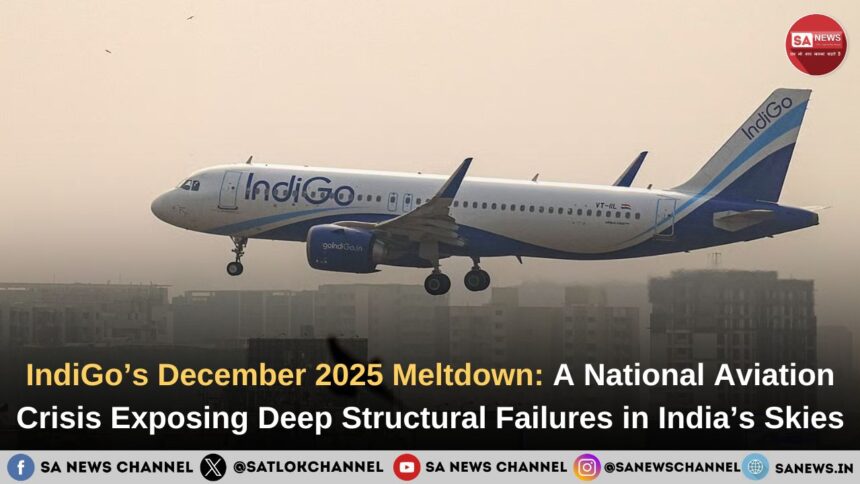
India’s aviation sector faced one of its most destabilizing moments in December 2025, when IndiGo, the country’s largest airline, suffered a near-systemic collapse. The crisis grounded thousands of passengers, stranded families across major airports, disrupted business travel, and revealed the fragility of a market heavily dependent on a single dominant carrier. More than just an operational failure, the incident exposed significant gaps in regulation, corporate planning, crisis readiness, and passenger protection.
- How the Chaos Began: A Minor Glitch That Triggered a National Breakdown
- Passengers Left Stranded: Long Queues, Missed Events, and Mounting Anger
- Government Intervention: Full Refunds and Emergency Oversight
- Why IndiGo’s Collapse Became a National Crisis
- Regulatory Scrutiny: The DGCA Under Fire
- Impact on IndiGo: Reputation, Revenue, and Reliability
- Broader Lessons for India’s Aviation Sector
- 1. Stronger redundancy and backup planning
- 2. Stricter regulatory foresight
- 3. Diversified airline ecosystem
- 4. Passenger rights enforcement
- 5. Technology resilience
- Conclusion: A Crisis That Must Lead to Reform
How the Chaos Began: A Minor Glitch That Triggered a National Breakdown
The disruption started on December 2, when a seemingly routine technology glitch delayed late-night check-ins across the IndiGo network. What looked like a small inconvenience quickly spiraled into a chain reaction that crippled the airline’s entire operation.
By the next day, flight delays multiplied. Airports in Delhi, Mumbai, Bengaluru, Chennai, Hyderabad, and Kolkata saw long queues forming as passengers struggled to get information or alternatives. Instead of swiftly containing the glitch, IndiGo’s tightly packed schedule—built on fast turnarounds and minimal buffer time—allowed delays to cascade uncontrollably.
The situation escalated further because of newly introduced government regulations, which mandated:
- Longer mandatory rest hours for pilots
- Reduced night landings
- More conservative crew-duty calculations
These rules, designed for safety, unintentionally plunged IndiGo into staffing shortages. Crew rostering systems failed to adapt in real time, leaving aircraft ready but without pilots.
By December 5, the crisis peaked when IndiGo cancelled all flights from Delhi Airport until midnight, grounding approximately 750 flights in a single day. Across the country, over 1,000 flights were cancelled in 24 hours, making it one of the largest aviation disruptions in Indian history.
Passengers Left Stranded: Long Queues, Missed Events, and Mounting Anger
Airports turned into temporary shelters as thousands of passengers waited with no clarity on refunds or alternative flights. Images of chaotic terminals flooded social media:
- Elderly passengers sleeping on floors
- Families missing weddings and funerals
- Students stranded during exam season
- Patients stuck en route to medical appointments
- Tourists abandoning travel plans entirely
Many passengers complained that IndiGo’s app showed cancelled flights as “delayed,” while customer support lines went unanswered for hours. The airline’s refund process, although later relaxed, was initially slow and confusing, leading to allegations of non-compliance with passenger-rights regulations.
Government Intervention: Full Refunds and Emergency Oversight
As public frustration surged, the Civil Aviation Ministry stepped in. It issued a directive ordering IndiGo to provide full refunds, with no questions asked, for all cancellations and rescheduling between December 5 and December 15. This was one of the strictest consumer-protection measures invoked in recent aviation history.
The Prime Minister’s Office was briefed immediately, signaling the gravity of the crisis.
IndiGo CEO Pieter Elbers assured authorities that the airline was working to stabilize operations “on a war footing.” The airline extended its waiver on cancellation and rescheduling charges and redeployed additional staff to major airports.
Also Read: Air India Flight AI 139 Diverted to Abu Dhabi
On December 7, IndiGo announced it aimed to operate 1,650 flights, yet still cancelled around 650 more, highlighting the prolonged instability.
IndiGo later admitted that full recovery may not be possible until February 10, 2026, meaning operational unpredictability could continue for months.
Why IndiGo’s Collapse Became a National Crisis
IndiGo controls over 50% of India’s domestic air-traffic market, making it the backbone of the country’s aviation system. When IndiGo falters, the entire sector feels the shock.
Key vulnerabilities exposed:
- Overdependence on a single airline
India lacks sufficient competition or backup capacity. No other airline—Air India, Vistara, Akasa—can absorb IndiGo’s massive load on short notice. - Aggressive scheduling with minimal buffers
IndiGo’s efficiency model relies on fast turnarounds and tight crew utilization. Such systems offer little resilience when disruptions occur. - Failure to anticipate new regulatory impacts
Crew-duty rule changes were known in advance, yet IndiGo did not sufficiently adjust staffing or rosters. - Technology bottlenecks
Heavy reliance on automated systems without adequate manual fallbacks allowed a minor glitch to trigger widespread collapse. - Weak contingency planning
The crisis revealed an absence of robust emergency response mechanisms within the airline.
Regulatory Scrutiny: The DGCA Under Fire
The Directorate General of Civil Aviation (DGCA), responsible for oversight, faced sharp criticism:
- Why did the regulator not require contingency planning for the new pilot-duty rules?
- Why were airlines allowed to run aggressive schedules despite winter fog forecasts?
- Why did DGCA intervene only after the meltdown began?
The crisis followed the Air India crash in Ahmedabad, making 2025 one of the most troubled years for Indian aviation. Industry experts argue that these events reveal deeper structural flaws: insufficient regulatory foresight, limited accountability, and outdated infrastructure.
Impact on IndiGo: Reputation, Revenue, and Reliability
IndiGo’s brand—built on punctuality and predictable service—has taken a major hit. Even though competitors cannot absorb its entire market share, passengers may temporarily shift to Air India, Vistara, Akasa, or even trains.
Internal documents suggest continuing challenges:
- Crew shortages
- Congested winter schedules
- Backlogs in training and pilot recruitment
- Fragile IT systems
CEO Pieter Elbers has attempted to reassure staff that the “worst is over,” but analysts warn that restoring consumer confidence will take far longer than restoring schedules.
Broader Lessons for India’s Aviation Sector
The IndiGo crisis highlights the urgent need for systemic reforms:
1. Stronger redundancy and backup planning
Airlines must maintain buffer capacity for crew, operations, and IT systems.
2. Stricter regulatory foresight
DGCA must anticipate bottlenecks and mandate preparedness before rule changes.
3. Diversified airline ecosystem
India must encourage more carriers to prevent overreliance on one market leader.
4. Passenger rights enforcement
Refunds, rebooking clarity, and real-time information must be legally enforceable, not optional.
5. Technology resilience
Airlines must invest in systems that can withstand failures without nationwide consequences.
Conclusion: A Crisis That Must Lead to Reform
The IndiGo operational collapse of December 2025 is more than a temporary disruption—it is a defining moment for Indian aviation. It exposed how profit-driven scheduling, poor regulatory planning, and lack of structural safeguards can escalate into a national emergency. As IndiGo works to restore normal operations, the incident must drive long-term reforms to ensure that India’s skies remain reliable, safe, and resilient for the millions who depend on them.