


Artificial intelligence is transforming healthcare, education, business, entertainment and everyday life. Yet behind every AI chatbot, image generator and automated service is a physical infrastructure that is easy to overlook: the data center. These facilities house thousands of computers and specialized AI chips that require enormous amounts of electricity and sophisticated cooling systems. As AI adoption accelerates, data-center construction is expanding rapidly, but so are concerns about water consumption, electricity demand, noise, land use, emissions and pressure on local infrastructure.
- The AI Revolution Has a Physical Cost
- Why Are Communities Fighting Data Centers?
- 1. Electricity Demand Is Becoming a Major Concern
- 2. Water: The Cooling Challenge
- 3. Data Center Noise Is Becoming a Local Issue
- 4. Land Use and the Transformation of Communities
- The Economic Benefits Are Real-but So Are the Costs
- The Global Data Center Backlash
- Why Transparency Matters
- Can AI Data Centers Become More Sustainable?
- What Should Governments Do?
- Mandatory Environmental Assessments
- Water Disclosure
- Grid-Cost Transparency
- Noise Standards
- Community Consultation
- Stronger Efficiency Standards
- The Consumer’s Role in the AI Boom
- A Lesson in Responsible Development
- FAQs on The Hidden Cost of AI
Communities in several countries are now questioning whether the economic benefits of AI data centers justify their environmental and social costs. The debate is becoming one of the biggest challenges surrounding responsible AI development.
The AI Revolution Has a Physical Cost
Artificial intelligence often feels weightless. A person types a question into an AI application, receives an answer within seconds and may never think about where that computation occurred.
But AI does not operate in the cloud in a literal sense. It operates in physical buildings filled with servers, networking equipment, cooling systems and power infrastructure.
These facilities are known as data centers, and the rapid development of generative AI has created a new wave of demand for them.
The International Energy Agency (IEA) estimates that global data-center electricity consumption could more than double from around 485 terawatt-hours (TWh) in 2025 to approximately 950 TWh by 2030. That would make data centers responsible for around 3% of global electricity consumption by 2030.
The issue is therefore no longer simply about technological innovation. It is increasingly about energy, water, land, infrastructure and communities.
Why Are Communities Fighting Data Centers?
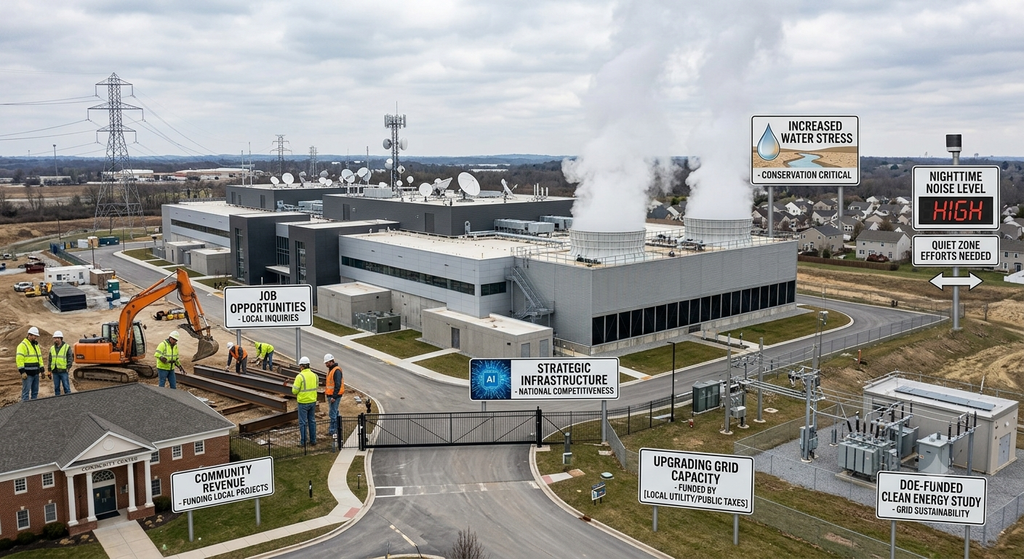
Data centers can bring investment, construction activity, tax revenue and skilled jobs. However, residents living near proposed facilities may experience the costs much more directly.
Community opposition generally revolves around several major concerns:
- Electricity demand
- Water consumption
- Noise pollution
- Land use
- Local infrastructure
- Environmental impacts
- Electricity prices and utility costs
- Transparency around projects
- Limited community participation in planning
The result is a growing conflict between the demand for faster AI development and the desire of communities to protect local resources.
1. Electricity Demand Is Becoming a Major Concern
One of the biggest hidden costs of AI is its growing electricity demand. Training and operating advanced AI models require large amounts of computing power. As AI applications become more sophisticated, companies are building increasingly powerful data centers equipped with specialized processors.
The U.S. Department of Energy reported that U.S. data-center electricity demand had grown substantially and could double or even triple between 2024 and 2028 under different scenarios. The department has also highlighted data centers as a significant contributor to near-term electricity-demand growth, with estimates suggesting they could account for as much as 9% of U.S. electricity generation by 2030.
This creates a difficult question:
Who pays for the additional electricity infrastructure required by AI?
If utilities need to build new transmission lines, substations or generation capacity, those investments can affect electricity systems far beyond the physical boundaries of a data center.
That is why some communities fear that the benefits of AI infrastructure could be private while some of the infrastructure costs become public.
2. Water: The Cooling Challenge
AI data centers generate substantial heat because thousands of processors may operate simultaneously.
Cooling systems are therefore essential.
Some data centers rely on water-based cooling, while others use air cooling, closed-loop systems or alternative technologies. Water consumption can vary dramatically depending on the facility’s design, climate, cooling technology and electricity source.
The World Resources Institute reported in February 2026 that a mid-sized data center can use hundreds of thousands of gallons of water per day, while some large facilities can consume millions of gallons daily. It also cited estimates that U.S. AI-related data centers could require billions of gallons of water annually by 2028.
However, water figures should be interpreted carefully. Not every data center uses the same cooling technology, and estimates can differ depending on whether they count only water consumed directly at the facility or also account for water used to generate electricity.
This distinction matters because communities experiencing drought or water shortages may be especially sensitive to additional industrial demand. In Texas, for example, concerns about the rapid development of AI infrastructure and water regulation have become part of the wider public debate.
Also read:World Water Day 2026: Glacier Preservation For A Sustainable Future
3. Data Center Noise Is Becoming a Local Issue
Electricity and water are not the only concerns. Large data centers can operate around the clock, and their cooling equipment, backup generators and other mechanical systems can produce continuous industrial noise.
For people living nearby, this can turn an otherwise quiet area into a permanently industrial environment.
In August 2026, residents in Vineland, New Jersey, filed a class-action lawsuit concerning noise from a data center under construction. Residents reported persistent low-frequency and mechanical sounds affecting their homes.
The case illustrates an important point: even when a data center creates relatively few permanent jobs compared with a traditional industrial facility, its physical footprint and operating characteristics can still significantly affect neighboring residents. Noise therefore deserves consideration during planning-not after construction is completed.
4. Land Use and the Transformation of Communities
Data centers can be enormous. AI infrastructure may require large buildings, electrical substations, transmission connections, backup power systems, roads and other supporting facilities.
That can transform agricultural land, open space or areas on the outskirts of communities.
Loudoun County, Virginia, is one of the most famous examples. The region has become one of the world’s largest data-center hubs, generating substantial tax revenue and supporting public investment. Yet rapid expansion has also produced concerns about transmission infrastructure, noise, environmental impacts and development pressure.
This creates a complicated reality:
Data centers can be economically valuable and still create legitimate local problems. The debate should therefore not be reduced to “AI is good” versus “AI is bad.” The real question is whether data-center development is being planned responsibly.
The Economic Benefits Are Real-but So Are the Costs
Supporters of data centers point to several advantages.
Job Creation
Construction projects can create employment for electricians, engineers, equipment operators, technicians and other workers.
Tax Revenue
Data centers can generate significant property-tax or other local revenue, depending on the jurisdiction’s tax system.
Digital Infrastructure
Data centers support cloud computing, online services, AI applications, financial systems and other digital services.
National Competitiveness
Governments increasingly see AI infrastructure as strategically important because countries want to remain competitive in artificial intelligence and advanced computing.
The U.S. Department of Energy, for example, has been examining cleaner energy resources that could help meet rising data-center electricity demand.
But economic benefits should be evaluated alongside costs. If a community receives tax revenue while facing increased infrastructure expenses, water stress, noise or environmental damage, policymakers need to calculate the net community benefit, rather than focusing only on investment numbers.
The Global Data Center Backlash
The debate is no longer limited to the United States.
In 2026, opposition to data-center expansion has increasingly appeared in countries including the United Kingdom and Australia. A September 2026 report from The Guardian described growing opposition in the UK, including concerns over water consumption, electricity demand, environmental impacts and limited transparency about large data-center projects.
Australia is experiencing a similar debate. Reuters reported in August 2026 that Australian data-center operator NextDC recorded increased water and energy use during the financial year, while policymakers were considering stronger national standards for data-center energy and water use.
The pattern is becoming increasingly clear: The AI boom is creating an infrastructure boom-and communities want a greater say in where and how that infrastructure is built.
Why Transparency Matters
One of the most important issues is not simply how much electricity or water a data center uses.
It is whether communities know how much it will use before approving the project.
Residents may reasonably ask:
- How much electricity will the facility require?
- Where will that electricity come from?
- Who will pay for new grid infrastructure?
- How much water will the facility consume?
- Will water use increase during drought conditions?
- What will the facility sound like at night?
- How many permanent jobs will actually be created?
- What tax benefits will remain with the community?
- What renewable-energy commitments are guaranteed?
- What happens if the facility expands?
Clear answers can build trust. A lack of information can have the opposite effect.
Can AI Data Centers Become More Sustainable?
Yes-but sustainability requires deliberate planning.
- Renewable Energy: Data-center operators can increasingly contract renewable electricity or invest in new clean-energy generation. However, simply purchasing renewable-energy certificates does not automatically mean a facility is physically powered by renewable electricity at every moment. Policymakers and communities may therefore increasingly demand more transparent energy accounting.
- Water-Efficient Cooling: Advanced cooling technologies can reduce freshwater requirements.
- Closed-loop systems, air cooling and other approaches can potentially reduce direct water consumption, although each technology has its own energy and cost considerations.
- Better Site Selection: Data centers can be planned in areas with adequate electricity transmission, lower water stress, suitable land and community infrastructure. Building a massive facility in a water-stressed region without adequate planning can create unnecessary conflict.
- Waste Heat Recovery: In some locations, excess heat from computing facilities can potentially be captured and used for district heating or industrial purposes. This approach will not work everywhere, but it demonstrates how data centers could become part of a broader energy system rather than functioning as isolated consumers.
What Should Governments Do?
Governments face a difficult balancing act. They want AI investment and technological leadership, but they also have responsibilities toward residents and natural resources.
A sensible policy framework could include:
Mandatory Environmental Assessments
Large data centers should undergo appropriate assessments of electricity, water, land and environmental impacts.
Water Disclosure
Operators should clearly report projected and actual water consumption.
Grid-Cost Transparency
Communities should understand who is paying for transmission lines, substations and other electricity infrastructure.
Noise Standards
Planning rules should address continuous mechanical and low-frequency noise.
Community Consultation
Residents should have meaningful opportunities to review major projects before final approval.
Stronger Efficiency Standards
Governments can establish energy-efficiency and water-efficiency requirements for large facilities.
Several U.S. states were already considering data-center legislation in 2026, including measures addressing energy costs, reporting requirements and development restrictions.
The Consumer’s Role in the AI Boom
It is easy to blame technology companies alone, but consumers are also part of the equation.Every AI query requires computing resources.
That does not mean people should stop using AI. Artificial intelligence can provide enormous benefits in education, medicine, scientific research, accessibility and productivity.
But society should recognize that digital convenience has a physical footprint. The Lincoln Institute of Land Policy has similarly highlighted the need to consider the land and water implications of growing data-center demand while recognizing that AI can also potentially help solve problems such as water-system and electricity-grid efficiency.
The goal should therefore not be to reject AI. The goal should be responsible AI infrastructure.
A Lesson in Responsible Development
The growing debate over AI data centers reminds us that technological progress should not come at the cost of people, nature and future generations. The teachings associated with Sant Rampal Ji Maharaj emphasize compassion, responsible living and avoiding unnecessary harm to living beings. This perspective can encourage society to think beyond economic growth and consider the wider impact of development.
AI can bring valuable benefits, but its infrastructure should also be planned responsibly, with attention to electricity, water, land, noise and local communities. True progress should aim for a balance between innovation, human welfare and environmental responsibility, so that development creates benefits without placing an unfair burden on society.
FAQs on The Hidden Cost of AI
1. Why are communities fighting AI data centers?
Communities are concerned about electricity use, water consumption, noise, land use and pressure on local infrastructure.
2. Do AI data centers use a lot of electricity?
Yes. AI data centers can require large amounts of electricity because they run powerful computing systems continuously.
3. Do data centers consume water?
Yes. Some data centers use water for cooling, although the amount varies by technology, location and facility design.
4. Are AI data centers bad for the environment?
They can create environmental impacts, but renewable energy, efficient cooling and responsible planning can reduce them.
5. Can AI data centers become sustainable?
Yes. Cleaner energy, water-efficient cooling, better site selection and stronger environmental standards can make data centers more sustainable.