

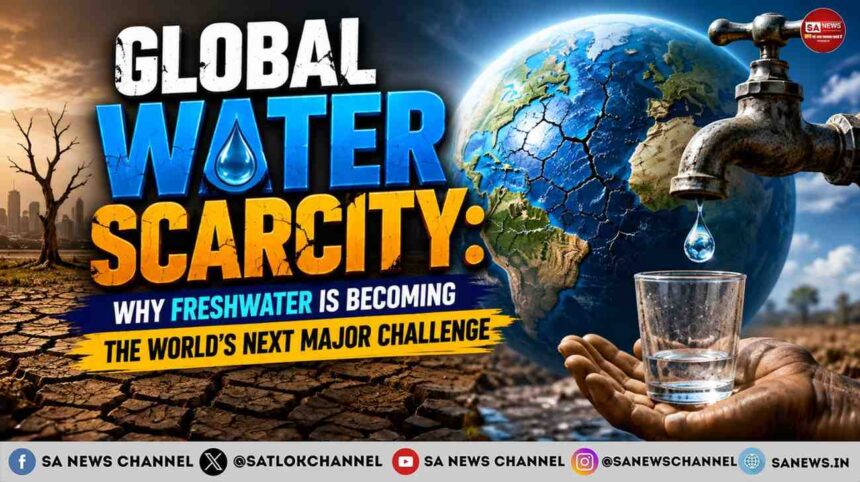
Freshwater is becoming one of the defining challenges of the 21st century. Although Earth is covered largely by water, only a small share is readily available as freshwater for human consumption, agriculture, industry and ecosystems. Rising populations, urbanization, pollution, inefficient water use and climate change are increasing pressure on rivers, lakes, groundwater and glaciers. The latest international data show that billions of people still lack safely managed drinking water, while agriculture accounts for more than 70% of global freshwater withdrawals. Global water scarcity is therefore no longer a distant environmental concern-it is becoming a major economic, social and humanitarian challenge.
- Why Is Global Water Scarcity Becoming a Major Challenge?
- Climate Change Is Disrupting the Water Cycle
- Agriculture Uses Enormous Amounts of Freshwater
- Groundwater Is Under Growing Pressure
- Pollution Makes Freshwater Scarcer
- The Economic and Social Impact of Water Scarcity
- What Can the World Do to Address the Freshwater Crisis?
- A Message of Responsible Use and Compassion
- The Future of Freshwater Depends on Today’s Choices
- FAQ on Global Water Scarcity
Why Is Global Water Scarcity Becoming a Major Challenge?
Water scarcity occurs when available water supplies cannot adequately meet the needs of people, agriculture, industry and ecosystems. The problem is not simply that the world is “running out of water.” Instead, freshwater availability varies dramatically by location and season, while demand is increasing and water quality is being damaged.
According to the WHO/UNICEF Joint Monitoring Programme’s 2025 update, 2.1 billion people still lacked safely managed drinking water in 2024. This shows that improving global water access remains a major challenge despite decades of progress.
Climate Change Is Disrupting the Water Cycle
Climate change is making water availability less predictable. Some regions are experiencing longer droughts, while others face intense rainfall and flooding. Higher temperatures also increase evaporation and can raise water demand for crops and communities.
Also Read: Monsoon 2026 in India: Heavy Rainfall, Flood Alerts and the Growing Climate Challenge
Mountains and glaciers are particularly important because they act as natural water towers. UNESCO’s 2025 United Nations World Water Development Report notes that mountains supply 55–60% of global annual freshwater flows, while around 2 billion people depend on mountain waters. The report also states that mountain glaciers worldwide are projected to lose 26–41% of their total mass by 2100 with global warming of 1.5°C–4°C.
Agriculture Uses Enormous Amounts of Freshwater
Agriculture is at the centre of the global water challenge. The Food and Agriculture Organization (FAO) reports that agriculture accounts for 72% of global freshwater withdrawals, with irrigation as the primary driver.
As populations grow and diets change, farmers must produce more food while dealing with increasingly uncertain water supplies. Inefficient irrigation, groundwater overuse and water-intensive crops can intensify water stress in already vulnerable regions.
Improving water-use efficiency, drip irrigation, rainwater harvesting and drought-resistant agriculture can reduce pressure on freshwater resources.
Groundwater Is Under Growing Pressure
Groundwater is an essential source of drinking water and agricultural irrigation, particularly in regions where rainfall is unreliable. However, excessive pumping can lower groundwater levels faster than natural systems can replenish them.
This creates a hidden form of water scarcity. A region may appear to have functioning farms and cities today while gradually exhausting its underground reserves.
Sustainable groundwater management therefore requires accurate monitoring, responsible extraction and policies that balance agricultural, domestic and ecological needs.
Pollution Makes Freshwater Scarcer
Water availability is only part of the problem. Water pollution can make freshwater unsuitable for drinking, farming or ecosystems.
Industrial waste, untreated sewage, agricultural chemicals, plastics and other pollutants can contaminate rivers, lakes and groundwater. Water pollution, scarcity and flooding are among the major challenges affecting freshwater resources worldwide.
Also Read: What Is Happening to Our Planet? Climate Change vs Global Warming Explained
Protecting freshwater therefore means not only conserving quantity but also improving water quality, sanitation and wastewater treatment.
The Economic and Social Impact of Water Scarcity
The effects of water scarcity extend far beyond drinking water.
Insufficient water can reduce agricultural production, increase food prices, threaten livelihoods and put pressure on energy systems. Industries also require reliable water supplies for manufacturing and processing.
Water shortages can particularly affect poorer communities because they often have fewer alternatives when local supplies become unreliable. The 2025 WHO/UNICEF report highlights continuing inequalities in access to safely managed water, including differences between regions, income groups and urban and rural populations.
What Can the World Do to Address the Freshwater Crisis?
There is no single solution to global water scarcity. Governments, businesses, farmers and households need to work together.
Key Solutions
Water conservation: Reducing unnecessary consumption can protect local supplies.
Efficient irrigation: Drip and precision irrigation can deliver water more efficiently to crops.
Rainwater harvesting: Capturing rainfall can supplement groundwater and municipal supplies.
Wastewater recycling: Treated wastewater can be reused for agriculture, industry and other suitable purposes.
Groundwater management: Monitoring aquifers and controlling excessive extraction can protect underground reserves.
Wetland and watershed protection: Healthy ecosystems naturally store, filter and regulate water.
Better water governance: Transparent water accounting, fair allocation and effective enforcement are essential for long-term water security. FAO emphasizes improved water accounting and management as important tools for sustainable agricultural water use.
The encouraging message is that solutions already exist. The challenge is scaling them quickly, affordably and fairly.
A Message of Responsible Use and Compassion
The growing freshwater crisis also raises an important human question: How should we treat the resources that sustain every living being?
In the teachings associated with Sant Rampal Ji Maharaj, emphasis is placed on living a disciplined, compassionate and morally responsible life. From this perspective, natural resources should not be treated as something to waste or exploit without limits. Protecting water, avoiding unnecessary wastage and considering the needs of other living beings can become part of responsible living.
This spiritual perspective does not replace scientific water-management policies; rather, it can complement them by encouraging personal responsibility, compassion and moderation. As the world searches for practical answers to water scarcity, responsible consumption and respect for nature can help turn awareness into everyday action.
The Future of Freshwater Depends on Today’s Choices
Freshwater scarcity is becoming a global challenge because climate change, population growth, agriculture, pollution and rising consumption are converging at the same time.
The latest evidence makes one point clear: progress is possible, but it must accelerate. Between 2000 and 2024, about 2.2 billion people gained access to safely managed drinking water. Yet 2.1 billion people still lacked safely managed drinking water in 2024.
The future will depend on whether societies continue treating freshwater as an unlimited resource or begin managing it as one of humanity’s most valuable assets. Water conservation, sustainable agriculture, groundwater protection, wastewater recycling and stronger governance can all contribute to a safer and more resilient water future.
FAQ on Global Water Scarcity
1. What is global water scarcity?
Global water scarcity occurs when available freshwater cannot adequately meet the needs of people, agriculture, industry and ecosystems in a particular region or period.
2. Why is freshwater becoming scarce?
Major causes include climate change, population growth, agricultural demand, groundwater depletion, pollution, urbanization and inefficient water use.
3. How many people lack safely managed drinking water?
According to the latest WHO/UNICEF 2025 update, 2.1 billion people lacked safely managed drinking water in 2024.
4. How does agriculture contribute to water scarcity?
Agriculture is the world’s largest freshwater user, accounting for about 72% of global freshwater withdrawals, mainly because of irrigation.
5. What are the best solutions to the global water crisis?
Important solutions include water conservation, efficient irrigation, rainwater harvesting, wastewater recycling, groundwater management, pollution control, ecosystem protection and better water governance.