


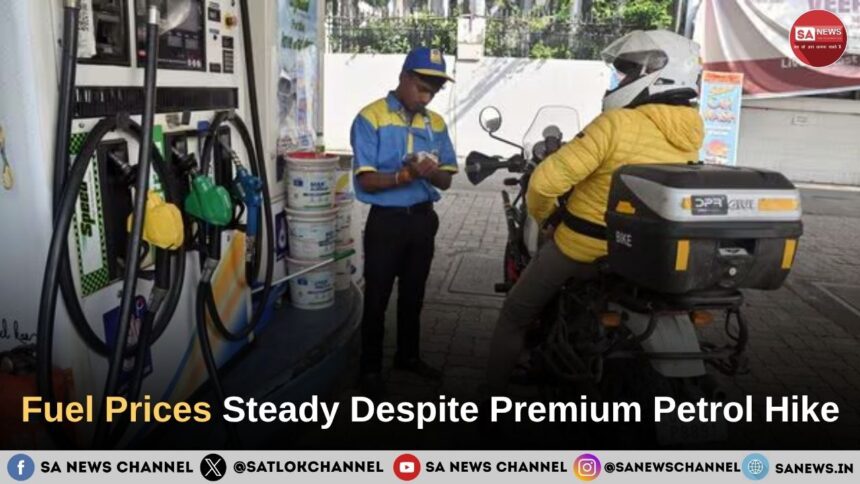
Fuel prices across major Indian cities remained unchanged on March 21, 2026, even as state-run oil marketing companies increased premium petrol rates by over ₹2 per litre. The revision, driven by volatility in global energy markets due to the ongoing Middle East conflict, has impacted high-performance fuels while leaving regular petrol and diesel prices unaffected. However, a sharp rise in bulk diesel prices signals increasing pressure on industrial consumers amid fluctuating crude oil rates.
- Key Takeaways: Petrol, Diesel Prices and Premium Fuel Hike
- Fuel Prices Remain Stable Across Major Cities
- Premium Petrol Prices Increased by Oil Companies
- Bulk Diesel Prices Surge Sharply
- Global Crude Oil Volatility Driving Price Movements
- India’s Energy Dependence and Economic Impact
- Retail Stability vs Industrial Cost Pressures
- Balancing Retail Stability and Global Pressures
- Spiritual Perspective on Rising Global Tensions
- FAQs on Petrol and Diesel Prices in India
Key Takeaways: Petrol, Diesel Prices and Premium Fuel Hike
- Premium petrol prices increased by ₹2.09–₹2.35 per litre
- Regular petrol and diesel prices remain unchanged across cities
- Bulk diesel prices surged by around ₹22 per litre
- Crude oil prices peaked at $119/barrel before easing to ~$108
- Middle East conflict impacting global energy markets
- India imports 85–90% of crude oil; 40–50% via Strait of Hormuz
- Retail fuel stability contrasts with rising industrial fuel costs
Fuel Prices Remain Stable Across Major Cities
The prices of petrol and diesel in Delhi, Noida, Mumbai, Kolkata, Chennai and other cities have remained stable on Saturday, March 21, 2026. This stability continues despite ongoing volatility in global crude oil markets.
Also Read: US-Israel-Iran War Live Updates: The Conflict Reshaping the Global Order
Fuel prices across metro cities such as Hyderabad, Kolkata, and Bhopal remain relatively higher due to local taxation structures. In Noida, petrol is priced at approximately ₹94.90 per litre and diesel at ₹87.98 per litre.
Latest Petrol and Diesel Prices in Major Cities
| City | Petrol (₹/L) | Diesel (₹/L) |
| New Delhi | 94.77 | 87.67 |
| Noida | 94.90 | 87.98 |
| Mumbai | 103.54 | 90.03 |
| Kolkata | 105.41–105.45 | 92.02 |
| Chennai | 100.84–101.06 | 92.3–92.66 |
| Bengaluru | 102.96 | 88.94–90.99 |
| Hyderabad | 107.50 | 95.70 |
| Ahmedabad | 94.49 | 90.17 |
| Pune | 104.29 | 90.82 |
| Jaipur | 104.72–104.91 | 90.21–90.36 |
| Lucknow | 94.69 | 87.76 |
| Gurugram | 95.65 | 87.85 |
| Patna | 105.18 | 92.04 |
| Bhopal | 106.47 | 91.84 |
| Chandigarh | 94.24 | 82.40 |
Despite fluctuations in global crude oil prices, retail fuel rates have remained largely unchanged.
Premium Petrol Prices Increased by Oil Companies
State-run oil marketing companies have increased the price of premium-grade petrol by over ₹2 per litre. The revised rates came into effect on March 20, 2026.
The hike affects high-performance fuels such as:
- BPCL’s Speed
- HPCL’s Power
- IOCL’s XP95
The increase ranges between ₹2.09 and ₹2.35 per litre. Premium petrol is typically used for improved engine performance and higher mileage.
Despite this revision, the prices of regular petrol and diesel have not been changed across the country.
Bulk Diesel Prices Surge Sharply
While retail fuel prices remain stable, industrial consumers are facing a significant increase in diesel costs. The price of bulk diesel has been increased by around ₹22 per litre.
In the national capital, bulk diesel prices have risen from ₹87.67 per litre to ₹109.59 per litre. This sharp increase reflects the surge in global crude oil prices.
At a media briefing, Sujata Sharma, Joint Secretary, Ministry of Petroleum and Natural Gas, stated that there is no increase in the prices of normal petrol and diesel.
According to ANI, regular petrol prices also remain unchanged despite the revision in premium fuel rates.
Global Crude Oil Volatility Driving Price Movements
The revision in premium petrol and bulk diesel prices comes amid heightened volatility in global energy markets. Crude oil prices climbed to $119 per barrel on Thursday before easing to around $108 per barrel.
This volatility is linked to the ongoing conflict involving Iran, which has disrupted global energy dynamics.
Also Read: India’s LPG Situation: Adequate Supply or Hidden Crisis?
A key concern is the Strait of Hormuz, a critical transit route through which nearly 20% of global energy supplies pass. Heightened attacks on energy infrastructure and concerns over shipping disruptions have contributed to rising crude prices.
India’s Energy Dependence and Economic Impact
India’s heavy dependence on imported crude oil makes it particularly vulnerable to global disruptions. The country imports approximately 85–90% of its crude oil requirements, with around 40–50% passing through the Strait of Hormuz.
Any disruption in this route leads to:
- Increased freight and insurance costs
- Higher overall import bills
- Risk of supply constraints
Analysts caution that even a $10 increase in crude oil prices can significantly expand India’s import bill and fuel inflationary pressures.
The effects are already visible in the form of pressure on the rupee, foreign investor outflows, and rising concerns over fuel and LPG costs.
Retail Stability vs Industrial Cost Pressures
The current situation highlights a clear divergence in fuel pricing trends. While retail petrol and diesel prices remain stable for consumers, industrial fuel costs, particularly bulk diesel, have risen sharply.
This divergence reflects the government’s effort to maintain stability in retail fuel prices despite global uncertainties, while industrial segments directly absorb the impact of rising crude oil costs.
India also remains an outlier in terms of limited retail fuel price increases despite global volatility linked to the Iran conflict.
Balancing Retail Stability and Global Pressures
The stability in retail fuel prices, despite rising global crude oil costs and geopolitical tensions, underscores a cautious approach in domestic pricing. However, the sharp increase in bulk diesel prices and premium petrol rates indicates underlying pressure in the energy sector. As global uncertainties persist, particularly around key supply routes such as the Strait of Hormuz, the divergence between consumer-facing fuel prices and industrial costs is likely to remain a key area of concern.
Spiritual Perspective on Rising Global Tensions
The ongoing fuel price volatility linked to the Middle East conflict reflects a deeper global uncertainty that is increasingly affecting everyday life. Such developments are often seen as indicators of larger geopolitical disruptions, with growing concerns around a possible wider conflict.
It has been expressed in spiritual discourse that even in times of rising global tension, the role of spiritual guidance becomes crucial. In this context, Tatvdarshi Sant Rampal Ji Maharaj Ji’s teachings emphasise understanding the root causes of unrest and moving towards peace through true spiritual Knowledge. Listening to His Satsang and understanding His thoughts is presented as a way to reflect on why such conflicts arise and how humanity can move towards harmony.
For more information visit:
Website:www.jagatgururampalji.org
YouTube: Sant Rampal Ji Maharaj
Facebook: Spiritual Leader Saint Rampal Ji
X (Twitter): @SaintRampalJiM
FAQs on Petrol and Diesel Prices in India
1. Why have premium petrol prices increased?
Premium petrol prices increased due to global crude oil volatility linked to the ongoing Middle East conflict.
2. Are regular petrol and diesel prices affected?
No, regular petrol and diesel prices remain unchanged across major Indian cities.
3. What is the increase in premium petrol rates?
Premium petrol prices have increased by ₹2.09 to ₹2.35 per litre.
4. Why has bulk diesel become expensive?
Bulk diesel prices rose by around ₹22 per litre due to rising global crude oil prices.
5. How does the Middle East conflict affect India?
It disrupts crude supply routes, increases costs, and impacts India’s import bill due to heavy dependence on imported oil.