

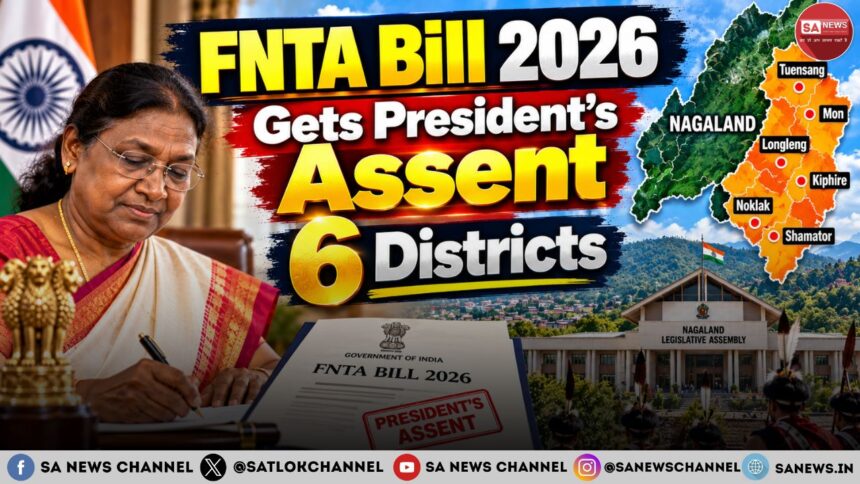
President Droupadi Murmu has given her assent to the Frontier Nagaland Territorial Authority (FNTA) Bill, 2026, marking an important step towards establishing a regional authority for six districts in eastern Nagaland. Chief Minister Neiphiu Rio announced the development on October 25, 2026. However, the authority’s actual commencement depends on the required government notifications.
The legislation aims to support regional self-governance and address long-standing development concerns in eastern Nagaland. The agreement to establish the FNTA was signed on February 5, 2026, by the Government of India, the Nagaland government and the Eastern Nagaland Peoples’ Organisation (ENPO).
Which Six Districts Will Come Under FNTA?
The proposed Frontier Nagaland Territory covers these six districts:
- Mon
- Tuensang
- Longleng
- Kiphire
- Noklak
- Shamator
These districts form the region covered by the FNTA legislation. The authority is intended to provide a regional administrative arrangement within Nagaland, rather than establish a separate state.
How Will the 62-Member FNTA Work?
The legislation provides for a 62-member authority with elected, ex-officio and nominated members.
| Category | Number of members |
| Directly elected representatives | 40 |
| Ex-officio MLAs | 20 |
| Governor-nominated members | 2 |
| Total | 62 |
The 40 elected members will represent single-member territorial constituencies. One-third of the elected seats will be reserved for women.
The 20 MLAs whose constituencies fall within the territory will serve as ex-officio members without voting rights. The two members nominated by the Governor will have voting rights, subject to the provisions of the Act.
The authority will exercise responsibilities across 46 subjects, as provided for in the legislation. Its precise functioning will depend on the Act’s provisions and the steps taken by the state government.
When Will the FNTA Start Functioning?
Presidential assent is an important legal step, but it does not automatically mean that the authority has begun operating.
Section 1(3) of the legislation states that the Act will come into force on a date appointed by the Nagaland government through a notification in the Official Gazette. The state government must complete the required formalities before the authority becomes operational.
The legislation also provides for an interim council until the first elected FNTA is constituted. Under the provisions reported in the Bill, the interim council may function for up to one year or until the elected authority is established, whichever occurs first.
Readers should check the state government’s latest Gazette notifications for confirmation of the commencement date and implementation arrangements.
Why Is the FNTA Important for Eastern Nagaland?
The FNTA arrangement follows years of demands for a special administrative structure in eastern Nagaland. The ENPO has advocated for greater regional autonomy and a stronger response to the area’s development needs.
The agreement signed on February 5, 2026, established the framework for creating the authority through state legislation. The Nagaland Legislative Assembly unanimously passed the revised Bill on September 3, 2026, before it received presidential assent.
The arrangement is intended to bring regional decision-making closer to the people and help address development gaps. Its practical impact will depend on how the authority’s powers, responsibilities, funding and administrative arrangements are implemented.
FAQs
1. What is the FNTA Bill 2026?
The Frontier Nagaland Territorial Authority Bill, 2026, provides for a regional authority covering six districts in eastern Nagaland.
2. Who gave assent to the FNTA Bill 2026?
President Droupadi Murmu gave her assent, as announced by Nagaland Chief Minister Neiphiu Rio on October 25, 2026.
3. Which districts are covered by the FNTA?
The six districts are Mon, Tuensang, Longleng, Kiphire, Noklak and Shamator.
4. How many members will the FNTA have?
The proposed authority has 62 members: 40 elected representatives, 20 ex-officio MLAs and two Governor-nominated members.
5. Has the FNTA started functioning?
Presidential assent has been reported, but the Act’s commencement depends on a date appointed by the Nagaland government through an Official Gazette notification. Check official notifications for the latest implementation status.
6. Is the FNTA a separate state?
No. The legislation provides for a regional authority within Nagaland; it does not create a separate state.