


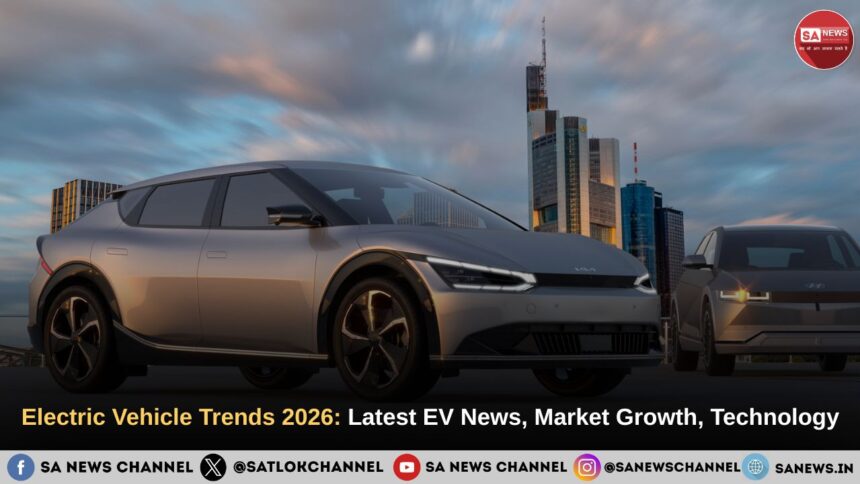
The electric vehicle (EV) industry is entering one of its most transformative phases. Governments worldwide are promoting clean transportation solutions, automakers are investing billions in EV technology, and consumers are increasingly choosing electric vehicles due to lower running costs and environmental benefits.
- Latest EV Trends in 2026
- India’s Growing EV Market
- Battery Technology is Improving
- Charging Infrastructure Expansion
- Government Policies Supporting EV Growth
- Artificial Intelligence in Electric Vehicles
- Connected and Software-Defined Vehicles
- Sustainability and Battery Recycling
- Electric Commercial Vehicles
- Consumer Benefits
- Challenges Facing the EV Industry
- Recent Industry Developments
- Future Outlook
- Final Thoughts:
- Spiritual Perspective
- FAQs
According to projections from the International Energy Agency (IEA), global electric vehicle sales are expected to continue growing significantly in 2026, potentially accounting for more than one-quarter of new vehicle sales worldwide.
India is also witnessing rapid growth in electric mobility, supported by improved charging infrastructure, new product launches, and government incentives.
Latest EV Trends in 2026
Several trends are shaping the EV industry this year:
- More affordable electric cars are entering the market.
- Rapid improvements in battery technology.
- Expansion of fast-charging networks.
- Growing adoption of electric two-wheelers.
- Increased focus on battery recycling.
- AI-powered vehicle management systems.
- Software-defined vehicles receiving over-the-air updates.
- Greater investment in renewable energy-powered charging stations.
Recent industry developments also show strong momentum in India, with companies expanding their EV portfolios and sales targets.
India’s Growing EV Market
India has become one of the fastest-growing EV markets.
Major factors driving growth include:
- Rising fuel prices.
- Government subsidies.
- Better charging infrastructure.
- Lower maintenance costs.
- Increasing environmental awareness.
Manufacturers such as Tata Motors, Mahindra, MG Motor India, Hyundai, Kia, and several startups are introducing new electric models across different price segments. Market reports indicate continued growth in EV adoption across passenger vehicles.
Battery Technology is Improving
Battery innovation remains the biggest driver of EV growth.
Key developments include:
- Higher energy density.
- Faster charging.
- Longer battery life.
- Improved thermal safety.
- Lower battery costs.
- Research into solid-state batteries.
As battery prices continue to fall, electric vehicles are becoming increasingly affordable.
Charging Infrastructure Expansion
Charging infrastructure is expanding rapidly across highways, cities, residential complexes, shopping malls, and workplaces.
Current trends include:
- Ultra-fast DC charging.
- Smart charging stations.
- Solar-powered charging.
- Mobile charging solutions.
- Battery swapping for commercial vehicles and two-wheelers.
This growing infrastructure is reducing range anxiety and encouraging wider EV adoption.
Government Policies Supporting EV Growth
Governments across the world continue supporting electric mobility through:
- Purchase incentives.
- Tax benefits.
- Charging infrastructure funding.
- Manufacturing incentives.
- Battery production support.
- Research and development funding.
These policies are accelerating the transition from conventional vehicles to electric mobility.
Artificial Intelligence in Electric Vehicles
Modern EVs increasingly use Artificial Intelligence (AI).
Applications include:
- Battery health monitoring.
- Predictive maintenance.
- Route optimization.
- Smart charging management.
- Driver assistance.
- Voice assistants.
- Energy efficiency optimization.
AI improves both the driving experience and vehicle efficiency.
Connected and Software-Defined Vehicles
Today’s EVs function much like smartphones on wheels.
Features include:
- Over-the-air software updates.
- Remote diagnostics.
- Mobile app integration.
- Digital keys.
- Real-time navigation.
- Cloud connectivity.
Manufacturers continue enhancing vehicles through software without requiring visits to service centers.
Sustainability and Battery Recycling
Battery recycling has become a major industry focus.
Recovered materials include:
- Lithium
- Nickel
- Cobalt
- Copper
- Graphite
Recycling reduces mining requirements and supports a circular economy.
Electric Commercial Vehicles
Electric buses, delivery vans, and trucks are becoming increasingly popular.
Benefits include:
- Lower operating costs.
- Reduced emissions.
- Quieter operation.
- Lower maintenance.
- Improved fleet efficiency.
Many logistics companies are expanding their electric fleets.
Consumer Benefits
Electric vehicles provide several advantages:
- Lower fuel costs.
- Reduced maintenance.
- Instant acceleration.
- Quiet driving.
- Environmental benefits.
- Government incentives.
- Better driving experience.
Challenges Facing the EV Industry
Despite rapid growth, challenges remain:
- Limited charging infrastructure in rural areas.
- Higher upfront purchase prices.
- Battery replacement costs.
- Charging time compared to refueling.
- Grid capacity concerns.
- Availability of raw materials.
- Battery recycling scalability.
Manufacturers and governments are actively working to address these issues.
Recent Industry Developments
The EV sector continues to evolve rapidly:
Global EV sales are projected to continue growing in 2026 despite varying regional growth rates.
In India, companies are reporting renewed consumer interest in electric mobility, partly driven by fuel prices.
New EV launches across different price segments are increasing competition and consumer choice.
Future Outlook
The future of electric mobility looks promising.
Expected developments include:
- Affordable solid-state batteries.
- Charging in under 10 minutes.
- Vehicle-to-grid technology.
- Autonomous electric vehicles.
- AI-driven battery optimization.
- Wireless charging.
- Renewable energy integration.
- Sustainable battery manufacturing.
Electric vehicles will continue playing a major role in reducing carbon emissions and creating cleaner transportation systems worldwide.
Final Thoughts:
Electric vehicles are no longer a niche technology; they are becoming the foundation of the future automotive industry. Continuous advancements in batteries, charging infrastructure, software, and government support are making EVs more practical and accessible than ever before.
Although challenges such as charging availability, battery costs, and infrastructure expansion remain, the overall outlook for the EV industry is highly positive. As innovation continues, electric vehicles are expected to become the preferred mode of transportation for millions of people around the world.
Spiritual Perspective
Electric vehicles are an important step toward cleaner transportation and a healthier environment. Scientific innovations can make human life more comfortable and help protect nature, but they cannot remove the deeper problems of human life such as birth, old age, disease, and death. According to the spiritual teachings of Sant Rampal Ji Maharaj, the real purpose of human life is to attain complete salvation (Moksha) through true devotion to the Supreme God.
Along with adopting technologies that benefit society and the environment, every person should also strive to understand the true purpose of life through spiritual knowledge. Those who wish to learn more about this spiritual path can read the book Gyan Ganga, written by Sant Rampal Ji Maharaj, to explore these teachings in greater detail.
FAQs
1. What are Electric Vehicles (EVs)?
Electric vehicles (EVs) are automobiles powered entirely or partially by electricity instead of conventional internal combustion engines.
2. Why are EVs becoming popular?
They offer lower running costs, reduced emissions, lower maintenance, government incentives, and improving charging infrastructure.
3. What is the biggest challenge for EV adoption?
Charging infrastructure and battery costs remain the primary challenges in many regions.
4. Are EV batteries recyclable?
Yes. Many battery materials such as lithium, nickel, cobalt, and copper can be recovered and reused.
5. What is the future of Electric Vehicles?
The future includes faster charging, longer-range batteries, smarter software, AI integration, solid-state batteries, and wider adoption across personal and commercial transportation.