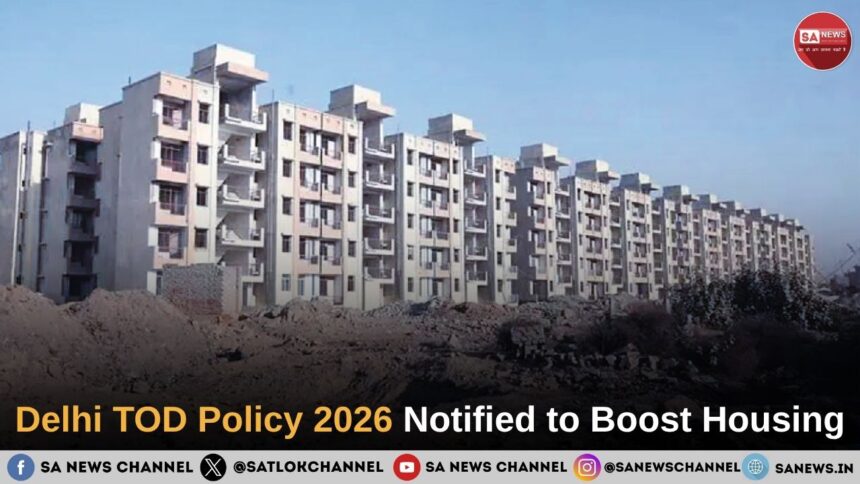
The Centre has notified the Transit Oriented Development (TOD) Policy and Charges, 2026 for Delhi, aiming to promote affordable housing and planned, high-density development near metro, railway, and RRTS corridors. The policy opens up around 207 sq. km for development within a 500-metre influence zone, including areas previously excluded. Officials said the revised framework simplifies approvals, enables development on smaller plots, and mandates residential use to support housing needs. It is expected to improve connectivity, reduce congestion, and enhance urban livability while aligning growth with public transport networks.
- Key Takeaways: Delhi TOD Policy 2026
- Policy Notification and Objectives
- Corridor-Based Development and Coverage
- Flexibility in Development and Plot Size
- FAR Norms and Affordable Housing Focus
- Simplified Approval System and Charges
- Infrastructure and Connectivity Improvements
- Expected Impact on Urban Development
- A Step Towards Transit-Linked Urban Transformation
- Spiritual Perspective on True Living
- FAQs on Delhi TOD Policy 2026
Key Takeaways: Delhi TOD Policy 2026
- Covers 207 sq. km within 500m of metro, railway, and RRTS corridors
- Includes 80 sq. km of previously excluded areas
- Allows development on minimum 2000 sq. m plots
- Permits FAR up to 400–500, with 65% reserved for residential use
- Focus on affordable housing (units under 100 sq. m)
- Introduces single-window clearance system
- Sets ₹10,000 per sqm TOD charge
- Enables development along operational and proposed corridors
- Aims to improve connectivity, mobility, and urban livability
Policy Notification and Objectives
The Ministry of Housing and Urban Affairs (MoHUA) has notified the new Transit Oriented Development (TOD) Policy and Charges, 2026 for Delhi. The policy is expected to open up large swathes of land near metro and rapid rail corridors for high-density development, enhancing accessibility and enabling the creation of affordable housing stock.
Announcing the revised framework, Union Minister for Housing and Urban Affairs Manohar Lal, along with Delhi Chief Minister Rekha Gupta and Lieutenant Governor Taranjit Singh Sandhu, said the TOD concept was already envisaged in the Master Plan of Delhi 2021 but faced delays due to implementation hurdles.
Also Read: Delhi Government Invites Feedback on Circle Rate Revision to Match Real Market Prices After a Decade
The revised policy aims to promote planned, sustainable, and transit-linked urban growth while addressing traffic congestion and housing requirements in the national capital.
Corridor-Based Development and Coverage
The policy adopts a corridor-based approach, enabling development within a 500-metre influence zone of metro corridors and a 500-metre radius of RRTS and railway stations.
| Component | Details |
| Total Area Covered | 207 sq. km |
| Influence Zone | 500 metres |
| Newly Included Area | 80 sq. km |
| Excluded Earlier | Land pooling zones, low-density areas, unauthorised colonies |
Out of the total 207 sq. km, around 80 sq. km of previously excluded areas, including land pooling zones, low-density residential areas, and unauthorised colonies, have now been brought under the new TOD framework.
Officials said this expansion is expected to facilitate planned development and redevelopment with a focus on affordable housing.
Flexibility in Development and Plot Size
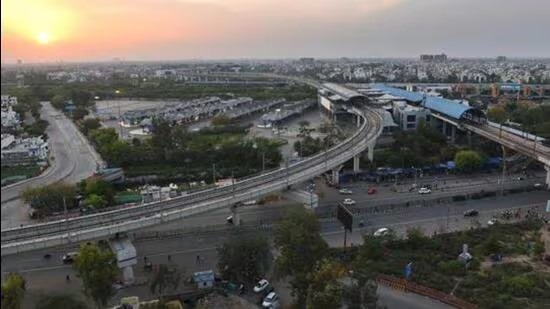
The policy introduces flexibility by allowing TOD development along both operational and proposed metro corridors, RRTS, and railway stations. This ensures that development aligns with upcoming transit infrastructure.
A significant change is the reduction in minimum plot size requirements:
- Earlier requirement: 8 hectares (80,000 sq. m)
- New requirement: 2000 sq. m
This enables development on smaller land parcels, making it easier for stakeholders to participate in TOD projects.
FAR Norms and Affordable Housing Focus
The revised policy allows a maximum Floor Area Ratio (FAR) of up to 400–500, depending on road width conditions, particularly for plots of 2000 sq. m and above with an 18-metre road.
Out of the total permissible FAR:
- 65% is mandatorily reserved for residential use
- Residential units are capped at 100 sq. m (less than 99 sq. m)
This provision ensures that a significant portion of development is directed towards affordable housing, particularly benefiting lower and middle-income groups.
The remaining FAR allows for mixed-use development, including commercial, institutional, office spaces, and studio apartments.
Simplified Approval System and Charges
The policy replaces multiple approvals with a single-window clearance mechanism, aimed at improving ease of doing business.
Applicants will no longer need to approach multiple agencies such as:
- Municipal Corporation of Delhi (MCD)
- Delhi Jal Board (DJB)
- Delhi Fire Services (DFS)
Instead, approvals and charges can be processed at one point, with provisions for time-bound clearances within 60 days.
The government has also rationalised various charges into a single TOD charge:
- Fixed charge: ₹10,000 per sqm
- Funds to be maintained in a ring-fenced escrow account
- Utilisation limited to development within TOD zones or specific projects
A dedicated TOD committee under the Delhi Development Authority (DDA), comprising representatives from relevant agencies, will oversee approvals.
Infrastructure and Connectivity Improvements
The policy also focuses on improving pedestrian connectivity and urban infrastructure. It provides for:
- Underground and elevated walkways connecting residential areas to transit stations
- Enhanced FAR for public and semi-public facilities to support infrastructure needs
Officials said these measures are expected to improve accessibility, increase metro ridership, and enhance overall urban mobility.
Expected Impact on Urban Development
According to officials, the revised TOD policy is expected to:
- Promote compact urban growth
- Optimise land use efficiency
- Increase public transport usage
- Improve ease of living
- Reduce traffic congestion and pollution
Chief Minister Rekha Gupta said the policy is expected to improve connectivity and benefit lower and middle-income groups, while also supporting Delhi’s housing requirements.
Union Minister Manohar Lal said the revised norms relax earlier restrictions that had limited private sector participation, enabling broader engagement in urban development.
A Step Towards Transit-Linked Urban Transformation
The notification of the TOD Policy and Charges, 2026 marks a significant step in aligning Delhi’s urban development with its expanding transit network. By integrating housing, infrastructure, and transport planning within a defined corridor-based framework, the policy seeks to address long-standing challenges related to congestion, housing shortages, and fragmented growth. With provisions for affordable housing, simplified approvals, and expanded coverage, the framework is expected to reshape development patterns across key transit corridors in the national capital.
Spiritual Perspective on True Living
In the context of rapid urban development and expanding infrastructure, it becomes equally important to reflect on the deeper purpose of human life. No matter how much property, infrastructure, or material wealth is created, none of it ultimately remains with us. All worldly assets are temporary, and every individual has to leave them behind one day.
Human life has a higher purpose beyond continuous accumulation and material pursuits. The true objective is to engage in true devotion (Sat Bhakti) rather than spending an entire lifetime only in worldly arrangements. Without understanding this purpose, life may pass in struggle without real benefit.
According to the teachings of Tatvdarshi Sant Rampal Ji Maharaj, one should seek refuge in a True Saint and listen to His spiritual discourses. He explains that the ultimate goal is to return to Satlok, the eternal place where souls originally resided with the Supreme God and where a permanent existence is believed to remain.
He emphasises that spiritual knowledge holds far greater value than temporary material success. By understanding this, individuals can align their lives towards lasting peace and purpose.
For more information visit our
Website: www.jagatgururampalji.org
YouTube: Sant Rampal Ji Maharaj
Facebook: Spiritual Leader Saint Rampal Ji
X (Twitter): @SaintRampalJiM
FAQs on Delhi TOD Policy 2026
1. What is the Delhi TOD Policy 2026?
It is a framework for transit-linked development promoting high-density, mixed-use growth near metro, railway, and RRTS corridors.
2. What area does the policy cover?
It covers around 207 sq. km within a 500-metre zone of transit corridors.
3. What is the minimum plot size allowed?
The policy allows development on plots as small as 2000 sq. m.
4. How much FAR is permitted under TOD?
FAR up to 400–500 is permitted, with 65% reserved for residential use.
5. What is the TOD charge under the new policy?
A fixed charge of ₹10,000 per sqm has been introduced for TOD developments.