

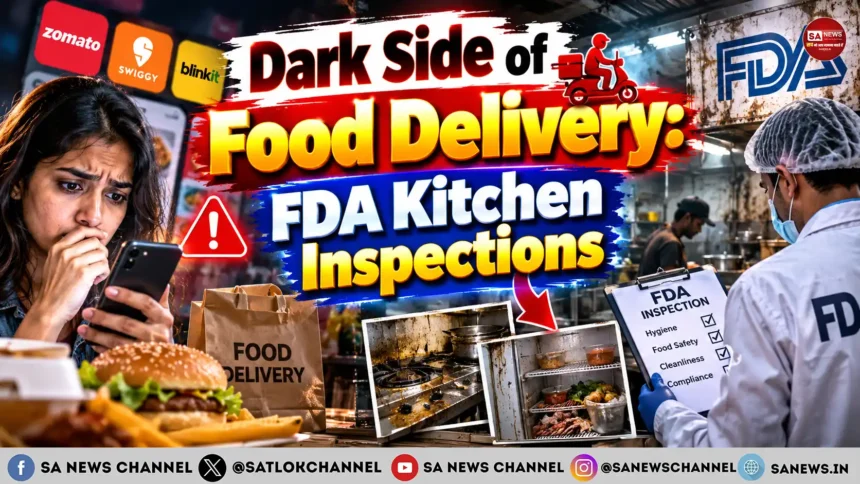
Dark Side of Food Delivery: Food delivery has transformed the way millions of people eat. With a few taps, meals can arrive at our doorstep without us ever seeing the kitchen where they were prepared. But recent food-safety inspections in Maharashtra have raised uncomfortable questions about what happens behind the screen. Authorities have reported problems involving hygiene, pest control, food storage, temperature management, personal hygiene and licensing across parts of the online food ecosystem. In June and August 2026, Maharashtra’s FDA expanded inspections involving restaurants, cloud kitchens and online food operations, while quick-commerce facilities also faced significant enforcement action. These developments show why convenience must never come at the cost of food safety.
- The Dark Side of Food Delivery: What Is Happening Behind the App?
- What Did Food Safety Inspections Find?
- 1. Poor Food Storage
- 2. Temperature-Control Problems
- 3. Cockroaches, Rodents and Pest-Control Failures
- 4. Expired or Poorly Managed Food
- Cloud Kitchens: Why Are They Harder to Monitor?
- Popular Brand Does Not Automatically Mean Risk-Free
- The Hidden Risk of the “Last Mile”
- What About Delivery Workers?
- Why Food Delivery Ratings Are Not Enough
- What Regulators Are Doing
- What Consumers Can Do Before Ordering Food Online
- Check the Restaurant Information
- Look Beyond Discounts
- Read Recent Reviews
- Check Packaging
- Be Careful With Perishable Food
- Report Serious Problems
- Why Transparency Matters
- A Lesson in Responsibility and Purity
- FAQs on Food Delivery
The Dark Side of Food Delivery: What Is Happening Behind the App?
Food delivery platforms have changed consumer behaviour. Instead of visiting a restaurant, customers increasingly depend on apps to select meals, compare ratings and receive food at home.The convenience is undeniable. However, the customer usually sees only the menu, food photographs, rating, price and delivery time. The actual food-preparation environment remains invisible.
That makes food hygiene, kitchen sanitation, food storage, temperature control and pest control particularly important.Recent enforcement activity in Maharashtra has brought these hidden parts of the food-delivery ecosystem into focus.In June 2026, Maharashtra FDA officials announced stricter compliance expectations covering hotels, restaurants, cloud kitchens, caterers and online food-delivery operators. Reported concerns included hygienic kitchens, safe food handling, potable water and proper storage. Then, in August, a major inspection drive involving establishments selling or distributing food through online platforms produced another major warning.
86 Establishments Inspected in Maharashtra
On August 13, 2026, Maharashtra FDA inspected 86 establishments involved in selling and delivering food through online platforms.According to the regulator’s reported findings, 60 improvement notices were issued and 14 food-business licences were suspended. One establishment was also directed to temporarily stop operations. The action involved facilities linked with major online and quick-commerce operations including Blinkit, Zepto and Swiggy Instamart.
This is important-but it needs to be understood correctly.These facilities were largely quick-commerce warehouses/dark stores and food-distribution operations, rather than traditional restaurant-style cloud kitchens preparing meals for customers.Still, they are part of the broader online food ecosystem and demonstrate why food safety in online delivery cannot stop at the restaurant door.
What Did Food Safety Inspections Find?
The reported inspection findings were varied, but several common themes appeared.
1. Poor Food Storage
Food storage is one of the most basic food-safety requirements.At some inspected facilities, officials reported inadequate storage arrangements, congestion and products being kept in unsuitable locations.An Instamart facility in Andheri, for example, reportedly had food packets stored directly on the floor, along with shortcomings involving storage space, temperature control, cleanliness and personal hygiene.
Why does this matter?
Food placed directly on floors can potentially be exposed to dirt, moisture, pests and other contaminants. Proper shelving and segregation are therefore essential parts of food contamination prevention.
2. Temperature-Control Problems
Perishable food needs appropriate temperature management.If chilled or frozen food is kept outside the required temperature range for extended periods, microorganisms can multiply more rapidly, potentially increasing food-safety risks.Maharashtra FDA inspections reportedly identified temperature-control deficiencies at several facilities.At a Blinkit facility in Malad West, inspectors reportedly recorded a chiller-room temperature of 6°C and identified other food-safety deficiencies. This highlights the importance of maintaining the cold chain from storage through delivery.For consumers, it also explains why certain foods should not sit outside refrigeration for long periods after delivery.
3. Cockroaches, Rodents and Pest-Control Failures
Perhaps the most disturbing inspection findings involved pests.Reuters reported that Maharashtra FDA inspections found cockroach infestations at one Blinkit facility and rotten vegetables, while other facilities had reports of rodent droppings and unhygienic conditions. Photos released during the enforcement campaign showed dirty and rusted storage racks and cockroaches around food items. The presence of pests in a food-storage environment is more than a cleanliness issue.Cockroaches and rodents can potentially carry microorganisms and contaminate food-contact surfaces, packaging and storage areas.That is why pest control in commercial kitchens and food warehouses needs to be continuous rather than something done only when an inspection is expected.
4. Expired or Poorly Managed Food
Food businesses must have effective systems for managing product dates and inventory.
During the August inspections, a Zepto facility in Pune’s Lohegaon area was reported to have food products stored beyond their declared “Use By” dates. Inspectors also reported problems involving stock rotation, pest control and personal hygiene. Such findings are particularly relevant for consumers because the entire point of rapid delivery is to provide food quickly-not to compromise on its safety.The issue also demonstrates why food traceability, inventory management and proper stock monitoring remain important even in technology-driven businesses.
Cloud Kitchens: Why Are They Harder to Monitor?
A cloud kitchen, sometimes called a ghost kitchen or delivery-only kitchen, prepares food primarily for delivery rather than serving customers in a traditional dining area.
The model has several advantages.
It can reduce:
- Restaurant rental costs
- Dining-room expenses
- Front-of-house staffing
- Location-related costs
- The investment required to launch a food brand
But the same model can create regulatory challenges.
A customer cannot simply walk into the kitchen and see its cleanliness.There may be no dining room, visible kitchen or traditional storefront.That means online food safety depends heavily on inspections, licensing, food-safety systems and responsible operators.An Indian Express report quoting a Maharashtra FDA official noted that cloud kitchens have expanded rapidly after COVID-19 and can be difficult to inspect because some operate from residential settings. The report also said the state had conducted a June drive involving Swiggy, Zomato and Blinkit kitchens, with some licences suspended and improvements mandated. This makes the cloud-kitchen model an important part of the wider food-safety conversation.
Popular Brand Does Not Automatically Mean Risk-Free
One important lesson from the recent crackdown is that consumers should not assume that a famous brand automatically guarantees perfect food safety.Maharashtra’s enforcement drive also affected well-known food businesses.Reuters reported that the state’s FDA shut four Domino’s outlets during the wider crackdown. This does not mean that all outlets of a particular company are unsafe.
Rather, it demonstrates an important principle:
Food safety has to be evaluated at the individual establishment level.
A large brand may have strong systems, but individual outlets still need to comply with hygiene, storage, temperature-control and food-handling requirements.
Also read:World Food Safety Day 2026: Know The God Who Is Nurturing Everything Everywhere
The Hidden Risk of the “Last Mile”
Food safety does not end when a restaurant prepares a meal.There is another stage: delivery.
The journey from kitchen to customer can involve:
- Food preparation
- Packaging
- Temporary holding
- Pickup
- Transportation
- Delivery
- Consumption
Every step matters.
The U.S. FDA, working with the USDA and CDC, has separately published food-safety best practices for online food delivery. Its guidance specifically highlights risks involving packaging, temperature control,contamination and allergens, including risks that can occur during the “last mile” of delivery. Although this is U.S. guidance rather than Indian regulation, the underlying food-safety principle is universal: safe preparation can be undermined by unsafe handling later in the chain.
What About Delivery Workers?
Food safety also involves the people handling food and delivery equipment.During the Maharashtra FDA’s August inspection drive, officials checked 125 two-wheeler delivery riders at a Blinkit store in Karad and reportedly found missing identity cards and medical fitness records. The regulator also said the required FSSAI licence information was not displayed on delivery carts, bags or boxes. This raises a wider question about food-handler training.Delivery workers may not prepare food, but they can still become part of the food-safety chain through handling, transport and contact with packaging.
Why Food Delivery Ratings Are Not Enough
A restaurant can have thousands of positive reviews and still need to comply with food-safety regulations.
Customer reviews can tell us about:
- Taste
- Portion size
- Delivery speed
- Packaging
- Value for money
But customers may not be able to identify:
- Poor refrigeration
- Incorrect food temperatures
- Pest-control failures
- Unsafe storage
- Inadequate staff hygiene
- Licence problems
- Cross-contamination risks
Therefore, online ratings should not be treated as a substitute for food-safety compliance.
Maharashtra FDA itself describes its Hygiene Rating initiative as a way to help consumers make informed choices about hygienic and well-managed food establishments.
What Regulators Are Doing
The recent enforcement drive is part of a broader push toward stronger food-safety oversight.In June 2026, Maharashtra FDA directed officials to pursue year-round enforcement, rather than relying only on occasional special drives. Reported inspection findings across food businesses included unhygienic preparation, reused cooking oil, lack of medical fitness certification for food handlers, temperature-control problems and unsuitable packaging.
Meanwhile, FSSAI’s 2026 regulatory changes have also focused on making compliance more risk-based while retaining important food-safety safeguards. In September 2026, FSSAI CEO Rajit Punhani also indicated that the regulator was looking to expand scrutiny to areas including e-commerce, quick-commerce, dark stores and cloud kitchens, reflecting the changing way Indians buy food.
What Consumers Can Do Before Ordering Food Online
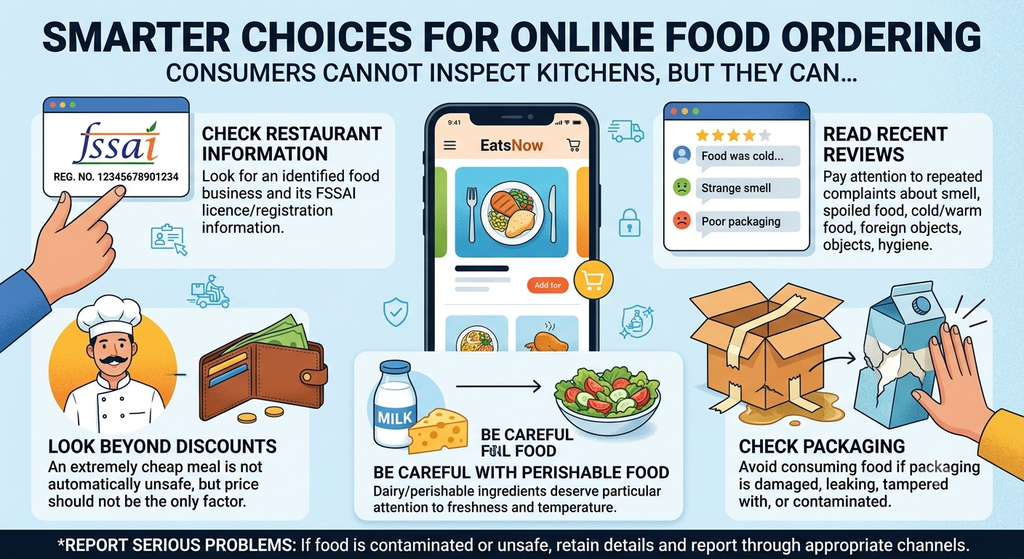
Consumers cannot inspect a commercial kitchen themselves, but they can make smarter choices.
Check the Restaurant Information
Look for a clearly identified food business and, where available, its FSSAI licence or registration information.
Look Beyond Discounts
An extremely cheap meal is not automatically unsafe, but price should never be the only factor influencing your decision.
Read Recent Reviews
Pay attention to repeated complaints about:
- Strange smell
- Spoiled food
- Poor packaging
- Food arriving unusually cold or warm
- Foreign objects
- Hygiene concerns
One complaint may be accidental. Repeated similar complaints deserve attention.
Check Packaging
Avoid consuming food if packaging is visibly damaged, leaking, tampered with or contaminated.
Be Careful With Perishable Food
Foods containing dairy, or other highly perishable ingredients deserve particular attention to freshness and temperature.
Report Serious Problems
If food appears contaminated or unsafe, retain the packaging and order details and report the issue through the appropriate food-safety or platform channels.
Why Transparency Matters
One of the biggest lessons from the FDA crackdown is that consumers need greater transparency.Technology has made ordering food easy.But technology should also make food-safety information easier to access.
In an ideal system, consumers should be able to understand whether a food business is properly licensed, whether regulatory action has been taken and whether serious violations have been corrected.The regulator has also emphasised that businesses should follow proper Good Hygiene Practices (GHP), storage practices and food-safety standards.
Food delivery should ultimately be about more than speed.It should be about safe food delivered safely.
A Lesson in Responsibility and Purity
According to the true spiritual knowledge taught by Saint Rampal Ji Maharaj, human life is governed by the law of karma-every action carries inescapable consequences. Food directly impacts physical health and spiritual well-being. Compromising hygiene, using unsafe ingredients, or prioritizing profit over public safety generates severe negative karma.
Saint Rampal Ji Maharaj teaches that true devotion (Bhakti) requires absolute honesty, moral discipline, and compassion. Preparing food is a duty performed under the gaze of the Almighty, making cleanliness, purity, and truthfulness essential-whether in a public restaurant or a closed cloud kitchen.
FAQs on Food Delivery
1. What did Maharashtra FDA inspections reveal about food delivery businesses?
Recent inspections found several food-safety and hygiene deficiencies, including poor storage, temperature-control problems, pest-related concerns, inadequate cleanliness and licensing/compliance issues at some inspected establishments.
2. Are cloud kitchens safe to order from?
Cloud kitchens are not inherently unsafe. Their safety depends on proper licensing, hygiene, food handling, storage, temperature control and regulatory compliance. Consumers should check available business and hygiene information before ordering.
3. What is the difference between a cloud kitchen and a dark store?
A cloud kitchen primarily prepares food for delivery without a traditional dine-in restaurant. A dark store is generally a delivery-focused retail or grocery facility where products are stored and dispatched to customers.
4. How can consumers check food safety before ordering online?
Consumers can look for identifiable and licensed food businesses, examine recent reviews for repeated safety complaints, check packaging when food arrives and report suspected contamination or unsafe practices to the relevant platform or food-safety authority.
5. Why are FDA and FSSAI inspections important for food delivery?
Inspections help regulators identify unsafe food-handling practices, hygiene failures, improper storage and other compliance problems. They also encourage food businesses to maintain standards even when consumers cannot see their kitchens.